
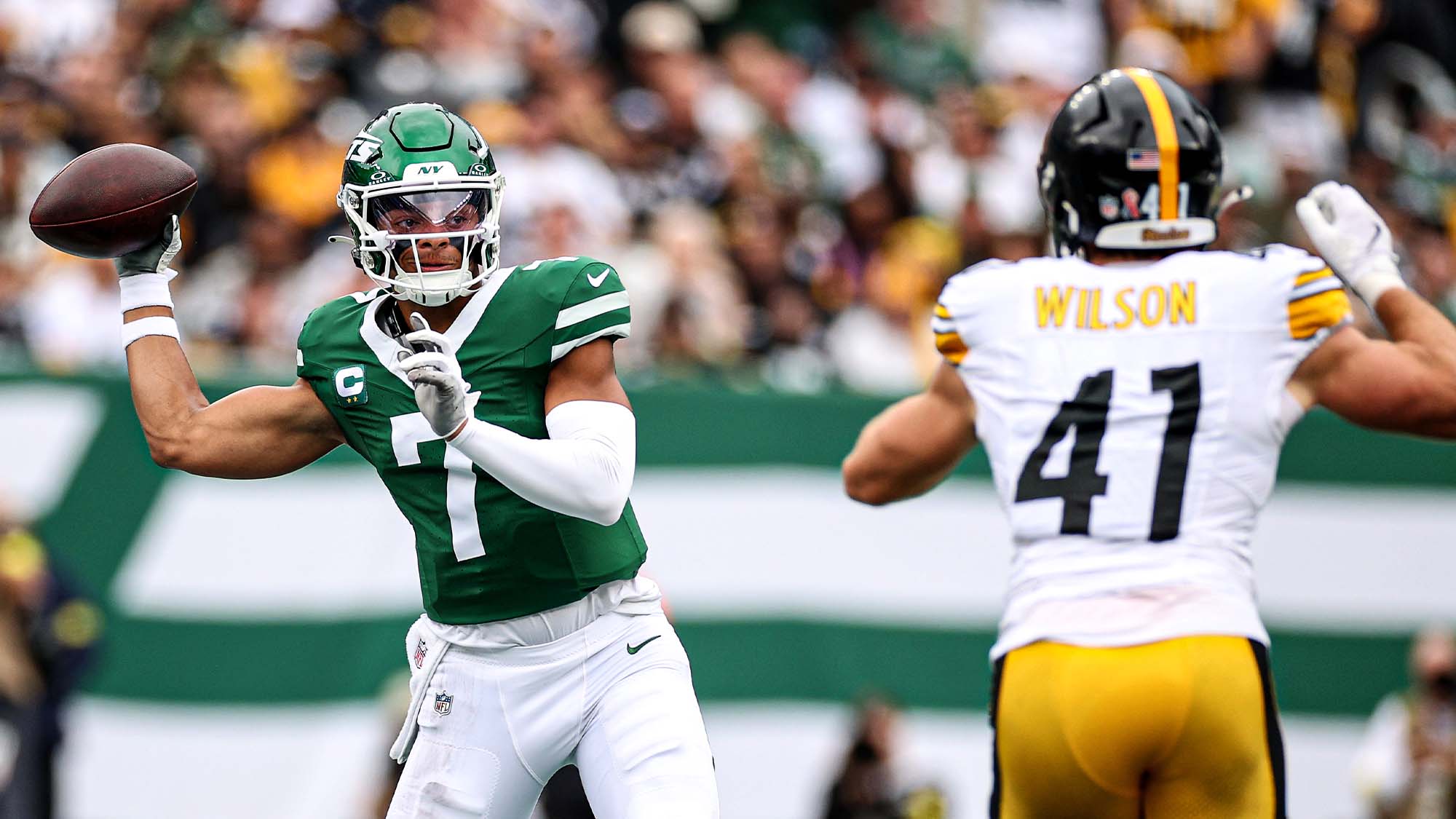
Backstory of the QB Grades
From 2018 to 2022, I graded every play from the starting quarterback in every New York Jets game.
My goal was to go beyond the stat sheet to gauge the development of New York’s young quarterbacks. It started with Sam Darnold, and when the Jets swapped Darnold for Zach Wilson, the mission remained the same.
While we can try to evaluate quarterbacks using statistics, countless variables are overlooked when we rely on numbers. These flaws are blatant when using basic box-score metrics, like passing yards or completion percentage, but even if we use advanced metrics, like EPA, CPOE, and so on, there are still many factors unaccounted for.
This is why I set out to create a grading system that relies on the film to quantify the quarterback’s performance. By going play by play and using my eyes to decipher every variable that goes into every play, I could draw significantly more accurate conclusions than if I relied on statistics.
Pro Football Focus attempts to do this. But nobody in the public has access to whatever deep, dark cave they calculate these grades in, so we have no idea what leads them to their conclusions. While PFF grades are a useful ingredient to stir into the pot, we cannot fully rely on a subjective grading system when there’s little transparency regarding how the grades are calculated – and who is calculating them.
So, I figured, why not do it myself?
My process was simple: Grade the quarterback on a 0-to-10 scale for his performance on every play.
Everything was taken into account: processing, decision-making, mobility, accuracy, ball placement, the pressure on the QB, the separation of his receivers, the quality of the play call, the difficulty of each pass attempt – you name it, I factored it into the score, which is something that no other publicly available metric does (save for PFF grades, supposedly).
If the QB threw a checkdown for eight yards on first-and-10 after skipping over a wide-open 30-yard post in the progression, I would ding him for costing the team a potential touchdown, whereas any statistical metric would make it seem like he did a good job.
If the QB threw a laser beam of a 15-yard dig that hit the receiver’s numbers, popped in the air, and got picked off, I would give him credit for throwing a laser beam, while any statistical metric would crush him for throwing an interception.
These examples summarize the gist of the rating system: Evaluate the QB based on how the coaches will evaluate him in the film room, not the final result that goes on the stat sheet.
I tabled the grading process when Aaron Rodgers came to town, as I did not feel it necessary to gauge the progress of a 39-year-old with four MVP trophies on his shelf. But with a new promising young quarterback in town, it’s time to get back into the swing of things.
Let’s grade every play that Justin Fields runs in a New York Jets uniform.
With a twist.
New grading system
I am overhauling the grading system for the 2025 season.
Instead of arbitrarily grading every play with a single 0-to-10 score, I will be grading Fields in three categories on each play:
- Decision
- Execution
- Difficulty
I scored Fields from 0 to 100 in each category, averaging those three scores together for his overall grade on each play. His final grade for the game is calculated by averaging his overall grade across all plays.
The thought process behind this new system is to judge the QB based on how well he does his job on each play relative to the expectations of that situation.
The previous system was more predicated upon the cumulative “quality” of the performance based on the eye test, giving too much weight to plays that popped out positively or negatively while undervaluing the minutiae. I gave the QB immense credit for hitting highlight-reel backyard football plays, and I would substantially ding them for brutal plays.
Meanwhile, ho-hum checkdowns and easy in-structure passes received minimal positive credit and played a small role in the final score, even if the QB was just doing his job to the best of his ability. If the QB was very inaccurate on a routine out route, but completed the pass, I did not ding him as much as I should have. It was the minority chunk of stellar plays and awful plays that had the largest effect on skewing the scores up or down.
The flaw in this system was that it did not properly account for the context of what the QB was presented with in each situation. He can only work with what is available. I want to rate Fields similar to how the Jets’ coaches will evaluate him. They will be watching every play and grading them all equally, no matter how trivial, simply judging him on how well he does his job on a down-to-down basis.
That means, if the best thing Fields can do on a play is to immediately chuck the ball at Breece Hall’s feet to avoid an imminent sack, he should be getting full credit for achieving that. If the best thing he can do is hit the open five-yard out to Garrett Wilson, and he throws it quickly with perfect accuracy, he should also be getting full credit.
Just because a play isn’t a highlight, it shouldn’t necessarily be graded as less effective than a highlight if the QB did the most with the play that he possibly could.
That’s what this grading system is all about.
Here is a synopsis of how I arrived at my scores in each category.
1. Decision
The idea here is simple: Did Fields make the best available decision on the play?
If the answer is yes, he received a perfect score of 100 for his decision on the play. Simple as that.
On a traditional passing play, this is based on his choices within the progression. If he takes the best available route, then he receives full credit.
To be clear, this is only as far as I can definitively judge. I am not going to ding him for missing an open player on the back side of a progression if his first read is open and he targets it. That’s not how this works.
I am not in the Jets’ building, so I cannot judge Fields for not hitting throws that he did not get the chance to look at. Maybe he could have started his read on that side based on his pre-snap read, maybe not – that’s where subjectivity comes into play.
I do not know what the designed progression is on any given play. All I can grade him on is his decision to target or not target the routes I know he looked at. If he skips something he should have targeted, I will knock him, and if he goes through his progression and targets the first receiver who warrants a target, he should be credited.
If I do not answer “yes” to whether Fields made the best available decision, I arrived at his decision score by ranking his decision among all possible options.
For instance, if there were four plausible options – 1) hit first read, 2) hit second read, 3) scramble, 4) throwaway – and he skipped the first two (skipping two reads but deciding to scramble for decent gain), then it’s a 2/4, giving him a 50 score. If he skipped all four and got sacked while extending the play, it’s a 0/4, giving him a 0 score. And so on.
It is often a more complex process, but that summarizes the general model that I attempted to follow.
Sometimes, the decision-making goes beyond the route progression. In certain scenarios, the best decision is to scramble or extend the play, since nothing in the progression is open, and he has a clean pocket to make something happen. We must also evaluate his decisions on zone reads, RPOs, and such.
Simply put: A 100 represents making the best available decision, while a 0 represents making the worst possible decision. Between that, it comes down to my subjective opinion of where the QB’s decision stacks up amongst all of the decisions he could have made.
2. Execution
Execution is solely about the physical aspect of the play. Once the decision is made – whether it was good or bad – how well did Fields execute?
Whether it was a pass or run, the execution grade is based on how effectively Fields performed at achieving his desired goal. If he attempted a pass, did he throw it with the utmost accuracy, placement, and timing? If he ran, did he get as many yards as possible?
Processing speed is also included in this. Fields may make the correct decision to get through his progression and target his checkdown, but if he is slow to get there, that is an execution issue, not a decision issue.
No matter how easy or hard the play is, the execution grade is scored with 100 representing the best possible execution in that situation. If Fields throws a quick out with pristine placement, it’s a 100. If he drops a dime on a 60-yard go route, it’s a 100.
The next category is what allows us to grade execution in this fashion while still properly accounting for how challenging each throw is.
3. Difficulty
The difficulty category essentially serves as an adjuster for the context of each play. If we are giving Fields a 100 for his decision and execution on a first-read quick out to the boundary side with no pressure on him, then he will get a 0 for difficulty, bringing the overall score of the play down to 66.7.
This is not to ding his performance – it simply indicates that the play was nothing special, dragging down the overall grade to reflect that it shouldn’t be valued similarly to, say, a perfectly executed deep shot into tight coverage.
My process here is to use 50 as the base score for difficulty, and to adjust it up or down based on factors that alter the difficulty of Fields’ job. The quality of the protection, the number of reads in the progression, the quality of his receivers’ separation, and the depth/difficulty of the throw are among the factors considered when evaluating how difficult the quarterback’s job was.
Thus, the “perfect” play in this grading system would be something like a perfectly thrown go route (100 execution) while under heavy pressure in the pocket (100 difficulty), with that go route being the clear-cut best available decision for the quarterback to make (100 decision). It would net 100 scores in all three of decision-making, execution, and difficulty.
Disclaimers
First and foremost, all of this is completely subjective. You could watch the same plays and grade them differently. These grades are my opinion, and I am not presenting them as factual or definitively more accurate than other analysts’ opinions or other methods of quarterback analysis.
That will always be a flaw in this type of analysis. There isn’t a definitive way to grade quarterbacks – unless you are one of his coaches and know what is being asked of him on every single play. That, I am not.
Secondly, since this is the first game I have used this grading system for, I do not know what constitutes a “good” or “bad” score, whether it’s for the final grade or the grades in each category. Maybe a 50 grade would be league average if I did this for every NFL quarterback. Maybe it would be 70. I have no clue.
But that’s not the point of this analysis. It is not designed to rate Fields based on how he is playing relative to the average NFL quarterback. The idea is to gauge Fields’ progress as the season goes on. As he stockpiles games, we can compare them against one another to get a feel for how he is progressing overall, and in each individual category.
Without further ado, if you are somehow still reading this, let’s dive into my grades for Fields’ Jets debut against the Pittsburgh Steelers.
Justin Fields’ grade vs. Pittsburgh Steelers
Grading formula:
- Each play receives 0-100 score for Decision, Execution, and Difficulty
- Those scores are averaged together for an Overall score on each play
- Final Grade = average of Overall score across all plays
- Handoffs on zone reads count as half a play (only the Decision is graded on these plays)
Justin Fields vs. Pittsburgh Steelers:
- 45 plays graded
- Decision: 77.9
- Execution: 82.6
- Difficulty: 46.6
- Final Grade: 70.0
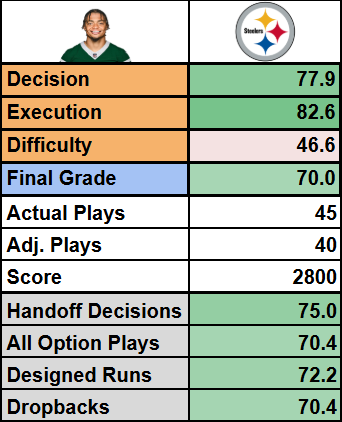
Again, keep in mind that I don’t know what constitutes “league average” for any of those categories. I am uncertain whether these marks would be elite, great, or good relative to the average NFL quarterback. As the season goes on, we’ll see where this game stacks up for Fields. That’s the purpose of these numbers.
For now, though, I can tell you this: I thought Fields played extremely well. I would venture to guess that a 70 grade will be one of his best of the year, and would likely rank as an elite game among all NFL quarterbacks.
As reflected by his decision and execution grades, I think Fields was remarkably consistent at playing his part. Decision-wise, he made the best available call at a fantastic rate, and execution-wise, he consistently threw and ran the ball to the best of his ability. Not much yardage was left on the field due to poor decisions, inaccuracy, or lackluster runs.
Fields’ difficulty grade checks in just below 50, which is a testament to the offensive line and coordinator Tanner Engstrand. Fields had a lot of cushy pockets to throw from, while Engstrand cooked up some fairly routine completions for him, so I would not venture to say that Fields “carried” the Jets in this one. The offense performed tremendously as a group. Fields maximized the situation by deciphering and executing at an elite level.
Let’s dive into some notable plays from the film. I am sure you have seen some of the highlights multiple times by now, so I will lean toward a few of the more underrated plays that helped drive Fields’ grade in this game.
Justin Fields film vs. Steelers
Salvaging a near disaster
This is a perfect example of a play that will rate tremendously in this grading system while being overlooked by other metrics.
After a play fake, Fields runs a designed sprint out to the left, but he is immediately pressured, facing an imminent sack that would cost New York eight yards on first down. Instead, Fields spins out to prevent the sack, and he sprints to the edge for a two-yard gain.
This is a 10-yard turnaround created solely by Fields. He turned second-and-18 into second-and-8, and New York went on to finish the drive with a touchdown.
I scored this one with a 100 in all three categories. Fields made the best decision (try to avoid the sack, then scramble for whatever he could get instead of forcing a throw or throwing it away), executed to the best of his ability, and faced maximum difficulty (immediate sack threat with no available throwing options).
This likely did not make it into any highlight reels, and it certainly did not do much for Fields’ stats, but it is a tremendous quarterback play within the expectations of the situation. I hope my grading system can do a solid job of evaluating Fields based on his ability to do things like this, regardless of what his stats look like.
High-level execution in difficult situation
Here’s an example of Fields displaying high-level execution on a difficult play, with mostly solid decision-making that could be slightly nitpicked.
Facing third-and-9, Fields starts his read on the right side of the field, working toward the left. He correctly bypasses three options that are either covered or short of the sticks.
Fields is about to get to Arian Smith (bottom), who is open on an out route for the first down, but just as he does, he feels some interior pressure from the left, which John Simpson mitigates by plowing his man into the turf.
The pocket ends up being well-protected thanks to Simpson’s save (and an incredible job by Isaiah Davis), so, conceivably, Fields could have stayed put or made a slight adjustment to stay within his progression and target Smith. But he also couldn’t have predicted that the seemingly collapsing pocket would remain intact, so his decision to scramble is understandable, especially considering he had a gaping lane to use.
From there, the window to Smith gets a little tighter with defenders over top and underneath, so Fields comes back to Tyler Johnson over the middle, who is wide open, albeit with a safety closing down hard. With Johnson being Fields’ best shot at a third-down conversion, he elects to make the throw.
Throwing across your body over the middle of the field is typically a no-no. But considering the down and distance, along with the space that Johnson had, I think it’s a reasonable choice by Fields in this particular situation. He just needed to be perfect in his execution to make this work – and that’s precisely what he did.
Fields fires a missile with perfect outside-shoulder placement to keep this away from the closing defender. Anything less than perfect execution on this throw, and it’s an incompletion – possibly an interception.
This was a complex one to score. I decided to give Fields 100s for the difficulty (some pressure, no feasible options in first three reads of progression, and ultimately attempted an extremely challenging pass) and his execution.
I gave him an 80 for his decision, knocking off minor points for the slight possibility he could have hit Smith in-structure and for the danger of throwing across his body over the middle. Still, an 80 is deserved because he went through the progression fairly well, wisely avoided pressure and extended the play, and found his best option for a potential drive-extender.
Misdiagnosed option plays
I thought Fields made the right decision on his zone reads more often than not (hence his 70.4 overall grade on option plays and 75.0 decision grade when he elected to hand off), but there were a few that he would like to have back.
On this second-and-9 in the first quarter, Fields sets up Braelon Allen for a two-yard loss. You can see from Fields’ reaction that he knows he messed up. T.J. Watt took a hard inside angle, and Fields easily would have beaten him to the edge, where he would have had a tight end out in space to block for him. Instead, the Jets were left in third-and-11, and they settled for a field goal.
In this type of offense, the quarterback must be judged for these plays along with his passing dropbacks. There is no stat for Fields’ decision to hand a ball off, but it’s a consequential decision nonetheless. That’s why I included zone-read handoffs in my grades.
However, since the QB has no execution element to handoffs, I decided to only count these as a half-play in my system, giving them less weight than plays where the QB has to make a decision and execute with the ball. I felt it to be a fair balance.
On this third-and-3 late in the fourth quarter, the Jets held the lead and had a chance to ice the game. Fields misreads the play and puts himself in a precarious position, when he could have handed the ball off to Breece Hall for a likely conversion.
Smart pre to post-snap read with excellent throw execution
Tanner Engstrand used pre-snap motion to help Fields find clues, and Fields used those clues to his advantage. Here, Fields makes a quick pre-to-post-snap read that helps him identify and exploit his best matchup.
Fields brings Tyler Johnson in motion from left to right. While nobody follows him, the ensuing shift in the defense tips Fields off to potential man coverage.
With Hall running a wheel route to the left side, where there is a tight end to occupy the safety sitting over top, Fields knows he likely will have Hall matched up with a linebacker, whether it’s the outside linebacker on the edge or the middle linebacker who is too far inside to cover Hall. Either one is a mismatch.
Post-snap, Fields sees the middle linebacker sprint to Hall, and he immediately knows that he can hit Hall on the wheel route. Fields drops his arm and whips the ball around the unblocked edge rusher, and he leads Hall downfield for a nice chunk of yards. The LB does a nice job of making the tackle despite allowing the catch, but Fields couldn’t have done better here given the circumstances.
What you love about this play is the lack of hesitation. Fields trusts what he sees and smoothly whips that ball out to Hall, looking confident in his decision and his ability to execute it.
In the past, Fields’ game has been characterized by a feeling of clunkiness. He tends to second-guess what he’s seeing, causing hesitation in his mechanics. This hurts his accuracy in some cases, and in others, it provides an extra split-second for the defense to read his eyes and make a play. We didn’t see much of that from Fields in this game, and this play is a tremendous example.
Great decision, great execution, and a relatively difficult throw because of the defender blocking the passing lane and the tight window between Hall and his defender.
Takeaways
Fields’ Jets debut blew my expectations out of the water. I thought it would be a rough debut against an experienced and talented Pittsburgh defense, especially since the Steelers are familiar with him. Toss in Alijah Vera-Tucker’s late injury, and I was not expecting much of anything.
As a best-case scenario, I could have envisioned Fields padding his stats by breaking loose for a long rushing touchdown or uncorking a couple of deep bombs. But there was no way I could have expected him to lead a methodical, uber-efficient offense for four quarters through high-level decision-making and execution.
The question now is whether Fields can replicate it – not just once, but again, and again, and again. The greats perform with this type of consistency on a weekly basis.
From here on out, opponents will have a better idea of what the Jets are trying to do offensively. There was no film on this rebuilt Jets offense until now. Of course, we all had a pretty good idea of what the Jets’ offense would look like, but the picture was not exact.
Now that teams have a game of film to watch, the Jets lose somewhat of an advantage that they had going into the Pittsburgh game. Engstrand’s ability to adjust will be tested – and the same goes for Fields.
I expect Fields’ difficulty rating to rise as the season goes on. It’s not that his job was “easy” in this game, but his supporting cast did an excellent job of ensuring he did not have the weight of the world on his shoulders, which is exactly what Engstrand wants this scheme to accomplish.
Even relative to the friendly environment New York placed him in, Fields was incredibly consistent with his decision-making and accuracy, so it does not take away from how well he played in this game. But it will be interesting to see how his decision-making and execution grades fare when his difficulty goes up, whether he faces worse pass protection, more drops from his pass catchers, or has to work around Engstrand getting out-coached.
The Jets could not have asked for anything better in Fields’ debut. He led the NFL in EPA per dropback, and his film backs it up. The man looked cool, confident, and in control, no matter how many times the defense choked away the leads he built.
All we can do now is wait and see if Fields can replicate it. Hopefully, this grading system will serve as a useful tool for evaluating his progress throughout the season.
