
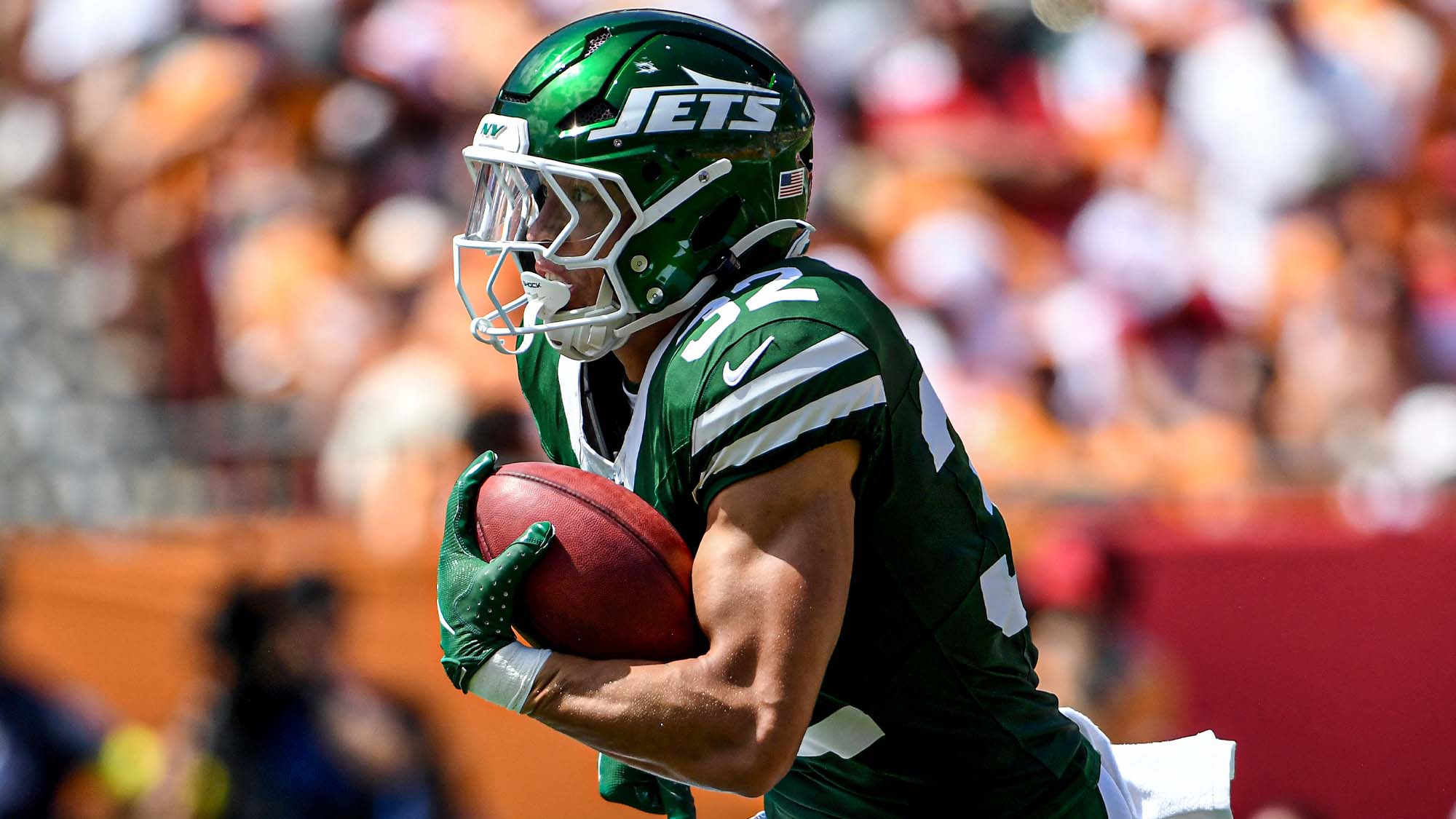
New York Jets head coach Aaron Glenn announced on Friday that running back Braelon Allen is expected to miss 8-12 weeks with the knee injury that landed him on injured reserve.
It opens up an opportunity for one of New York’s most underrated young players: Isaiah Davis.
The 2024 fifth-round pick from South Dakota State showed intriguing potential over a small sample of chances in his rookie year, averaging a team-best 5.8 yards per carry across 30 totes. So far in 2025, Davis has only received eight touches, but he’s turned them into 51 yards, an impressive 6.38 yards per touch.
Still only 23 years old, Davis enters Week 5 of his second NFL season with 300 yards from scrimmage on just 47 career touches. His career average of 6.38 yards per touch ranks seventh-best among the 104 running backs with at least 30 touches since 2024:
- Samaje Perine (8.09)
- Ty Johnson (8.06)
- Emari Demercado (7.57)
- Justice Hill (7.22)
- Sean Tucker (6.98)
- Dameon Pierce (6.67)
- Isaiah Davis (6.38)
- Dare Ogunbowale (6.34)
- Austin Ekeler (6.21)
- Derrick Henry (6.13)
It’s a tiny sample size, but the potential is intriguing. Now, handling RB2 duties for the first time in his career, Davis will have a chance to show he can maintain his efficiency on a larger volume of touches.
If he pulls it off, Davis will provide New York’s offense with a noticeable upgrade. Allen, despite being drafted a round earlier than Davis in 2024, has been much less efficient to start his NFL career.
Across 21 games, Allen has recorded 575 yards from scrimmage on 131 touches, an average of just 4.39 yards per touch. It places Allen 77th on the 104-player list that featured Davis in the No. 7 spot.
If you project Davis’ 6.38 yards per touch over Allen’s 131 touches, he would have had 836 yards from scrimmage, over 260 more yards than Allen.
READ MORE: Here's Where The Jets' RB Unit Ranks Across the NFLObviously, Allen has had to carry a much heavier workload than Davis, so it is unlikely that the gap in efficiency will be as big once Davis takes over Allen’s role. Still, the gap is large enough that Davis should still be an upgrade even if his efficiency drops a few notches. Allen has been given 84 more chances to touch the ball than Davis, yet he’s only generated 275 more yards with those opportunities. That’s not ideal.
Simply put, there is a lot of room for Davis to set himself apart from Allen and strengthen the Jets’ offense in the process.
Isaiah Davis vs. Braelon Allen
Davis projects as a potential upgrade over Allen in many facets of the running back position.
For starters, Allen, despite his 245-pound frame, has actually not been very good at generating yardage after contact. So far in 2025, Allen ranks 42nd out of 58 running backs (min. 15 carries) with just 2.56 yards after contact per carry. In 2024, he was 35th out of 51 backs (min. 80 carries) at 2.89.
Compare that to Davis, who owns a career average of 4.03 yards after contact per carry. For comparison, it’s an identical mark to the one owned by Indianapolis’ Jonathan Taylor this season.
Davis’ yards-after-contact numbers are a product of his contact balance. He will not truck defenders like Allen can, but Davis is excellent at staying on his feet, allowing him to keep chugging for extra yards.
While Allen can plow through defenders, he can struggle to stay on his feet, often opting to put his head down and dive forward for an extra yard or two when a more balanced runner would bounce off the tackle and keep running for more yards. It’s part of why Allen has yet to pick up a run for over 20 yards on 110 career carries.
The Jets’ aerial attack should also benefit from Davis’ increase in snaps.
Davis, who has been operating as New York’s third-down back, is more capable of providing a multi-faceted impact in the passing game than Allen. The Jets have trusted Davis to play 16 pass-blocking snaps this year, more than twice as many as Allen (6).
Davis displays good recognition and aggression as a pass blocker. Having him on the field more often can assist a Jets offensive line that, despite an overall solid start, has struggled with blitz pickups.
Davis’ hands are another upgrade that he offers over Allen. In two seasons, Allen has a drop rate of 19.2%, recording five drops against 21 receptions. Davis has only one drop against 12 receptions (7.7% drop rate).
Speaking of hands, Davis can also be trusted to maintain a tighter grip on the football. Allen lost a costly fumble at the goal line in New York’s latest loss to Miami, while Davis has never fumbled in his NFL career.
In fairness to Allen, it was his first career fumble, while Davis has had far fewer chances to fumble the ball. However, Allen’s ball-security track record is spotty going back to college.
Allen had four fumbles in his final season at Wisconsin, part of his nine fumbles in three seasons. Comparatively, Davis had just three fumbles in four seasons, never fumbling more than once in a season. Dating back to 2020, Davis has three fumbles on 777 touches between college and the NFL, while Allen has 10 fumbles on 776 touches.
The only area where Allen has a likely advantage over Davis is in short-yardage situations. Allen has converted 12 of 15 (80%) career rush attempts on third or fourth down with two or fewer yards to go, which is excellent. Davis has yet to even get an attempt in that scenario.
It’s conceivable that Davis can be just as good as Allen in this department, considering his success after contact. Until that is proven, though, the Jets will certainly miss Allen’s reliability as a short-yardage runner.
Otherwise, Davis projects as a possible upgrade over Allen in just about every area.
Quietly, Allen has been somewhat disappointing for New York. In his shadow, Davis has sneakily looked like the better player. We’re about to see whether that’s truly the case. If it is, the Jets’ offense will receive a much-needed shot in the arm.
