
Yesterday, we analyzed the history of NFL head coaches to start 0-6 with a new team. The results were anything but pretty. The majority of those coaches went on to have short and unsuccessful tenures.
Before Aaron Glenn, 17 coaches had undergone such a start since 1980. Of those 17 coaches, 13 of them (76%) never led that franchise to the playoffs.
Four exceptions, though, provide hope for Glenn. That includes three recent examples: Dan Campbell (2021 Lions), Zac Taylor (2019 Bengals), and Kyle Shanahan (2017 Niners). Hall-of-Fame coach Jimmy Johnson also stumbled out of the gates in Dallas back in 1989.



But has Glenn done anything yet to inspire faith that he might be the next Campbell or Shanahan?
As of right now, no.
He must use the next 11 games to change that to a “Yes.”
If the answer is still “No” on January 5, the Jets would be wise to trust the odds and understand that giving Glenn another year would most likely be a waste of time considering the history of coaches who started out similarly.
So, how can Glenn turn things around and provide evidence that he can be the next Campbell or Shanahan?
Here are three ways Glenn can strengthen his case for a 2026 return.
1. Substantial progress in game management
When it comes to managing games, Glenn has appeared utterly lost. Whether it’s costly fourth-down decisions or wasted timeouts, Glenn has consistently decreased his team’s chances of success on gameday.
Let’s start with the fourth down calls. Many times this year, Glenn has minimized the Jets’ odds of victory by making a suboptimal call on fourth down.
This past week against Denver, Glenn opted for a punt on fourth down and about a half-yard while the Jets were leading by one point in the fourth quarter. While the Jets were at their own 30-yard line, it was still an obvious “go” situation based on any analytical model. The decision was not close enough to justify Glenn using his “gut” to override the recommendation.
Not only did Glenn make a decision that sliced the Jets’ win probability by 4%, but he wasted a precious second-half timeout to mull it over, and he still made the incorrect call.
Glenn’s decision was a poor process regardless of the ensuing result. However, it stands out as even more glaring because it did ultimately cost the team. On the ensuing possession, Denver drove for the go-ahead field goal, and the Jets never recovered.
In Week 5 against Dallas, Glenn opted for a cowardly punt in the first quarter while New York still had a chance to seize control of the game. Facing fourth-and-5 at Dallas’ 43-yard line in a 3-3 tie game, Glenn elected to punt instead of keeping his offense on the field. Once again, this was deemed a “strong” recommendation; Glenn cut the Jets’ win probability by 3% with his decision.
The Jets offense had actually been fairly successful up to that point, picking up 97 yards across two possessions, so a fourth-and-5 conversion felt attainable given the context of the situation. Instead, Glenn’s punt (a measly 33-yarder due to the constraints of punting on the opponent’s side of the field) set up an ensuing Cowboys touchdown drive.
From there, the Jets never regained any sort of momentum and went on to trail 30-3 before garbage time stat-padding. If Glenn made a proper game-management call, they could have seized control early and flipped the momentum of the game.
We’re not even close to done.
Trailing 23-3 in the third quarter of the Jets’ eventual Week 2 loss to Buffalo, New York faced a fourth-and-1 at its own 28-yard line. With 7:05 left in the quarter, there was still enough time for the Jets to begin staging a three-score comeback.
Instead of going for it to preserve the Jets’ final chances of winning, Glenn essentially waved the white flag by punting the ball back to a Bills offense that opened the half with a six-minute scoring drive. Buffalo responded with a touchdown, and the Jets got the ball back down 30-3 in the fourth quarter.
While Glenn has leaned toward the conservative end with his poor decisions, he also made an aggressive call that was suboptimal and backfired.
In the Jets’ Week 4 loss to Miami, New York faced a fourth-and-5 at Miami’s 36-yard line with 4:23 left in the second quarter, trailing 10-0. The analytics actually suggested kicking a field goal in this situation, albeit by a slight margin.
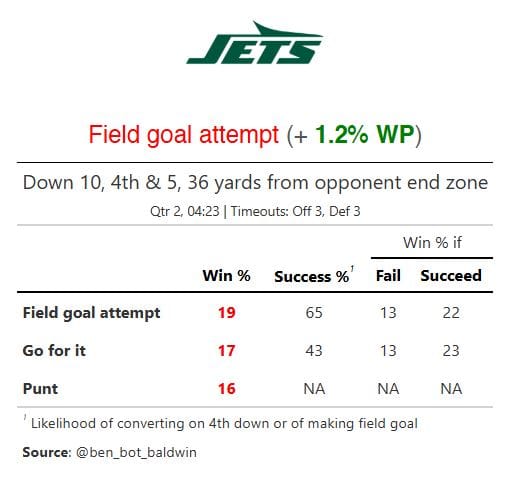
Considering Nick Folk’s reliability in recent years, his odds of success on a 54-yard field goal are probably higher than 65% (the assumed success rate used in this model’s calculation), which would further incentivize kicking the field goal. Folk is 5-for-5 from 50+ yards this season, with a long of 58.
Instead of taking a good chance at points to slice Miami’s lead to 10-3, Glenn kept the offense out there on fourth-and-5, and the result was a Justin Fields fumble.
Therein lies a truth that goes overlooked by the detractors of analytics: These models do not exist just to tell coaches they should go for it in every situation as if they’re playing Madden at 12 a.m.
Sometimes, it’s correct to kick a field goal or punt. The purpose of these models is to help coaches quickly make informed decisions in the heat of a game, whether that decision is aggressive or conservative. Glenn is ignoring this advice on both ends of the spectrum, and it’s crushing the Jets’ chances of victory.
Beyond the fourth down decisions, Glenn has displayed a bad habit of wasting timeouts in the second half.
We already mentioned how he blew one against Denver to make the wrong fourth down call; that was not the first time it happened. In Week 1 against Pittsburgh, Glenn wasted two timeouts on an early drive in the fourth quarter. Later on, the Jets paid the price for not having those timeouts, as they had to operate with urgency on a potential game-winning drive. They also had no chance of getting the ball back after that drive failed.
This is an incredibly long list of costly game-management mistakes for a span of only six games. Glenn needs to figure this out over the next 11 weeks. Being a rookie is hardly an excuse, as he had an entire offseason to study and prepare for these scenarios.
2. Accountability with roster and depth chart decisions
After a whole offseason of preaching about accountability and standards, Glenn has already burned those virtues, sending them up to the football heavens alongside Sauce Gardner’s cheesehead.
If you play for the Jets right now, you know in the back of your mind that it’s acceptable to not play to the best of your ability, because you will probably still get a second, third, or even fourth chance. After all, you’ve seen your head coach give ample chances to plenty of guys who are very likely playing worse than you.
Veteran returner Xavier Gipson was outplayed by undrafted rookie Jamaal Pritchett in training camp and the preseason after already being a poor player over his first two NFL seasons. Gipson still made the roster, and he ended up costing the Jets a win with a mistake he had already made numerous times in his career.
The Jets replaced Gipson with Isaiah Williams. In Week 4, Williams was arguably the main culprit for New York’s loss to Miami, as he fumbled away the second-half kickoff and later buried the Jets’ offense by fair-catching a punt at the three-yard line.
While New York promptly released Williams later in the following week, Williams was brought back to the practice squad, and in Week 6, he was called back up to play a prominent role as a returner. Williams escaped the game with no fumbles and had a couple of nice returns, but he still let the ball leave his hands on one return; luckily, it was forced by the ground.
Glenn publicly stated in training camp that Micheal Clemons needed to cut the penalties out of his game. After Clemons committed a foolish unsportsmanlike penalty in the preseason, along with lackluster overall play, he still made the roster as the Jets’ No. 3 defensive end. When Clemons killed the Jets’ early momentum in a Week 2 divisional game with another bad penalty, there were again no consequences.
Since a stellar Week 1 outing, Justin Fields has sabotaged the Jets with his abysmal play. Fields has gone four consecutive starts without reaching 100 net passing yards through three quarters. That includes two putrid games against Buffalo and Denver in which Fields netted -2 combined passing yards.
Despite Fields’ record-setting performance of -10 net passing yards against Denver, Glenn defended him after the game and immediately pegged him as New York’s starter moving forward. Glenn claimed that Fields only had one bad game, ignoring his 8 net passing yards against Buffalo in Week 2.
READ MORE: Aaron Glenn, not Justin Fields, deserves blame for Jets’ disasterWith all of these examples, Glenn has created a culture in which players subliminally know they are not under pressure to play at a championship-caliber level. You can fumble games away, constantly commit foolish penalties, or have the worst passing performance in Jets history, and you will still get another chance.
That’s not how you set a foundation for sustainable winning.
It might succeed at maintaining friendly relationships in the locker room, but it sure won’t win any Super Bowls. Heck, it might not even win a game; it hasn’t yet.
Glenn might already be too far gone in this regard to save face in a matter of 11 games; it will be difficult to undo the low standards he has already set for his players. Somehow, though, he must find a way to turn things around in this department, reigniting his promises of accountability and standards.
The rope for struggling players must be shorter. The passionate public defense of players struggling at league-worst levels must cease. Until these things happen, it will appear to outsiders that the Jets are not operating with as much urgency to win games as the rest of the NFL. That is an insurmountable competitive disadvantage.
3. Drop the “Don’t lose” philosophy
Mimicking his predecessor, Robert Saleh, Glenn has the Jets operating with a “don’t lose the game” mentality. All it’s led to is more losing.
Prior to Sunday’s game against Denver, NFL Network reporter Sara Walsh shared the following quote from an exclusive conversation with Glenn: “Before you win, you have to learn how not to lose.”
Sigh…
This is the exact mentality that led to Saleh’s downfall in New York. Jets fans will remember the infamous quote that Saleh shared with Tony Dungy, calling New York’s 2023 game against the Las Vegas Raiders a “race to 20 points.”
While Saleh’s words were intended to praise Las Vegas’ defense, he inadvertently revealed the flaws in his philosophy. Saleh had the Jets playing too safely and too conservatively to win games at a high level. To win in today’s aggressive NFL, you need to get a step ahead of the competition by being proactive and looking to gain advantages in any way possible. If you sit back and fold your arms, the other team will outpace you.
Going into that game against the Jets in 2023, the Raiders’ defense ranked 19th in EPA per play allowed. So, it’s not as if the Jets were playing the 2000 Ravens. Saleh placing a 20-point cap on his team against a mediocre defense shows how he wanted to try and win games, and it’s not a strategy that works anymore in the 2020s.
Yes, the Jets had Zach Wilson at quarterback, but that should only further incentivize aggressiveness and chance-taking. As an underdog, your best shot at winning games consistently is to take gambles that raise your ceiling and pray things bounce your way. If you accept the low ceiling placed upon you by a guy like Wilson, you are accepting defeat.
Glenn is doing the same thing with the Jets right now.
Like Saleh in Las Vegas, Glenn’s quote before the Broncos game foreshadowed how his team would operate that day. The Jets were so focused on not losing the game that they forgot to win it.
New York played an excellent game on defense and special teams. While the offense was abysmal, the Jets had multiple chances to clear the low bar necessary for victory, but Glenn’s overarching “don’t lose” mentality cost New York the few points they needed to come out victorious.
The Jets shot themselves in the foot at multiple junctures by being complacent. At the end of the second quarter, the Jets had a chance to close the half by driving for a field goal or touchdown, but they operated with little to no urgency, continuously running the ball up the middle for small gains. They ultimately ran out the clock, which Glenn stated after the game was his goal.
Glenn admitted this strategy was a mistake later in the week, saying he wishes that he had the Jets throw a Hail Mary in the waning seconds. That’s still the wrong mentality, though. It does not excuse the sluggishness of the entire drive, going back to the called runs on three of the first four plays.
In the second half, Glenn had multiple opportunities to bench a struggling Fields for Tyrod Taylor, who would have been an upgrade if he gave out souvenirs to the British crowd on every pass. He rolled with Fields.
We already discussed earlier how Glenn was too safe with the big fourth down call in the fourth quarter, wasting a timeout while doing so. That was another move that aligns with his “don’t lose” philosophy.
To top it all off, the Jets’ overall offensive game plan reeked of fear. They essentially bowed down to Denver’s elite defense.
Whenever the Jets got a positive gain on first down, they were extremely predictable at running on second down instead of taking a shot downfield; New York ran the ball on 8-of-11 second down plays with fewer than eight yards to go (73%). Denver was all over it; those eight carries yielded an average of 2.8 yards.
Worse than the run-heaviness was the lack of creativity in the run game. The Jets largely went away from the zone-read game plan that made Fields look dangerous in Week 1. They introduced a new package of 13 personnel runs with tackle Max Mitchell on the field as a tight end, which failed miserably. The Jets predictably ran the ball on all five of Mitchell’s snaps and averaged 2.2 yards per carry with no first downs.
In the passing game, the Jets routinely checked the ball down instead of challenging a Denver defense that constantly played single-high man coverage. This fell primarily on Fields, as offensive coordinator Tanner Engstrand dialed up plenty of downfield shots that were available, but it was on Glenn and the Jets to recognize that Fields was a liability and take him out.
Engstrand is the play caller, but the philosophy of the offensive game plan trickles down from the head coach. Glenn was more focused on not turning the ball over than scoring points. He got his wish; the Jets finished with no turnovers. The cost? No touchdowns—and no “W”.
It seems Glenn has learned little from his days under Dan Campbell. Taking over an underdog franchise, Campbell didn’t accept the ceiling placed over his head. He smashed through it, and his aggressiveness has been rewarded in a league where fortune favors the bold.
Glenn has accepted the constraints of coaching the New York Jets. Losing is okay around here. So far, he has been unable to change that standard, and he never will until he adopts a philosophy that raises the Jets’ ceiling.
Recap: Glenn’s goals after 0-6 start
To recap, these are the three general areas where Glenn must improve mightily over the next 11 games to prove he should be viewed as a potential outlier among coaches who start 0-6:
- Substantial progress in game management
- Accountability with roster and depth chart decisions
- Drop the “don’t lose” mentality
If Glenn shows tremendous progress in these areas by the end of the season, he deserves an opportunity to try and join the 24% of coaches since 1980 who have rebounded from an 0-6 start to bring their franchise to the playoffs.
If not, he is more than likely among the 76% group, and the Jets should play those odds.
Glenn should mainly be evaluated in these controllable areas rather than wins and losses. With a weak quarterback room and now facing the possibility of playing without Garrett Wilson for at least two games, it might be tough for Glenn to rack up victories with this team.
That does not preclude Glenn from doing a better job in areas within his control. It’s on Jets fans and media members to understand how to isolate Glenn’s impact from the team’s win-loss record.
Still, if Glenn truly improves in these areas, wins should be expected to follow. He cannot be completely absolved from a lack of victories moving forward—not after starting 0-6.
While Glenn should be evaluated based on his individual process rather than the results, there is still a certain standard of on-field success he must be held to after already using up six losses in as many weeks. A much-improved finish in the standings would suggest that his individual improvements are leading to tangible results on the field.
Dan Campbell and Kyle Shanahan exemplify the type of late-season progress that would help Glenn build his case for a long-term turnaround.
Campbell’s 2021 Lions entered their Week 9 bye at 0-8 with a -13.8 point differential. The Jets have a bye week at the same point. Currently 0-6 with a -7.8 point differential, the Jets have not been blown out quite as badly as those Lions (although it would be closer if we subtract garbage time stat-padding), but with no Wilson over the next two games, Glenn could have a nearly identical start to Campbell once Week 9 rolls around.
After their bye week, the 2021 Lions finished 3-5-1 with a -3.9 point differential, nearly 10 points better than their pre-bye performance. Three of those five losses were by one score, and each of their four wins and ties were against teams that finished with eight-plus wins.
Shanahan led an even more impressive turnaround. After starting 0-9 with a -10.7 point differential, the 2017 Niners finished 6-1 with a +6.3 point differential.
These are the types of turnarounds that can salvage a head coach’s potential despite a brutal start.
Campbell’s team improved its point differential by 10 points after breaking its initial losing streak, while Shanahan’s team improved by 17 points. If Glenn really wants the Jets and their fans to forget about his start and buy back in, he will lead a turnaround of that degree.
Improving in the three areas we outlined will help Glenn facilitate that type of on-field improvement.
The Jets’ remaining schedule ranks fourth-easiest based on win percentage (.411) and third-easiest based on DVOA (-12.3%). If Glenn cannot make the 10-plus-point leap that Campbell and Shanahan did, the schedule cannot be used as an excuse. Realistically, the leap might have to wait for Wilson’s post-bye return, though.
Ultimately, a healthy blend of Glenn’s individual progress and the Jets’ team success will allow us to make a fair evaluation of Glenn’s outlook once the season is complete. We cannot solely evaluate him individually while totally absolving poor team performance, nor can we solely look at team performance without contextualizing his individual impact.
The bottom line is this: Aaron Glenn has his work cut out for him to prove he can be a successful head coach in New York.
While Glenn is only six games in, the odds are already stacked against him, and major improvements are needed over the next 11 games to show he is capable of overcoming those odds.
