

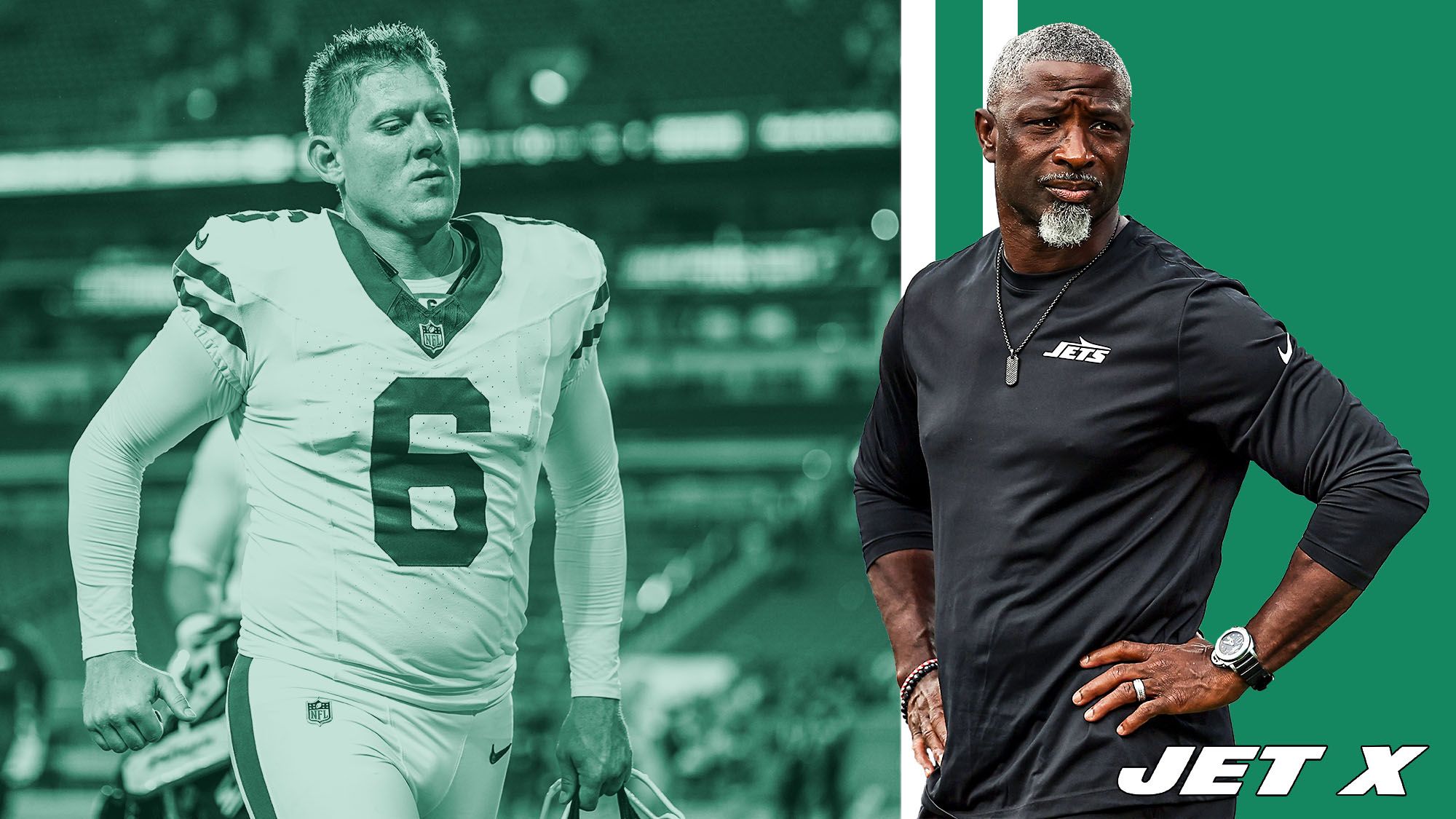
Week 6 for the New York Jets was anything but kind. Hey, what else is new?
The 13-11 loss to the Denver Broncos in London cemented the team’s sixth straight loss, all of which account for Aaron Glenn’s NFL head coaching start.
Losses happen—especially around these parts. Soul-crushing defeats occur—particularly in Northern New Jersey. Even worse than a 0-6 record through six weeks is how the Jets’ latest loss transpired.
In a game full of inept coaching decisions, one stands out as a crippler. One unbelievable decision that left fans aghast stands above the rest, and that’s not even the worst part.
What followed this no-good, terrible decision is what should sound the alarms everywhere.
The unbelievable fourth-and-8 decision
Faced with a fourth-and-8 at the Denver 44-yard line, Glenn’s Jets had a decision to make with the game on the line. Trailing by just two points in a 13-11 game, only 1:14 remained in regulation.
Leave the offense on the field or turn to Nick Folk.
Aaron Glenn decided to leave the offense on the field, which ultimately led to an absurd fourth-down sack.
Now, think about this decision from a head coach’s perspective. Up until this point in the game, your passing offense has done nothing. Scratch that: Your passing offense has done less than nothing (-10 net-passing yards in the game).
Justin Fields had been sacked eight times in the game (finishing the game with nine), and he routinely made the simple look improbable. Just a singular play earlier, Fields released the ball insanely late on a third-and-8 out-breaker at the sticks.
On the other side of the coin, the team’s kicker has been one of the few bright spots this season. Folk is a perfect 12-for-12 on field goal attempts with a long (and career high) of 58 yards—not to mention a perfect 7 of 7 on extra point tries.
The innate game-management trait is essential
Other than the apparent nature of everything that’s been mentioned already, having a feel for the game is essential for an NFL head coach. This is especially the case in today’s league.
When evaluating the best teams in 2025, a couple of top-level items constantly ring true.
For one, for the most part, head coaches are led by offensive-minded individuals and/or offensive play-callers. I doubt we need to go through the list at this point. The mere mention of many of the young head coaches—Shane Steichen, Liam Coen, and Ben Johnson—should be enough.
While the exceptions, such as Mike Tomlin, Mike Vrabel, Sean McDermott, and John Harbaugh, do exist, each of these sideline bosses shares a must-have trait …
They’re all brilliant in the game-management arena.
It’s an innate skill, really. Few (if any) can learn the game-flow feel if they currently do not possess it. Worse yet, this innate trait differs drastically today when compared to the same idea of yesteryear.
The motivational-type coaching archetype could more easily get away with a lack of game-management knowledge a couple of decades ago. Former Jets head coach Herman Edwards immediately comes to mind.
These days, however, this tough-to-describe attribute not only needs to be equipped, but it also needs to be understood from an offensive-first perspective.
Explaining why it was the wrong decision
To allow Fields a chance on a third-and-8 situation in nut-crunching time is beyond comprehension. Not replacing him with veteran Tyrod Taylor is even worse, but that’s a totally different story for a different day.
In this particular case, gambling with a Folk 61 or 62-yard field goal is the correct call every time.
Think about it: Not only has Folk been one of the few bright spots for the Jets this season, but the league, as a whole, has trended in a more long-range direction that must be considered.
Kickers are booming field goals like Steph Curry. Never have field goals been kicked from such insane lengths, and it’s related to an NFL rule change that flew under the radar this past offseason.
Once upon a time, back in 1999, the NFL introduced a special football. It was called the K ball, a special kicking ball that suited kickers much more nicely.
Little by little, the art of kicking has inched closer to perfection. This year, we’ve seen a dramatic change thanks to the league allowing teams to carry their own K balls.
Now, teams can manage their own K balls, and they’re producing monumental numbers.
Tampa Bay Buccaneers kicker Chase McLaughlin drilled a 65-yarder that tied the second-longest in history. Jacksonville Jaguars’ Cam Little nailed a 70-yarder that represents the longest made field goal of all-time—albeit it came in a preseason game.
Kickers are 77 of 108 on 50-plus yard field goals through Week 6 action, and the number of 60-yarders is on pace to shatter the previous single-season mark. In short, trusting the placekicker is no rough spot these days.
To allow Fields to drop back as opposed to letting Folk try one from 62 is malpractice of the highest order. No, Folk has never made a 60-plus-yarder, but this season has been entirely different.
To be fair, the lone negative that comes with opting for the field goal should be obvious: It would have given Sean Payton’s Denver Broncos plenty of time to march down the field and win the game. But hey, that’s a third-down concern, not a fourth-down issue.
When faced with a fourth-and-8, only one decision is correct in this scenario.
Read Also: The Jets won't win until they stop romanticizing the planGlenn’s demoralizing postgame comments
Pouring a heavy bucket of salt into a monstrously fresh wound were Aaron Glenn’s postgame comments.
When asked what the target line was for a chance to kick a game-winning field goal, Glenn answered with the 35-yard line.
“We were trying to get ourselves in position to get to that 35-40-yard line, and get a chance to get us that field goal,” Glenn told reporters about his team’s failed final drive.
“Thirty-five, yeah, for us. (Folk) kicked a 58-yarder, and that was his career long. So, if we could get to the 35, we felt like we were really good in that situation.”
Kicking from the 35-yard line results in a 52-yard field goal. Usually, the target line is one that’s used for the worst-case scenario. If Glenn is talking about the more comfortable target line, then ok, no problem.
When pressed about the distance, Glenn answered with, “Yeah, that’s tough. Again, when we said his line was the 35, we’re talking about nine yards back. … With the wind and all that, I just thought that was tough.”
The demoralizing comments have yet to come, however.
Near the end of the presser, Glenn mentioned that he decided to bypass a 65-yard or 68-yard field goal to go for the first down on fourth-and-8, while stumbling through the distance part when speaking.
“We just didn’t execute,” Glenn proclaimed. “I don’t want to put a 45-yard field goal … (quick corrected mid-sentence to) 60-something … (again, corrected to in real-time) 68-yard or 65-yard field goal on our kicker [who] has never done that, [especially] when we said the line was 35.”
With the ball at the 44-yard line, the attempt would have been 61 yards or 62 at the max (depending upon where exactly the ball was spotted).
There’s simply no form or fashion in which a head coach can be confused on this. No way.
It’s simple: The attempt is generally 17 yards back of the line of scrimmage, and it’s been this way for a long time. In more recent cases, the operation accounts for 18 yards, likely due to the ease with which distance is executed these days, which affords the unit more space to prevent a block, but 17 or 18 yards is pretty ironclad.
How there could possibly be any confusion about that number, especially in the postgame presser when it’s fresh in the mind, is disturbing beyond belief.
Seriously. There isn’t a single excuse that could wash this concern away.
In today’s league, where a singular game-management decision can sink or swim a football team, not possessing the ability to understand the situation quickly enough, coupled with the inability to adapt in real time, is beyond troublesome.
The decision was between a fourth-and-8 or a 62-yard field goal with 1:14 to go down two points. Anything that differs from that clear-cut mindset for any NFL head coach is horrifying beyond words.
There’s no room for confusion or inaccuracies—not in this league, not in this year (2025), not with the way the rules are currently stated. Period.
That’s really all that could be said at this point.
