
It was only a few weeks ago when the entire football world laughed in harmony at the New York Jets for letting perhaps the greatest quarterback in history walk out their doors to tear up the NFL with another AFC team.
Just a month later, those takes are aging like milk.
Where did the Aaron Rodgers brigade go?
Many fans and media members took victory laps when Aaron Rodgers and the Pittsburgh Steelers got off to a 4-1 start while Aaron Glenn and the Jets wallowed in 0-5 misery. The jokes wrote themselves. Glenn was a winless rookie head coach leading a perennial laughingstock of a franchise, and the quarterback he told to kick rocks is a GOAT candidate who had a 4-1 record on a consistently successful franchise.
“Aaron Rodgers was never the problem in New York,” shouted the critics, despite a 2024 season that saw Rodgers rank 28th in yards per attempt (6.7) with his handpicked offensive coordinator and a Garrett Wilson/Davante Adams/Breece Hall trio around him. Clearly, according to these football savants, the Jets let prime Rodgers walk out of the building. “Typical Jets!”
Fast forward to Nov. 10, and those takes are nowhere to be found.
The Steelers have dropped three of their past four games. At 5-4 with a -8 point differential, they look identical to the recent iterations of the team that Rodgers was supposed to separate them from. They’re the same gritty squad that ekes out close wins thanks to their defense and a competent offense, but can’t blow anybody out because of their lack of offensive firepower, giving them a hard ceiling as a wild-card-exit team.
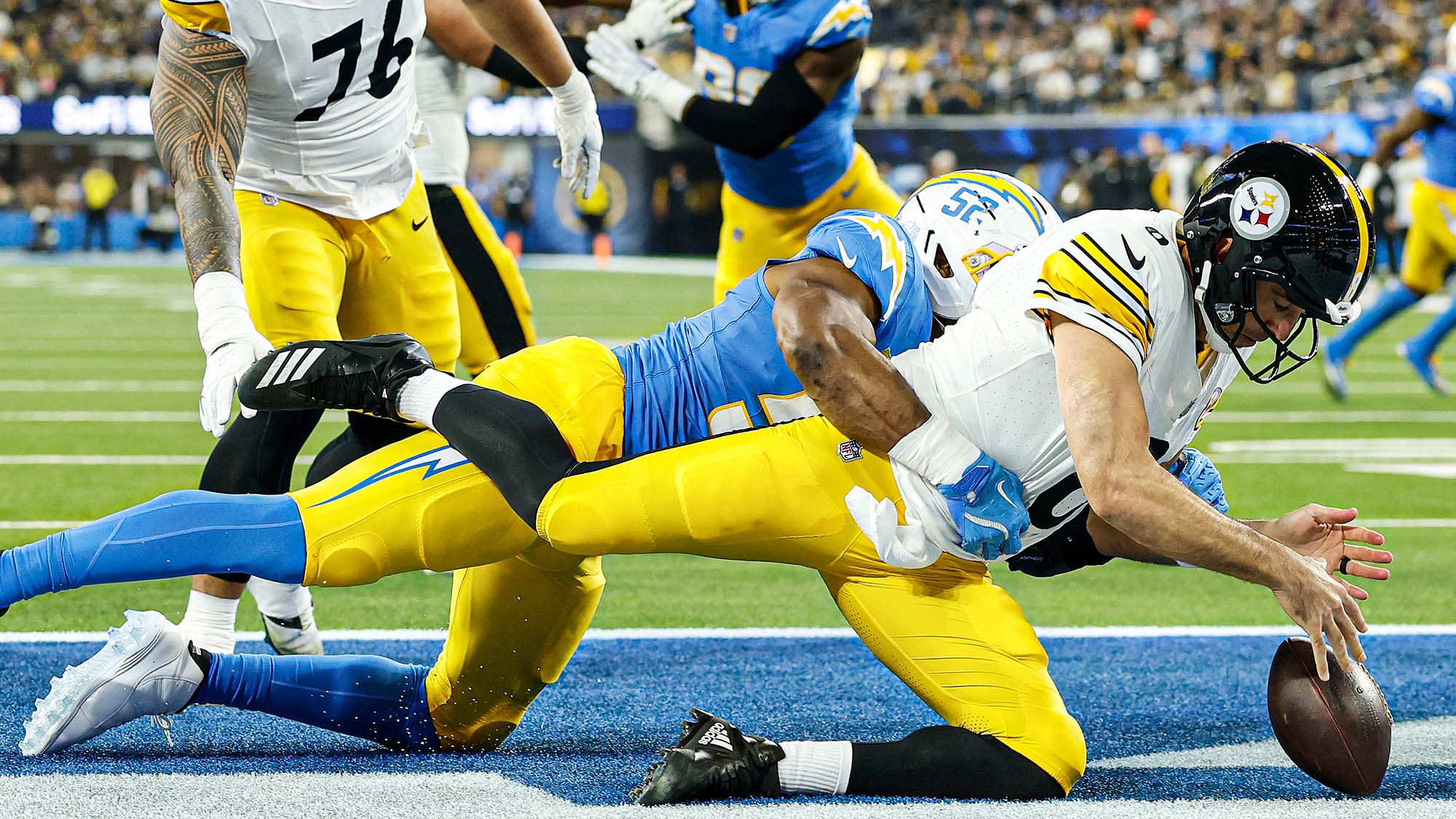
Shockingly, the soon-to-be 42-year-old Rodgers has not been any better than he was in his underwhelming 2024 season with a largely handcrafted supporting cast in New York. Rodgers was a major problem in the Steelers’ most recent loss, a 25-10 laugher at the hands of the Los Angeles Chargers, a fierce rival in the AFC wild card race.
In the defeat, Rodgers completed 16-of-31 passes for 161 yards, one touchdown, and two interceptions. The issues go beyond the box score. One of those picks was a blatant drop, but Rodgers still hurled three turnover-worthy throws to zero big-time throws, while posting a poor adjusted completion percentage of 67.9% (which accounts for drops, throwaways, etc.).
On the year, Rodgers has been a comfortably below-average starter. Through Week 10, he ranks 25th out of 33 qualifiers in QBR (44.9), 23rd in adjusted EPA per play (0.07), 19th in net yards per pass attempt (5.97), and 22nd in passing yards per game (205.9). Across the board, these numbers look very similar to his 2024 season in New York.
It was premature to claim the Jets mishandled Rodgers after only five games. Even after nine games, there is still plenty of football left to be played before we can make definitive judgments on any offseason decisions. Maybe Rodgers will catch fire and lead the Steelers to a 13-4 season. Maybe he has won his last NFL game. Nobody knows, and that’s why we should let things play out before hurling red-hot takes around.
Nonetheless, Rodgers’ overall level of play so far in 2025 suggests that it is extremely unlikely the Jets will end up regretting their choice to let him go.
That isn’t to say the Jets’ quarterbacks have been any better—they’ve been far worse, in fact, maybe even the worst in the NFL. The Jets might have another win or two at the moment if Rodgers were their starter.
That isn’t the point, though. The Rodgers decision was never a one-for-one football move between him and Justin Fields. It involved a complex array of factors.
First and foremost, the Jets saved a net two-year total of $37.5 million in cap space by letting Rodgers go. If he stayed, Rodgers would have a $23.5 million cap hit in 2025 while triggering a $63 million roster bonus in 2026, bringing his two-year total to $86.5 million. By releasing Rodgers, they sliced their dues down to $49 million, which they spread between $14 million in 2025 and $35 million in 2026 by designating him as a post-June 1 cut.
On top of the money aspect, the Jets knew they were headed for a rebuilding process under Glenn and general manager Darren Mougey. They wanted to get a head start on reshaping the culture and accumulating assets to build the roster. Keeping Rodgers around would hinder the Jets’ cultural and roster-building goals. He would make the team better, but not better enough to seriously compete, while hurting their long-term flexibility to flesh out the roster with handpicked players who fit the Jets’ new culture and schemes.
Not to mention, winning a couple of extra games with Rodgers could have possibly delayed the Jets’ pursuit of a franchise quarterback by one year. While the Jets probably did not expect to start 0-7, they showed through their Rodgers decision and their ensuing trade deadline moves that sliding the chess pieces toward their next franchise quarterback has been a top priority from the beginning.
If Rodgers stuck around and had the Jets with three or four wins at the trade deadline, they wouldn’t have made the Sauce Gardner and Quinnen Williams trades. That would leave the Jets sitting around in 2026 with no franchise quarterback, a middling first-round pick, and no extra assets to maneuver the draft board or strike on the veteran quarterback market.
Of course, the Jets did not envision this exact scenario playing out, but from the very start, their choice to dump Rodgers signaled that they wanted to accelerate their transition to the next hopeful franchise quarterback. They probably knew deep down that their decision would cost them a win or two in 2025, but they were more concerned about the larger chunks of wins to be gained by a future quarterback in 2026 and beyond.
There is also the cultural aspect of the decision. Glenn and Mougey, based on their deadline moves, are clearly committed to reshaping the team in their vision, even if it means sacrificing short-term talent. Rodgers, like Gardner and Williams, was acquired by a different regime. While he is a great leader and teammate by most accounts, he is also a larger-than-life figure who automatically commands the most attention out of anybody in his organization. It is understandable that the new regime preferred to wipe the slate clean.
The conversation would be different if we were talking about prime Aaron Rodgers, or even something close to it. In that case, the talent would override any of these other factors. But that remains the critical point here: Rodgers simply wasn’t good enough in 2024 to justify New York overlooking all of these critical long-term factors that would come with keeping him.
For Rodgers to be worth bringing back with all of the accompanying ramifications, he would have to be a surefire top 10-to-15 quarterback who could offer a strong chance of leading the Jets’ young, retooling roster on a playoff run. That was not the case with Rodgers getting one year older after an erratic 2024 season, which allowed the Jets to feel comfortable in their decision when they made it.
The thought process behind the decision was always valid, and that will not change regardless of the results. However, the results can change how people look at a big decision. So far in 2025, things have gone precisely as the Jets expected. Rodgers has been the same player he was last year: a guy who is still good enough to start games in the NFL, but nowhere close to good enough to justify the Jets keeping him for short-term rewards at the cost of long-term consequences.
