

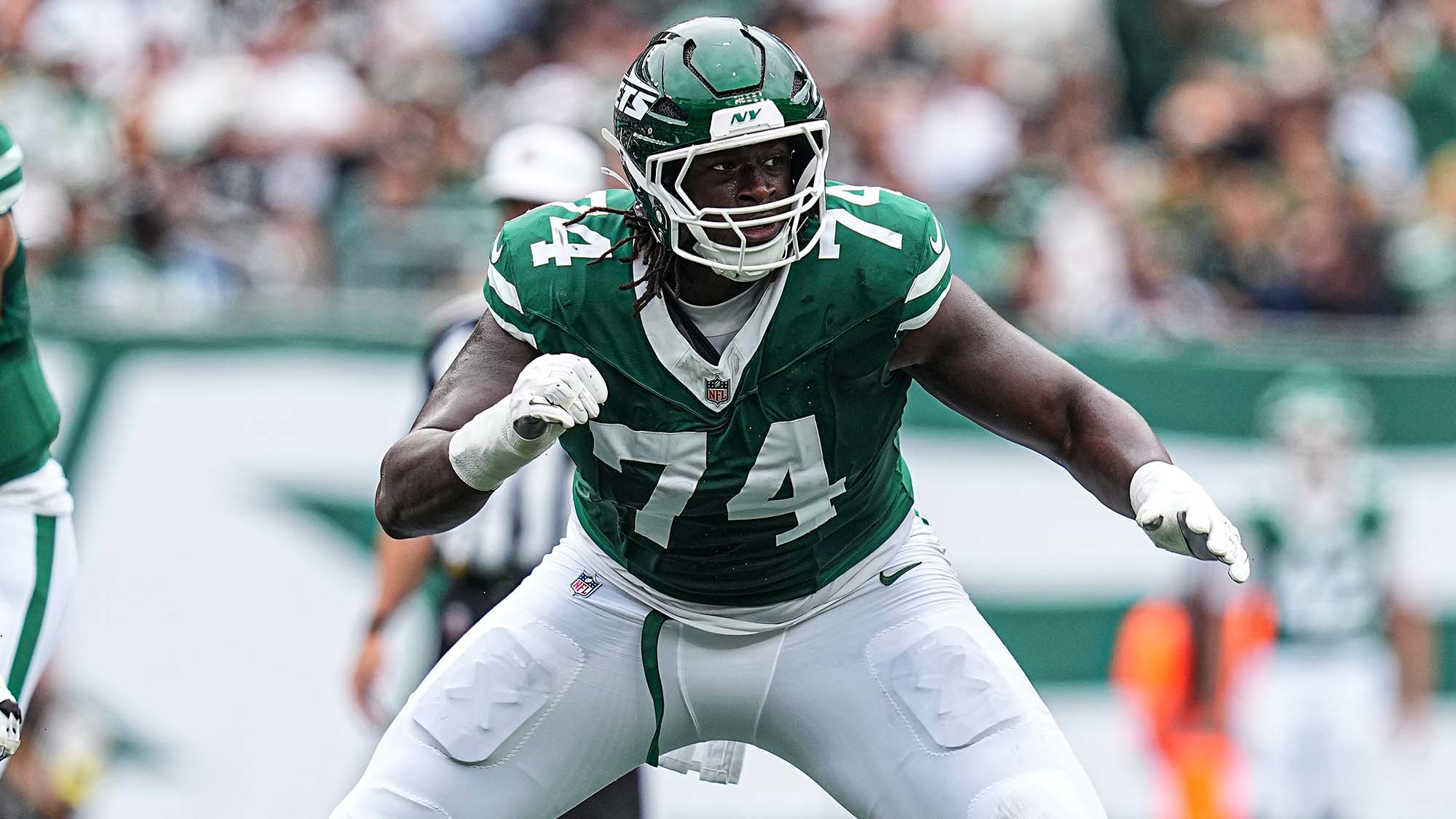
Olu Fashanu is one of the most important players on the New York Jets’ roster.
Why? It’s pretty simple: He plays left tackle, one of the most critical positions in football. Plus, as a 2024 first-round pick, Fashanu has the potential to be among the league’s best players at said critical position—for years to come.
If Fashanu can fulfill that potential, it means the Jets are already set with a long-term answer at one of the most important offensive positions. It would be a tremendous boon as they prepare for a roster overhaul.
Loaded with assets to rebuild the core of the team, the Jets will be able to allocate even more resources toward premium positions like quarterback, wide receiver, and edge rusher if they don’t have to worry about left tackle.
If Fashanu flops, though, it adds one more premium position that New York has to worry about, making it tougher to address other positions on the team.
That’s why Fashanu’s in-season development during the 2025 season is so vital to the Jets’ future.
It hasn’t been the smoothest ride, but the second-year man is trending in the right direction. His progress is exemplified by one particular metric that surely has the Jets feeling ecstatic about their young blocker.
Olu Fashanu’s upward trajectory
Following his rookie year, Fashanu was well on his way to establishing himself as the Jets’ long-term solution at left tackle.
Due to injuries across the Jets’ offensive line, the Penn State product was forced to bounce around at the start of his rookie year. Fashanu played right tackle and even right guard before he finally got to settle in at his natural position.
Once he did, though, Fashanu displayed the tantalizing upside that made him the 11th overall pick. At just 21 years old, Fashanu immediately looked like a quality NFL blindside protector. Across 230 pass-blocking snaps at left tackle, Fashanu coughed up just 12 total pressures, a better-than-average pressure rate of 5.2%. He only yielded one sack.
Having already set a high floor in his debut season, expectations were high for Fashanu entering his sophomore campaign. Unfortunately, though, things did not start as hoped.
Through five starts, Fashanu had allowed 18 pressures on 203 pass-blocking snaps. His pressure rate of 8.8% ranked 28th out of 33 qualified left tackles.
Things weren’t looking good. If Fashanu continued that level of play for the entire season, his status as the franchise left tackle would be in doubt entering the 2026 offseason.
But since his rough start, Fashanu has flipped the script.
Across his last four starts, Fashanu has allowed just five pressures on 132 pass-blocking snaps. Thus, you get the stat that must have Darren Mougey feeling confident that his left tackle of the future is already in green: Since Week 6, Fashanu has yielded a pressure rate of just 3.8%, ranking fourth-best among 32 qualified left tackles.
Lowest pressure rate allowed among left tackles (Weeks 6-10, 2025):
- Garett Bolles, DEN (2.0%)
- Taylor Decker, DET (2.8%)
- Patrick Paul, MIA (3.4%)
- Olu Fashanu, NYJ (3.8%)
- Laremy Tunsil, WAS (3.9%)
- Ronnie Stanley, BAL (4.1%)
- Jake Matthews, ATL (4.5%)
- Andrew Thomas, NYG (4.6%)
That’s some elite company for Fashanu. Six of the other seven players on that list have earned Pro Bowl and/or All-Pro recognition in their careers.
Making the production even more impressive is that Fashanu has to block for Justin Fields, who averages a higher time-to-throw (3.08 seconds) than the quarterbacks for six of the other seven tackles on the list, save for Andrew Thomas, who has to block for the young Jaxson Dart (3.09).
This is the caliber of player Joe Douglas thought he was getting when he chose Fashanu over tight end Brock Bowers and other appealing prospects in the 2024 draft.
Mougey may not have selected Fashanu, but the 22-year-old is one of the most intriguing young prospects inherited from the previous regime. If Fashanu continues building on the top-four pass protection he has provided over the last four games, Mougey will gladly commit to him as the Jets’ left tackle of the future.
The trade deadline showed that Mougey isn’t beholden to any holdovers from the Douglas era, regardless of their productivity. However, Fashanu is an offensive player on just the second year of his rookie contract. Sauce Gardner, Quinnen Williams, and Michael Carter II were defensive veterans on lucrative deals. They didn’t align with the team’s long-term vision, which is centered on acquiring a franchise quarterback and building an elite offense around him.
Fashanu can be a core piece of that vision.
Few things can make a rookie quarterback’s life easier than a dominant pass-blocking left tackle. At his recent level of play, Fashanu is displaying the potential to be the type of blindside protector who can make life glorious for a young signal-caller.
Just look at some of the other names alongside Fashanu on the list above. Many of them helped facilitate promising rookie seasons at the quarterback position: Garett Bolles for Bo Nix, Laremy Tunsil for C.J. Stroud, Ronnie Stanley for Lamar Jackson, and Andrew Thomas for Jaxson Dart.
There is a lot at stake for the Jets over the final eight games of 2025. This year’s playoffs are off the table, but the team’s chances of making future playoff runs will depend greatly on the performance of players like Fashanu over the next eight games.
Many players on the current roster could play critical roles on the team as they pursue the 2026 playoffs and beyond. These next eight games will tell us a lot about whether they can be trusted to anchor those future playoff pursuits.
If Fashanu sustains his progress over the next eight games, the Jets will have locked down perhaps the most important supporting piece around their future young quarterback. It will also leave them with surplus assets to allocate toward other premium needs.
If Fashanu reverts to the level of play we saw over his first five games, the Jets’ future young quarterback will be at risk of entering a situation with a subpar left tackle. The Jets may also have to allocate some of their future assets toward adding a left tackle to compete with Fashanu, whether it’s in 2026 or 2027, weakening their ability to improve other positions—all because their in-house solution failed to work out.
Those who believe the remainder of the Jets’ 2025 season is “meaningless” need to think again. When the Jets eventually get back to competing for playoff position, we can trace their success (or lack thereof) back to this year’s player evaluations.
Over the next eight weeks, the pass protection of No. 74 in green is a critical storyline for the New York Jets’ long-term future. Things are trending in the right direction after a rocky start, but the youngster must prove he can sustain this type of production over an extended period.
Fashanu’s next start will be just his 17th in the NFL, including his 14th at left tackle. After starting only seven games in his first year, he’s still a rookie in terms of starting experience. It isn’t surprising that he stumbled out of the gates in his second season, as it was more like the middle of his rookie year from a games-started standpoint.
Perhaps Fashanu is turning the corner as he approaches a full season’s worth of starting experience. It would be a massive victory for the Jets’ future if that turns out to be the case.
All Jets fans should be watching Fashanu closely over the next eight games. If you can’t get invested in rooting for the team as a whole over its remaining “meaningless” games due to the lack of playoff chances, then get invested in No. 74, as he is the player most directly connected to the success of the Jets’ future franchise quarterback—you know, the man solely responsible for the franchise’s long-term hopes of competing for a championship.
That sounds pretty meaningful to me.
