

Do the New York Jets already have a playoff-caliber core of offensive players?
According to one metric, they might.
The “Big 3” of the New York Jets offense
Every Jets fan knows that wide receiver Garrett Wilson and running back Breece Hall are the engines of New York’s offense. Each player has the potential to be one of the most explosive weapons at their position if placed in the ideal environment to succeed.
What the Jets are still looking for, though, is a third weapon to complete their “Big 3”. Most championship-level teams can go three-deep with weapons who keep defensive coordinators up at night.
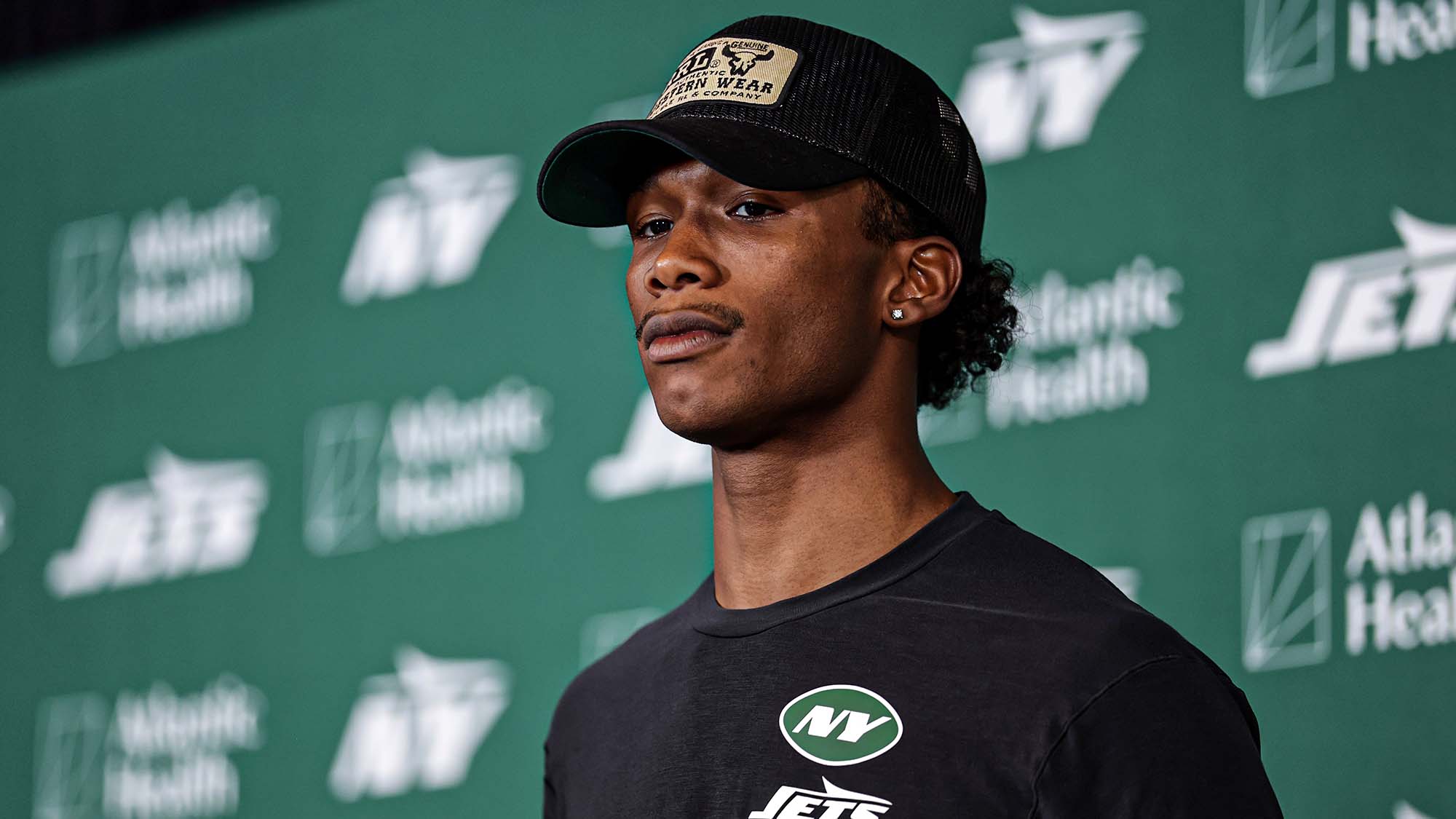
Could the Jets already have their tertiary threat in second-year tight end Mason Taylor?
As bad as the Jets’ offense performed in 2025, the unit was shockingly competent when Wilson, Hall, and Taylor shared the field. When that trio played together, the Jets displayed the consistency of a solid NFL offense.
According to RayCarp, the Jets logged 196 snaps with Wilson, Hall, and Taylor on the field. On those plays, they had an offensive success rate (percentage of plays generating positive EPA*) of 46.2%. For perspective, that would have ranked ninth-best in the NFL if accumulated by a team over a full season, right between the Colts (46.3%) and the Bears (45.8%).
*-EPA: Expected Points Added
Here is a look at the top 10 offenses in success rate (per Outside Zone) during the 2025 season, with the Jets’ Wilson/Hall/Taylor mark slotted in.
- 1. Rams (51.8%)
- 2. Bills (48.5%)
- 3. Patriots (48.4%)
- 4. 49ers (48.3%)
- 5. Packers (47.7%)
- 6. Cowboys (46.6%)
- 7. Seahawks (46.3%)
- 8. Colts (46.3%)
- Jets with Wilson/Hall/Taylor: 46.2%
- 9. Bears (45.8%)
- 10. Commanders (45.6%)
On plays with at least one of Wilson, Hall, and Taylor on the sidelines, the Jets’ success rate dropped to 39.2%. That would have ranked 30th in the NFL, slotted between their own season-long mark (40.7%) and the Raiders (37.6%).
Of course, this is a fairly small sample size. The trio only played in seven games together due to Wilson’s knee injury. Even in those games, they were only on the field together for 28 plays per game, which is less than half of your typical contest.
However, it’s not a meaningless sample, either. That’s nearly 200 plays, and the key factor in this discussion is that we are using a consistency metric rather than an efficiency metric.
If we were using something like EPA per play or yards per play, then yes, a 196-play sample could cause the metric to be inflated by a handful of big plays, masking otherwise poor play-to-play consistency. But success rate is intended to quantify an offense’s consistency at achieving the desired result on a play-to-play basis.
When evaluating a team through that lens, we can certainly glean some meaningful takeaways from a 196-play sample. There was definitely some legitimacy to the Jets’ consistency with Wilson, Hall, and Taylor on the field.
Jets fans know what Wilson and Hall bring to the table, but Taylor’s role in this electrifying trio is fascinating. He didn’t put up the flashiest numbers in 2025, finishing the year with 44 receptions for 369 yards and one touchdown; in seven games with Wilson, he had 22 catches for 181 yards and no touchdowns.
Yet, Taylor’s presence alongside Wilson and Hall made a big difference. The Jets’ consistency was not nearly the same when Wilson and Hall were paired with No. 2 tight end Jeremy Ruckert; across 92 plays with those three players on the field, New York had a 39.1% success rate.
Taylor is the game-changer here. The Jets haven’t been nearly as consistent when you isolate Wilson and Hall’s plays without Taylor. In the 2024 season (before Taylor was drafted), the Jets had a 41.3% success rate with Wilson and Hall on the field. It’s a tiny sample, but on 33 plays in 2025 with Wilson and Hall but no Taylor, the Jets had a very similar 40.9% success rate.
Toss in Taylor alongside the two stars, and the Jets suddenly shoot up to top-10 level consistency. That says a lot about the young tight end’s impact.
So, what is it about Taylor that made his presence so crucial in bringing the Jets’ offense to life?
Well, for one, his pass-catching impact goes beyond the box score. Despite his lackluster statistics on paper, Taylor was excellent at making the most of his opportunities. He finished the season with a 78.6% contested catch rate, securing 11 of his 14 contested targets, per Pro Football Focus. Only George Kittle performed better among qualified tight ends.
Taylor also made a difference as a blocker. He earned a 63.1 run blocking grade from PFF, placing him 25th among the 61 tight ends with at least 200 run blocking snaps.
A classic Y tight end who can both catch and block is a significant difference-maker for an offense. The defense has to respect him as a threat in both phases, so the offense has more options to catch the defense off guard.
If a tight end is a receiving threat but cannot block, the defense will respond by covering him with a defensive back, and the tight end won’t make the defense pay for the size downgrade in the run game. It allows the defense to match with ideal coverage skills to quiet the TE through the air without being at a disadvantage against the run. As a result, this type of TE will also tip off the defense to a high likelihood of a pass, since the offense wouldn’t trust that TE to block.
If a tight end can block but cannot catch, the defense will respond by covering him with a linebacker or a big safety, and the tight end won’t make the defense pay for the athletic downgrade in coverage. Similarly, this type of TE’s presence on the field might tip off the defense to a run, as the offense probably doesn’t want him running a key route.
Consider that, in 2025, the Jets’ run rate spiked from 28.8% with Jeremy Ruckert off the field to 50.2% when he was on. That’s a 21.4% jump, which is a ton of information to give the defense just by having one guy on the field.
Compare that to Taylor, whose presence didn’t tip off the defense nearly as much. The Jets’ run rate went from 43.9% with Taylor off to 35.8% with him on, an 8.1% difference, which isn’t stark enough to give the defense a real advantage.
Taylor made defenses respect him in both phases. That made the Jets’ offense more unpredictable, helping them optimize Wilson and Hall’s talents.
It’s also worth noting that the Wilson/Hall/Taylor combination produced such excellent consistency despite poor quarterbacking.
Sure, it is unsurprising that the Jets played better football when they had their best wide receiver, running back, and tight end on the field than when they didn’t. But it’s not as if those plays featured different quarterbacks. They still had the likes of Justin Fields under center for most of those plays. Yet, the “Big 3” didn’t just make the Jets’ offensive consistency better—it pushed it from bottom-of-the-barrel to top-10-caliber.
If this trio could produce a top-10 success rate with Fields under center, they could be even better with Geno Smith, who, at his best, is a better quarterback than Fields.
The question is, how often will we actually see this trio in 2026?
The Jets’ tight end dilemma
Despite Taylor’s impact, the Jets went out and used the 16th overall pick on a tight end, Oregon’s Kenyon Sadiq.
The surprising choice of Sadiq leaves the Jets in a strange place at tight end.
Taylor lived up to his second-round status as a rookie, performing well within his role and making a positive difference on the team’s offensive consistency. He fit in tremendously alongside the team’s two core building blocks on offense.
Yet, Taylor is now the second fiddle in the Jets’ tight end room in terms of invested capital. As a top-16 pick, Sadiq will be heavily prioritized. The Jets will do everything they can to extract value out of that selection.
This does not mean that Taylor will be tossed into the doghouse. As we’ve discussed, the Jets project to use a heavy dose of 12-personnel packages (two tight ends) this season, in response to both their roster makeup and trends around the league.
Still, as long as Sadiq is healthy, Taylor might not be able to establish himself as the fixture that he was in 2025—and deserved to be moving forward, based on his performance and impact. Taylor averaged an 81.3% snap count in his rookie year, playing well over 90% of the snaps in some games. That number will be hard to reach in games with Sadiq on the field.
Perhaps, though, the Jets essentially see Sadiq as a slot receiver, which would allow Taylor to stay in the same role. After all, Sadiq lined up as an in-line tight end on just 42.1% of his offensive snaps for the Ducks in 2025. He was in the slot on 44.4% of his snaps, while also dabbling out wide and in the backfield.
However, this would raise another question: If the Jets view Sadiq as a slot receiver, why did they choose an oversized slot receiver instead of a true slot receiver like USC’s Makai Lemon, or a player at another position? Sadiq, as talented as he is, would be a historic outlier if he succeeded as a quasi-slot receiver to a degree that justifies the 16th overall pick. There’s a reason you don’t see 245-pounders (even those with close to as much athleticism as Sadiq) playing in the slot: they’re just too big to be successful there in a full-time role.
The reality is that the Jets drafted Sadiq to play tight end. He is not going to be a “big slot receiver”. Yes, he will line up in the slot quite frequently, perhaps at one of the highest rates for the position. But he will still be a tight end. That is the position where he can provide a matchup advantage.
This means he’s going to step on Taylor’s toes at least a little bit, which is something of a shame given how good the Jets looked when they had him on the field with Garrett Wilson and Breece Hall.
Suffice to say, the revelation of Taylor’s impact on the Jets’ offense in 2025 only raises Sadiq’s expectations a little bit higher. The bar for a tight end chosen 16th overall is already quite high, but when you consider that he is entering a room where a very solid, 21-year-old, second-round rookie already acquitted himself as a building block last year, it isn’t a stretch to say that Sadiq must become a Pro Bowler to justify his selection.
Sadiq certainly has the potential to do that. He might be the most athletic tight end to ever play the game.
But the Jets took a big risk by taking him 16th overall when considering the rawness in his fundamentals. He needs development to make the most of his physical traits.
Because of his developmental nature as a prospect, choosing Sadiq with the 16th pick is already dicey in a vacuum. When you throw in Taylor’s presence on the team, it becomes a roster-construction dilemma.
After already using a second-round pick on Taylor last year, and seemingly getting their investment’s worth, is there a world where the Jets can get their investment’s worth on both Taylor and Sadiq over the long haul? Can two tight ends really generate the cumulative impact of the 16th and 42nd picks on an annual basis? There is a risk that either Taylor’s value will be handcuffed to make room for Sadiq or vice versa.
Having too much talent is usually a good problem to have, but for a rebuilding Jets team that won three games last year, it is imperative to make the most of every draft pick. In that regard, choosing Sadiq after witnessing Taylor’s impact in 2025 was a risky move.
The promising news, though, is that the Jets seem to have a “dude” in Mason Taylor. His presence elevated the team in 2025, particularly when he played alongside the Jets’ two best offensive players. It’s not hard to picture Wilson, Hall, and Taylor anchoring a playoff-caliber offense, especially with a solid offensive line and a veteran quarterback who has played winning football when surrounded by a competent supporting cast.
The concern is whether the Jets might not weaponize their budding Big 3 as much as they should.
In his first season as an NFL coach in three years, 64-year-old Frank Reich has an extremely challenging tight end dilemma on his hands. He will have to juggle putting the best team on the field with justifying the capital that New York invested in Sadiq, whose development will be even further stunted by a setback in his sports hernia recovery that might keep him out for the entire preseason.
If Sadiq develops as hoped and Reich can come up with creative solutions, the Jets might not have any problems at all. Sadiq and Taylor are different players and can frequently play together. Plus, if Sadiq becomes the star New York thinks he can be, the Jets might not miss the Wilson/Hall/Taylor reps that get converted to Wilson/Hall/Sadiq reps; Sadiq’s presence could make a similar or better impact.
It all comes down to Sadiq’s development and Reich’s ability to optimize his players.
Whatever happens, though, the Jets should be thrilled about how their offense looked with the Wilson/Hall/Taylor trio on the field in 2025, and they would be wise to tap into it as much as they can.
