
Ah, we meet again.
It’s not even Thanksgiving yet, and here we are, already talking about the ideal offseason plan for the New York Jets. Somehow, this franchise always pulls fans and analysts into draft mode long before the holidays.
So, let’s not waste any more time. It’s officially mock-offseason season, even if the calendar hasn’t flipped to December.
Just to be clear, this isn’t a prediction. This is simply what I think the Jets should do.
Coaching staff changes
- Jets fire defensive coordinator Steve Wilks
While the Jets’ defensive issues aren’t entirely on Steve Wilks, as he hasn’t had ideal personnel, it’s still becoming clear the team needs a change at defensive coordinator.
It goes beyond the numbers of the unit (as those can be chalked up to talent). Wilks has consistently displayed schematic stubbornness throughout the season. The main issue is that he continues to rely heavily on man coverage in third-down situations, making the Jets predictable, and opposing offenses are taking advantage of it.
At this point, the Jets simply have to make a change at DC. Regardless of the unit’s talent level, there is no excuse for the defense to be so predictable and easy to scheme against. You can’t hang your players out to dry by refusing to adjust, especially in a league where offenses live off identifying tendencies.
While the Jets are clearly in a rebuilding year, some form of accountability must take place after the type of season they’ve had. It is worth noting that after his 3-13-1 debut season in 2021, Lions head coach Dan Campbell fired offensive coordinator Anthony Lynn. The switch from Lynn to Ben Johnson ignited Detroit’s offensive turnaround in the coming years.
A fresher voice could unlock the Jets’ young talent defensively.
- Jets hire Jim Leonhard as defensive coordinator
Leonhard started 40 games for the Jets from 2009-11, and knows what it takes to succeed defensively in the New York market.
After hanging up his cleats, Leonhard jumped straight into coaching and took off fast. Wisconsin brought him in as their defensive backs coach in 2016, and he impressed so much that they handed him the entire defense a year later. Over the next six seasons, his defenses were consistently among the toughest and most disciplined in the country.
Throughout Leonhard’s six-year tenure as Wisconsin’s DC, the Badgers allowed the fewest points per game among FBS programs (17.9).
He even got a taste of being a college head coach. Wisconsin fired Paul Chryst in 2022 and made Leonhard the interim head coach. The former Jet did a solid job, leading the Badgers to a closing 4-3 record, while giving the program some hope moving forward.
In 2024, Leonhard jumped back to the NFL, joining Sean Payton’s staff in Denver as the defensive pass-game coordinator and DBs coach under defensive coordinator Vance Joseph. Once again, he made an immediate impact. Denver suddenly became brutal to throw against, finishing third in pass-defense DVOA, and the Broncos currently rank fourth in that same metric this season.
Leonhard brings familiarity with the Jets organization and proven success in the modern-day NFL.
NY Jets film breakdown: Could John Metchie be a keeper?- Jets fire quarterbacks coach Charles London
The Jets’ decision to hire Charles London as their quarterbacks coach never really added up. There was no previous connection to head coach Aaron Glenn, and London’s background didn’t exactly scream “QB whisperer.” He played running back, built most of his coaching resume as a running backs coach, and only shuffled into quarterback rooms later on, with mixed results at every stop.
In Atlanta, his two-year run as the Falcons’ quarterbacks coach didn’t move the needle. Desmond Ridder struggled to develop, and the offense never showed signs of consistent growth. London then returned to Tennessee in 2023, where Will Levis had a rocky rookie year and showed many of the same issues he entered the league with.
After that, Seattle brought him in as part of Mike Macdonald’s first staff, and he worked with Geno Smith during a bounce-back stretch.
When you look at London’s track record, RB background, uneven quarterback development, and no real ties to Glenn, the hire never really made any sense. The results since then haven’t done much to change that perception.
- Jets hire David Blough as quarterbacks coach
David Blough is still young by coaching standards, just 30 years old, and not far removed from his own playing days. From 2019 to 2023, he bounced around the league as a depth quarterback after coming out of Purdue undrafted. He had stops in Cleveland, Detroit, Minnesota, and Arizona, with his longest stretch coming in Detroit, where he spent two seasons crossing paths with Aaron Glenn.
The 2024 season marked Blough’s first real step into coaching, and he landed in a pretty intriguing situation. Washington brought him in as an assistant quarterbacks coach on Dan Quinn’s new staff, pairing him with Tavita Pritchard and giving him a chance to work under offensive coordinator Kliff Kingsbury.
Together, they were tasked with helping develop Jayden Daniels, and Daniels delivered one of the best rookie quarterback seasons the league has seen in years, pushing Washington all the way to the NFC championship game.
With the Jets expected to draft and develop a rookie selected high in this year’s NFL draft, Blough is the perfect fit to help develop that signal-caller, given his success with Daniels in Washington.
Options/extensions
- Jets pick up Will McDonald’s fifth-year option
This one’s simple: the Jets are picking up Will McDonald’s fifth-year option. He’s not a finished product, but the talent pops every time he’s on the field. You don’t throw away a pass rusher with that kind of juice, especially when the price tag is still team-friendly and doesn’t affect this offseason’s cap space.
- Jets do not extend Jermaine Johnson
Jermaine Johnson’s situation is a little different. He is a productive edge rusher, but not at the top-tier extension level yet. So, instead of forcing an extension, the Jets let him play out his option year and see where he goes from here.
If Johnson takes that leap? Awesome. Pay him next offseason and feel great about it. If not, the Jets kept their flexibility and didn’t rush into a deal they weren’t fully sold on.
Cuts/restructures
Ahead of roster cuts and restructured deals, the Jets hold $99.2 million in cap space.
Cuts:
- QB Justin Fields (Post-June 1: $10M savings in 2026, $13M dead money in 2026, $9M dead money in 2027)
With the amount of cap space the Jets have, this really isn’t a “clean house” offseason. They don’t need to gut the roster or make a surplus of cuts to create an ample amount of cap space to restructure the roster.
The one exception is Justin Fields. While the Jets have to eat $22 million in dead money to let him go, it’s a move they have to make. The experiment didn’t work. It happens. Sometimes a contract turns out worse than you thought, sometimes a fit just isn’t a fit.
Admit it, take the hit, and move on. The longer the Jets drag this out, the harder it becomes to build a real plan at quarterback.
The Jets opt for a post-June 1 cut with Fields to open more cap space in 2026 and push some of his dead money back to 2027.
- Cap space post cuts: $109.2 million
Re-signings
- DL Jowon Briggs (ERFA tender – $885K cap hit)
- WR John Metchie III (ROFR tender – $3.4M cap hit)
- RB Breece Hall (Transition tag – $11.4M cap hit)
- K Nick Folk (1 year, $3M – $3M cap hit)
- OL Alijah Vera-Tucker (1 year, $5M – $5M cap hit)
- OL Josh Myers (1 year, $4M – $4M cap hit)
- WR Tyler Johnson (1 year, $2.5M – $2.5M cap hit)
- TE Jeremy Ruckert (3 years, $8.5M – $3M cap hit)
- RB/ST Kene Nwangwu (2 years, $4.8M – $2.3M cap hit)
Instead of locking in a long-term deal right now, the Jets slap the transition tag on Breece Hall. It buys them one more year to figure out whether they should commit big money to a running back, and with how unpredictable that position is, it’s the safest move.
Alijah Vera-Tucker gets a one-year, prove-it contract after missing all of 2025. It’s a team-friendly, low-risk deal, and if he stays healthy and bounces back the way everyone hopes, both sides win.
Jeremy Ruckert, meanwhile, earns his payday. After a much-needed bounce-back season, the Jets reward him with a three-year extension. On special teams, Kene Nwangwu gets paid like the top-tier returner that he is.
Josh Myers returns as depth on the offensive line, Tyler Johnson sticks around as an end of the depth chart wideout option, and both Jowon Briggs and John Metchie III showed enough promise for the Jets to keep them on team-friendly tenders.
- Post re-signings: $73.7M left in cap space
Free agency
- G Daniel Faalele (1 year, $3.5M, $3M cap hit)
- DE Arnold Ebiketie (2 years, $8.5M, $5M cap hit)
- LB Alex Anzalone (2 years, $14M, $8M cap hit)
- S Geno Stone (1 year, $6.5M, $6.5M cap hit)
- QB Marcus Mariota (1 year, $9M, $9M cap hit)
With Alijah Vera-Tucker’s health and 2026 production anything but guaranteed, and after letting John Simpson walk in free agency, the Jets make a stabilizing move by adding guard Daniel Faalele to compete with Vera-Tucker.
On defense, the need for help on the edge is obvious. Enter Arnold Ebiketie. The former third-round pick brings sure-fire tackling on the perimeter and just enough pass-rush upside to make you believe there’s still another level in him. He’s not a superstar, but he’s a real, useful defensive presence, something this unit has desperately lacked on the outside.
The headline signing, though, is Alex Anzalone. After losing Quincy Williams, the Jets needed a tone-setter at linebacker, and Anzalone fits that mold perfectly. He’s one of the league’s most consistent, sideline-to-sideline hitters and steps in as an immediate defensive leader next to Jamien Sherwood. He also played for Aaron Glenn in Detroit and has spoken glowingly about him, which makes this reunion feel both natural and necessary.
Because the Jets can’t go into another season with an unproven safety group, they add a little stability on the back end. Enter 26-year-old Geno Stone, who gives them a proven, reliable presence in a room that badly needed one.
New York will add veteran signal-caller Marcus Mariota to help mentor their young quarterback and potentially compete for the team’s starting role over the summer.
- Post free-agency additions: $42.2M remaining in cap space
NFL Draft
- Round 1, Pick 5: Ty Simpson, QB, Alabama
- Round 1, Pick 28: Denzel Boston, WR, Washington
- Round 2, Pick 37: Keith Abney II, CB, Arizona State
- Round 2, Pick 44: Matayo Uiagalelei, EDGE, Oregon
- Round 4, Pick 105: Drew Allar, QB, Penn State
- Round 4, Pick 139: Jalen Stroman, S, Notre Dame
- Round 6, Pick 204: Zxavian Harris, DT, Ole Miss
- Round 6, Pick 210: Bryce Boettcher, LB, Oregon
- Round 7, Pick 214: Parker Brailsford, C, Alabama
- Round 7, Pick 251: Peyton Bowen, S, Oklahoma
- Round 7, Pick 253: Riley Mahlman, T, Wisconsin
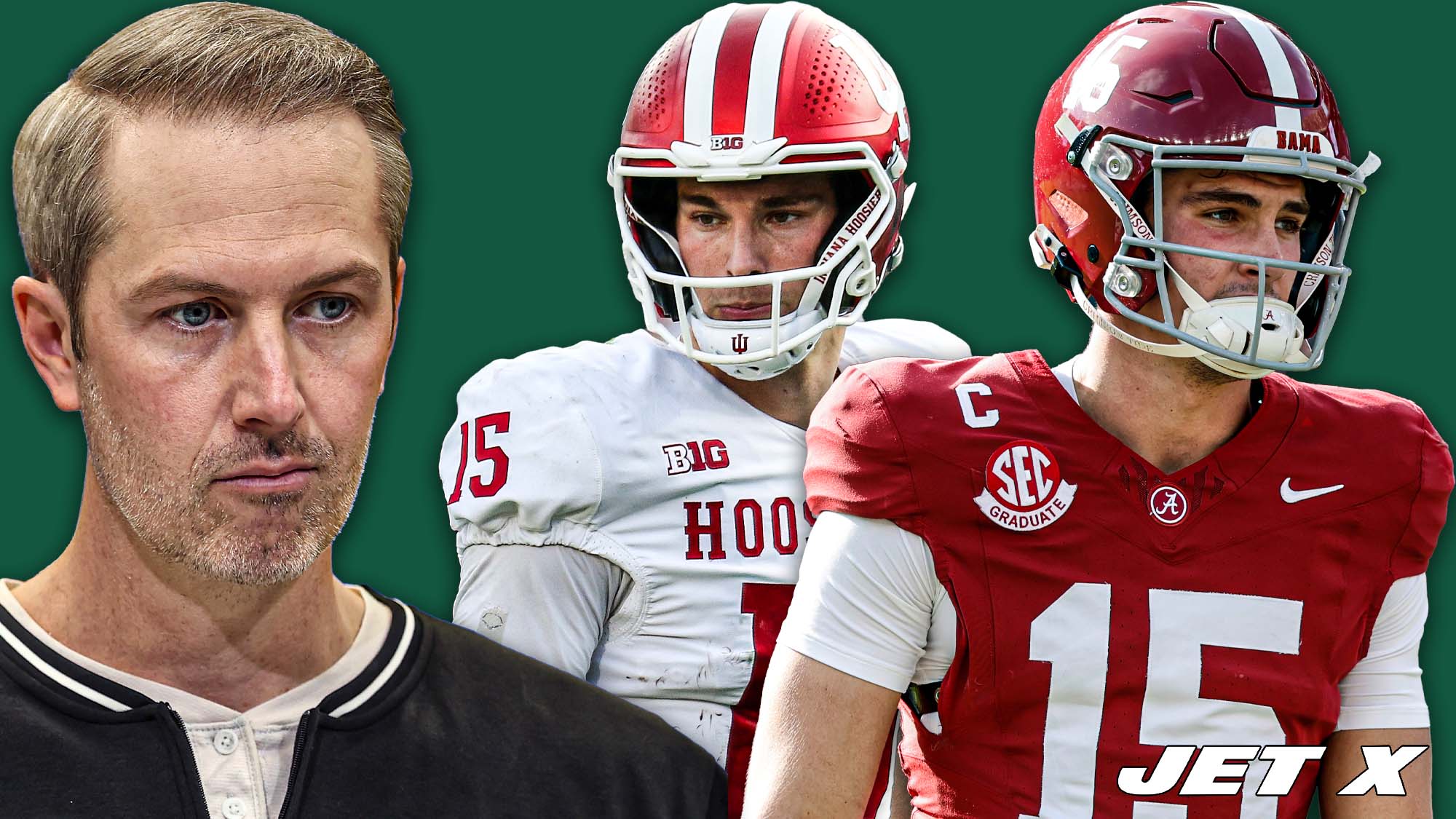
With Indiana quarterback Fernando Mendoza already off the board, the Jets select Alabama’s Ty Simpson with their top pick, committing to him as their “guy”.
Later in the first round, holding the No. 28 selection they picked up in the Sauce Gardner deal with the Indianapolis Colts, the Jets turn to Washington wideout Denzel Boston. It’s hard not to fall in love with the fit.
Boston checks every box you want in a modern NFL receiver. At 6-foot-4 and 209 pounds, he plays exactly how a guy his size should, but with the finesse of someone built much smaller. His 66.7% contested-catch rate this season jumps off the page, but the tape is even better. Add in a massive catch radius, strong hands, and elite hand-eye coordination, and you start to see why the Jets view him as a foundational piece.
Defensively, Abney arrives ready to battle AZ Thomas for a starting role in the secondary, while Uiagalelei projects as an instant-impact rotational edge rusher, someone who can eat snaps early and grow into something more.
Then comes the swing: New York doubles up at quarterback and grabs Penn State’s Drew Allar in the fourth round. Before his injury, Allar wasn’t just a first-round projection; he was in the conversation to be the first quarterback taken. His stock plummeted due to a season-ending ankle injury.
And when you’re sitting there with an extra fourth-round pick in your pocket, why wouldn’t you take that swing?
Allar brings the prototypical build, the NFL-level arm, and the raw tools teams spend years trying to develop. If he hits, the Jets walk away with one of the steals of the draft. If he doesn’t, you spent a Day 3 pick trying to get solid value at a position that hasn’t been secure in more than a decade.
