
To tank or not to tank: that is the question.
Once again, this age-old philosophical debate is the talk of the town among Jets fans these days. There is no correct answer, as fair arguments can be made for either side.
However, it is essential to acknowledge that one key statement holds great significance, regardless of your viewpoint on the issue: winning games in the NFL is challenging without a strong quarterback.
Unfortunately, this challenge has been a persistent problem for the New York Jets, who are currently enduring a 14-year playoff drought.
The Jets find themselves in a real predicament. Despite having only three wins this season, the team is currently positioned to select seventh in the upcoming draft (with five weeks left to play). If the Jets’ draft position does not improve, they could very well miss out on the top three prospects in the 2026 quarterback class: Fernando Mendoza, Dante Moore, and Ty Simpson.
Enter stage left: Darren Mougey and Aaron Glenn, the dynamic duo who were hand-picked to lead the effort to change the Jets’ losing ways.
Given that the Jets own five first-round picks and three second-round picks over the next two drafts, will Mougey and Glenn trade up to secure their desired player?
Maybe. If they have their hearts set on one of the three QBs listed above and the Jets win another game or two, they will have to dip into some of that precious capital.
That will surely drive “Team Tank” mad.
So, let’s walk together for a minute in the shoes of all the “Anti-Tankers.”
Let’s stand on ten toes that any win for this team in 2025 matters. Wins take the stink of the past 14 years out of One Jets Drive; these coaches and this young team need to learn how to win.
So, the million-dollar question is: What would the QB options look like if the Jets miss on the top tier of prospects?
Let’s take a look at two under-the-radar draft prospects who we know will be coming out and could be sneaky finds after the first round.
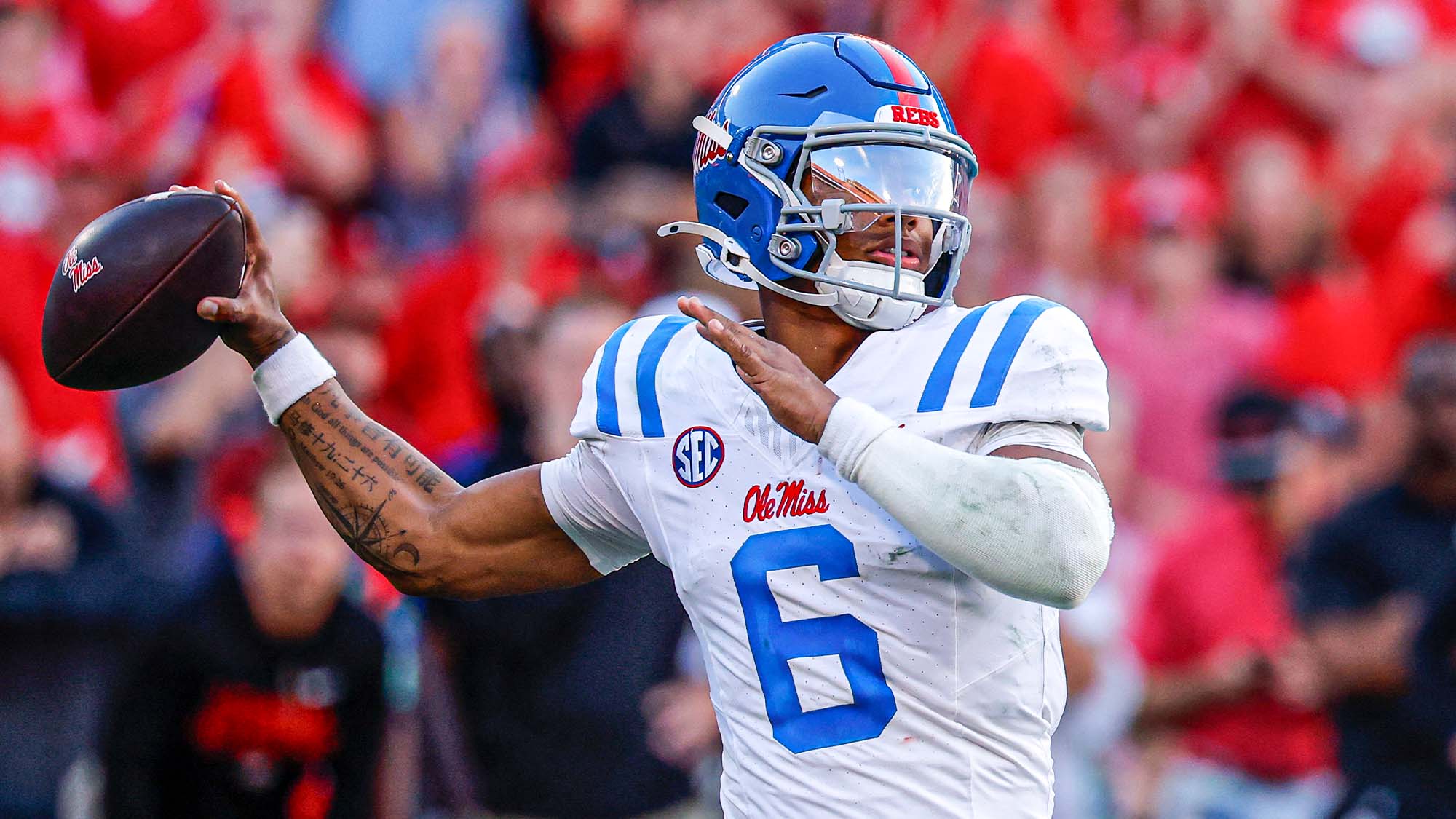
Trinidad Chambliss, Ole Miss
Chambliss, who transferred from Division II Ferris State, where he was named a D-II All-American in 2024, has adjusted to life as a Power-4 quarterback with remarkable ease.
As the leader of Lane Kiffin’s offense, Chambliss has helped propel Ole Miss to a No. 6 ranking and a secure spot in the College Football Playoff. Chambliss has a strong arm and is capable of making all the throws, both inside and outside the numbers, to the tune of almost 3,100 yards passing, 18 touchdowns, and three interceptions.
Chambliss is at his best when his athleticism and improvisational abilities are allowed to shine. Chambliss moves well on designed QB runs, can break tackles, and extends plays outside structure despite being only 6-foot-1 and roughly 205 pounds. He is strong and tough to bring down, and although not a true burner, his running ability is powerful and decisive. Chambliss has added 470 yards and six TDs on the ground this season.
There are some questions revolving around the rawness of his game. For one, Chambliss plays almost exclusively from the gun, so his footwork in the dropback game is super raw. He also needs to show improvements in full-field progression and processing speed, one of the most noticeable disadvantages of transitioning from Ferris State to the SEC.
With a good, young offensive staff led by Tanner Engstrand and Aaron Glenn’s admitted love for QBs that can hurt you with both their arms and their legs, Chambliss and the Jets may be a match made in heaven.
Cole Payton, North Dakota State
Payton, a redshirt senior, is the newest and latest FCS player to barnstorm the draft boards everywhere. Standing over 6-foot-3 and weighing 235 pounds, Payton is hard to miss.
Speaking of missing, Cole doesn’t do that much on the football field. In his first season as the NDSU Bison starter, Payton has completed almost 75% of his passes for over 2,600 yards and 15 touchdowns.
So far in 2025, he has shown more than sufficient arm talent and above-average arm strength. Payton can generate velocity on out-breaking NFL throws and shows clean RPM on intermediate shots. He’s not a pure “big arm” guy, but his arm talent is comfortably NFL-caliber. The Bison signal-caller has solid accuracy between the numbers and on rhythm throws, especially in play-action concepts.
His athletic profile has been his calling card to success in 2025. He epitomizes what a dual-threat QB is; he can extend plays, create explosive plays with his legs, and can throw off-platform almost as well as when he is in structure. Payton sure does have some early-year Josh Allen-like qualities in his game.
As a 23-year-old with only a dozen starts at the FCS level under his belt, he is far from a finished product. There very well could be an adjustment period for Payton (see Trey Lance).
NDSU definitely plays to Payton’s strengths and liabilities. He is not asked to be a high-level full-field operator, which plays a part in some of the timing and anticipation throws he struggles with; he’s just a bit late at times. The transition from running an almost exclusive RPO-based offense to learning a pro-style offense may take time.
Still, the running capabilities Payton possesses can help mitigate some of those risks until it all comes together (see Josh Allen or Lamar Jackson).
Jets have plenty to think about as tank dreams slip away
Are Trinidad Chambliss and Cole Payton the only worthwhile options after the “Big 3”? No, they are not.
However, if you consider the skill set that head coach Aaron Glenn seems to favor, these two players check most of the boxes: strong arms, strong build, physicality, and the ability to affect the game with their legs.
With five games left in the regular season, we will soon find out where the Jets land in the 2026 draft order and which QBs they could have a chance to target. In the years to come, we’ll see if it was the Tankers or the Anti-Tankers who ultimately win out.
