

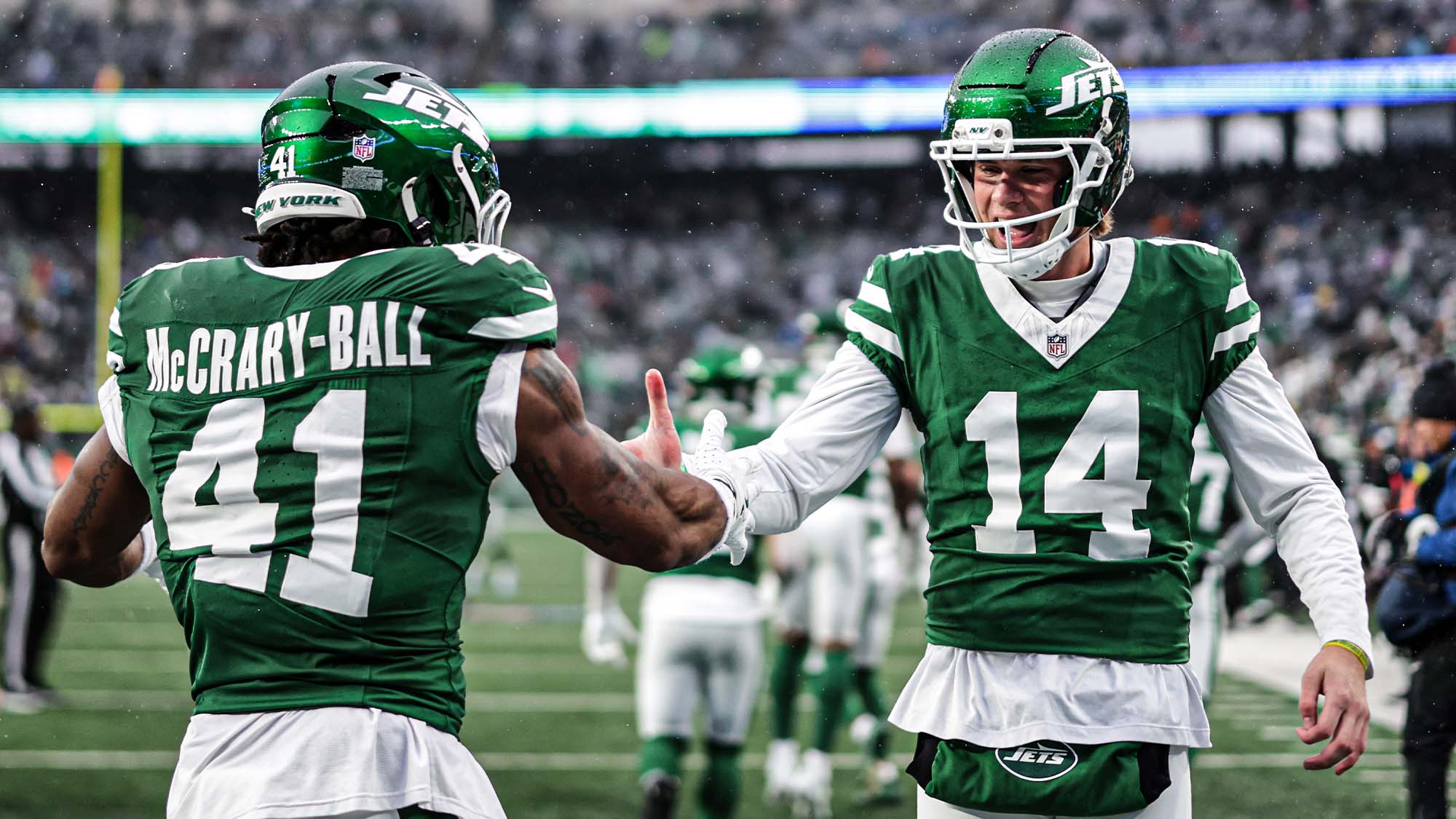
The New York Jets’ special teams isn’t just special—it’s the best in the NFL.
The gushing shall not stop there, though. This unit isn’t just the best in the NFL today—it’s on track to go down as one of the best in the history of professional football.
Yes, really.
The Jets are closing in on special teams immortality
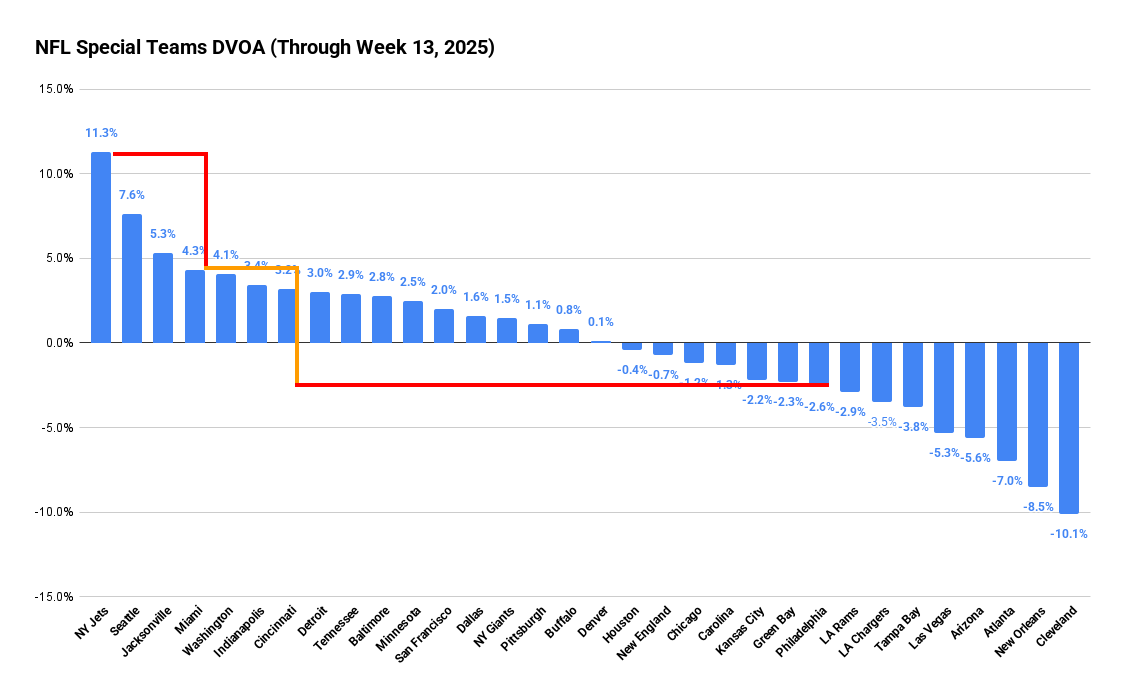
Based on the DVOA metric (courtesy of FTN Fantasy, formerly of Football Outsiders), an all-encompassing measure of efficiency, the Jets have the best special teams unit in the NFL so far this season. They boast a special teams DVOA of 11.3%.
Essentially, this means that on the average special teams play, the Jets are 11.3% more efficient than the league-average team. It adds up to incredible value over hundreds of plays across the season.
Not only are the Jets ranked first in that category, but they are in their own stratosphere. Nobody is touching them.
The second-ranked special teams DVOA belongs to the Seattle Seahawks at 7.6%. The gap between Seattle and first-ranked New York is 3.7%, larger than the one between Seattle and the fifth-ranked Commanders, who have a 4.1% DVOA.
If you go down to the fourth-ranked Miami Dolphins, you’ll find a special teams DVOA of 4.3%, separating them by 7% from the league-leading Jets. That’s a larger gap than the one between Miami and the 24th-ranked Philadelphia Eagles (-2.5%).
This caliber of dominance has the Jets on a historic trajectory.
A special teams DVOA of 11.3% would be the third-best single-season mark in NFL history. The record is held by the 2002 Saints, and it is within striking distance for the Jets: 11.8%.
These are the most impressive special teams units in NFL history based on DVOA (since 1978).
- 2002 New Orleans Saints (11.8%)
- 1985 Los Angeles Rams (11.5%)
- 2007 Chicago Bears (11.2%)
- 1994 Cleveland Browns (10.4%)
- 1986 New York Jets (9.9%)
- 1979 Philadelphia Eagles (9.8%)
- 2009 Cleveland Browns (9.7%)
- 1997 Dallas Cowboys (9.4%)
- 1996 Carolina Panthers (9.3%)
- 1986 New Orleans Saints (9.3%)
Only 0.5% back from tying the NFL record and 0.6% from breaking it, the Jets have a chance to do something remarkable.
How can they close the gap over the final five weeks of the regular season?
Let’s dive in.
How the Jets can break the special teams DVOA record
First and foremost, it’s important to understand that DVOA is an efficiency-based metric. Their 11.3% mark is calculated based on their average performance across each special teams play over their first 12 games. So, it is not as if they are on pace to fly past New Orleans’ record since there are five games to spare.
This means that, to finish the season with a special teams DVOA above 11.8%, the Jets must perform well enough over the next five games to drag their season-long average of 11.3% up a few more ticks.
In simpler terms, they need to be even better over the rest of the season than they have so far.
Here are the keys to pulling it off.
Kick return, Nick Folk, and Austin McNamara must keep doing what they’re doing
Out of the five core special teams phases, the Jets’ excellence is anchored by three phases in particular: punting, kick returns, and placekicking. Based on DVOA, the Jets rank first in all three of these phases.
If they are going to push for the all-time record, they need these three units to stay the course.
That means Nick Folk, who just missed his first kick of the season last week (from 55 yards out), must stay near-perfect. It means Austin McNamara, who has the second-best average hang time in the NFL (4.75 seconds), must keep launching bombs, and his gunners, who are allowing just 5.6 yards per return on his punts, must keep dominating.
It also means that the kick return duo of Kene Nwangwu and Isaiah Williams must keep chugging along. For the Jets, the exciting aspect of this pursuit is that opponents are running out of options to stop them.
Since Nwangwu scored on a kick return in Week 10, bringing his career total to five kick return touchdowns (most among active players), opponents have begun kicking away from him. Over his last two games, Nwangwu returned just one kick. Yet, Williams made the Jets’ opponents pay for targeting him, averaging 41.0 yards across five kick returns and taking all five to at least the 33-yard line.
For the Jets, scoring at least one more kick return touchdown over the final five games would do wonders for the team’s special teams DVOA. Even if they don’t get it, though, the Jets can stay within striking distance as long as their kick return unit continues generating positive field position on a routine basis.
On top of sustaining their league-leading excellence in these three phases, the Jets must strive to get even better in the other two phases.
Punt return and kickoff units can take a leap forward
The Jets have been excellent in all five phases of special teams, which is the most impressive feather in Chris Banjo’s cap. It’s one thing to have a great special teams DVOA thanks to one or two Pro Bowlers or a handful of fluke plays, but when every facet of the unit is clicking, it speaks to how well the group is coached.
There is no true “weakness” in this unit. However, to achieve the lofty goal of becoming the best unit in history, the standards are incredibly high. That means the Jets need two of their special teams phases to catch up to the Big Three.
New York ranks sixth in punt return DVOA and 10th in kickoff DVOA. These are the two phases where the Jets have the most room to improve as they strive to get their overall special teams production over the all-time hump.
When it comes to punt returns, the Jets are ninth-best in the league with 12.3 yards per punt return. Their best moment was a 74-yard punt return touchdown by Isaiah Williams in Week 10, but outside of that play, the Jets are averaging 10.1 yards per punt return, which is slightly below the NFL average (10.6). More consistency from this unit would be helpful.
To claim the all-time throne, though, game-breaking plays are necessary. If the Jets can manage to break out one more punt return touchdown, it could be enough for them to get ahead of the 2002 Saints, as long as the other phases maintain their current production.
As for kickoffs, the Jets have room to improve, as they only rank 15th-best in the league with 25.9 yards allowed per kick return. This group can certainly catch up to the dominance of the punt coverage group.
The good news for the Jets is that they’re trending in the right direction. This group was inefficient in the first half of the season while Nick Folk was kicking off; Folk’s kickoffs yielded an average starting field position of the 35.3-yard line, which is still the worst mark in the NFL. He launched six touchbacks on 29 attempts and averaged a league-low 55.7 yards per kickoff, leading to strong starts for opponents.
However, since Week 10, Austin McNamara has taken over kickoffs, and the production has flipped.
McNamara’s kickoffs have yielded the fifth-best average starting field position this season (28.6-yard line). With only three touchbacks on 27 attempts and an average kick distance of 61.1 yards, McNamara has been precise at landing his kickoffs in that money area just outside of the end zone, helping maximize the Jets’ field position. If McNamara keeps this up, the Jets are on a trajectory to continue climbing in kickoff DVOA.
History (the right kind) is within striking distance for the Jets
Simply put, if the Jets’ special teams unit continues generating game-changing plays while preventing opponents from doing the same, there is a realistic chance they could finish the 2025 season ranked first all-time in the most widely utilized metric for rating special teams units.
It would go a long way in proving that Aaron Glenn’s cultural overhaul is trending in the right direction. Banjo was Glenn’s hire, so the unit’s success can ultimately be traced back to Glenn. Not to mention, special teams units are mainly comprised of players at the bottom of the roster. When there’s buy-in all the way down to the 53rd man on the team, it speaks volumes about the culture in place.
Let’s see if the Jets can make history.
