
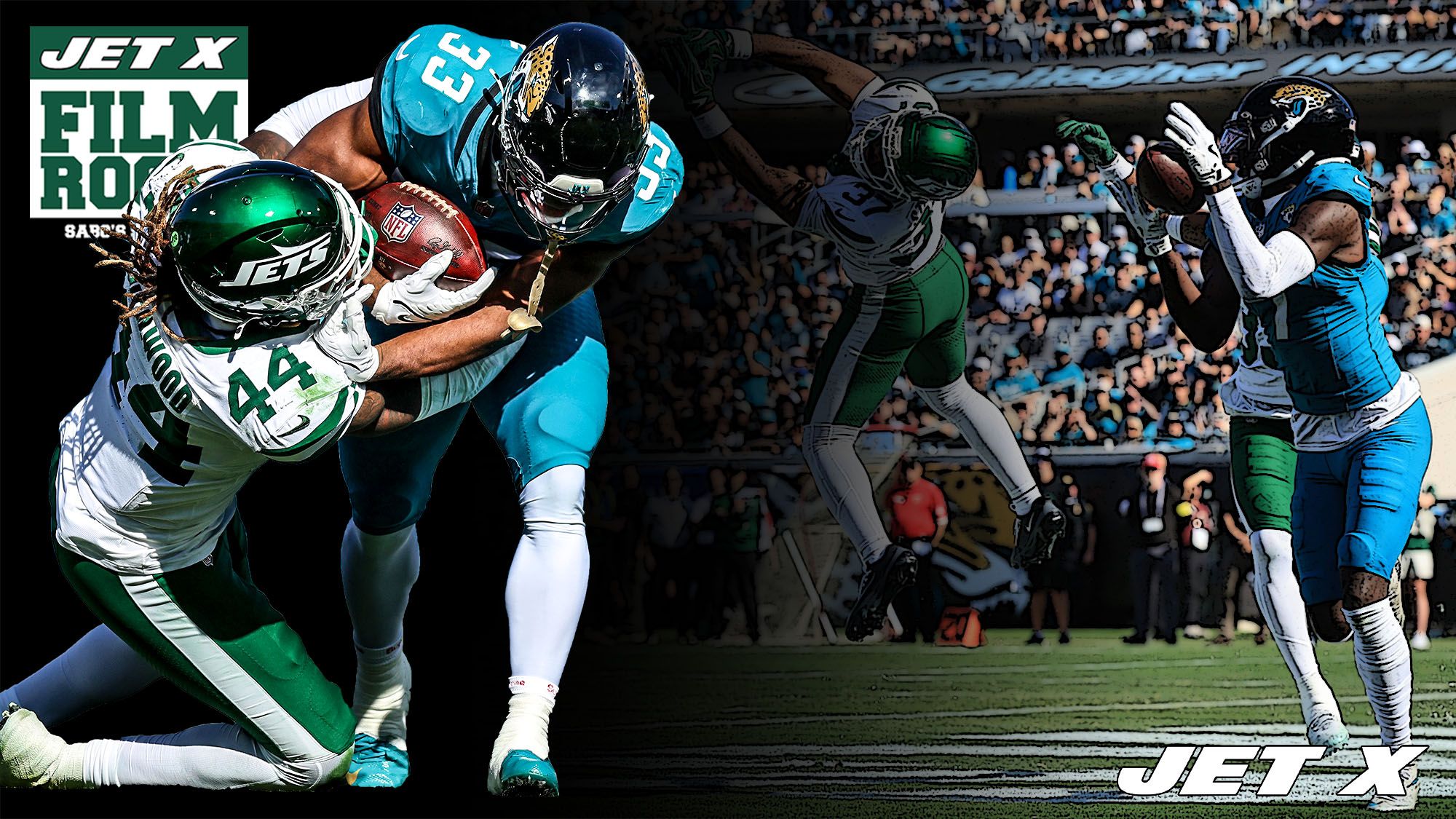
Playing selfishly in this sport is defined differently than the generic meaning of the word. This couldn’t be any truer than on the defensive side of the football.
Assuming football is the ultimate team sport, each of the 11 individuals comprising a unit must execute his singular job. Simply put, it’s the only way for a team to achieve quality status, as one man’s failure bleeds into the next man’s chances.
As it concerns the New York Jets’ defense—a unit currently ranked 30th in points allowed per game (28.4), 20th in yards allowed per game (337.4), and 31st in Defensive DVOA (18.5%)—few players are playing the game the right way.
Failing with a lack of talent is one matter, but falling flat on one’s face thanks to selfish play is something entirely different. It’s why the Jets fired defensive coordinator Steve Wilks earlier this week.
It must have taken head coach Aaron Glenn just a glance at the first two defensive possessions in the Jets’ humiliating 48-20 loss to the Jacksonville Jaguars to understand just how bad things went.
Play-action woes
Perhaps the most glaring defensive issue for the Jets arises when opposing offenses roll with play-action. Obviously, time and again, linebackers Jamien Sherwood and Quincy Williams are flying all over the place when trying to recover into their pass responsibilities.
Why? Well, it deals with selfish football play. It boils down to a defender not keying in on his read.
While there are several reasons a player may not key in on his reads, at the end of the day, it’s a complete lack of focus that can only be described as selfish—particularly when it occurs consistently.
The very first play of the game featured Jags’ head coach Liam Coen dialing up a play-action boot, with jet-motion, because he knew just how badly the Jets’ second-level would bite:
Honestly, there’s no shot the linebackers should have found themselves that close to the line when looking at the Jags’ offensive line. Despite Jacksonville’s fine play-action acting, it was clear that the line was in pass protection (which should signal a pass is coming).
Just a bit later, Trevor Lawrence found Brian Thomas on a dig that torched the Jets’ defense. It was like taking candy from a baby.
New York loves to activate its boundary cornerbacks when the tight end is the No. 1 on that side (meaning no receiver is wider than the tight end). All season, we’ve seen Sauce Gardner, Brandon Stephens, and even AZ Thomas (i.e., his tackle for loss a couple of weeks ago) trigger in run responsibility when lined up against a tight end pre-snap.
Coen knew this, and when offensive strategists in the modern era know this, it’s just too easy. That is, if the defense makes zero week-to-week adjustments.
Here, Qwan’tez Stiggers activates aggressively against the run, believing it’s a rush attempt all the way:
Unfortunately, it was another Jags’ play-action that went for a chunk. Stiggers had no chance to reach his outer-third responsibility to help the single-high Malachi Moore (Cover 3).
All he had to do was read the tackle on that side.
Smarts, responsibility
The next play features an example of an offensive mind using the defense’s aggressiveness against them. Actually, a case can be made that Coen also used one player’s hustle against him.
Watch defensive end Micheal Clemons on this 8-yard rush:
A general split-zone rush is a hand-off, but the Jags roll with a split-zone toss for one compelling reason: They knew it would overextend the Jets’ defense.
A toss instantly triggers the thought of an outside/wide concept. This concept, however, is designed to push the defense wide, only to zone it between the tackles (inside) with a split action (for the kickout).
Interestingly, Wilks had a run blitz dialed up on this play. Unfortunately, Clemons initiated his pursuit of the backside hustle when he had no business doing so.
Next, we get to a bit of pass coverage.
Granted, Stiggers has played tremendously on special teams this year, and any team would take him as their CB4 or CB5. But man, oh man, he struggled this past Sunday.
Once the Jags motion into a stack on the far side, the Jets defense is already behind the eight-ball, considering they’re clearly in some form of Cover 1 (man coverage):
It’s bad enough that it doesn’t look like the press corner on No. 2 and Stiggers aren’t matching in any form or fashion (allowing a switch route to run into each match coverage area). Much worse is the idea that the corner on top doesn’t anticipate an inside route.
There’s no chance Stiggers can get even with his responsibility here. Remaining inside-out is hugely crucial, as making up ground to rally into the flat, or pivoting to a potential wheel, is more than achievable (thanks to the near-sideline throw equating to more recovery time for the defensive back).
It’s the fact that the lead route takes an outside release that makes this a mortal sin on the defensive side. The odds that Stiggers’s weapon would also take an outside release are incredibly slim, meaning he should have anticipated an inside route the entire time.
At the very least, maintain inside leverage—especially since a five-man rush is headed towards Lawrence.
Modern strategy
Last but certainly not least is a matter near and dear to my heart: modern strategy.
Although the selfish play and lack of attention to detail are alarming, the most troubling consistency of this defense this season has been its sheer stubbornness. For whatever reason, the Jets’ defense seems intent on making things more difficult for itself:
It could only be described as hubris. To take away Stiggers’s eyes from the backfield is disturbing on a third-and-13—in a league that’s dying to throw a flag for coverage infractions.
The more Aaron Glenn and the New York Jets envision this team playing a specific way, the more they will find themselves lost among the dregs of the sport. The organization’s only shot is to mold its strategy around its current personnel, firmly coupled with the mandatory schematics that every successful defense deploys.
Not playing press-man lock in a Cover 6 on a third-and-13 would be a tremendous start. To not place all four defensive backs (minus the slot cornerback) with their heels at the first-down marker is as egregious as anything I’ve seen this season.
Granted, Steve Wilks is no longer the team’s defensive play-caller and leader, but don’t make the classic mistake of blaming the man thrown to the wolves for everything. Aaron Glenn and the players share just as much (if not more) responsibility for this mess.
That’s not to say they can’t improve this Sunday in New Orleans, and/or in the final two games of the season, but “scheme” (one of the most annoying words that’s mindlessly repeated far too often these days) cannot change in a week. The play-calls may change slightly, but the heart of the unit has been established.
The thing to watch for against the Saints is a noticeable bump in effort and focus. Will these New York Jets defenders start playing unselfishly? If they do, it would mean an appropriate level of focus is present.
