

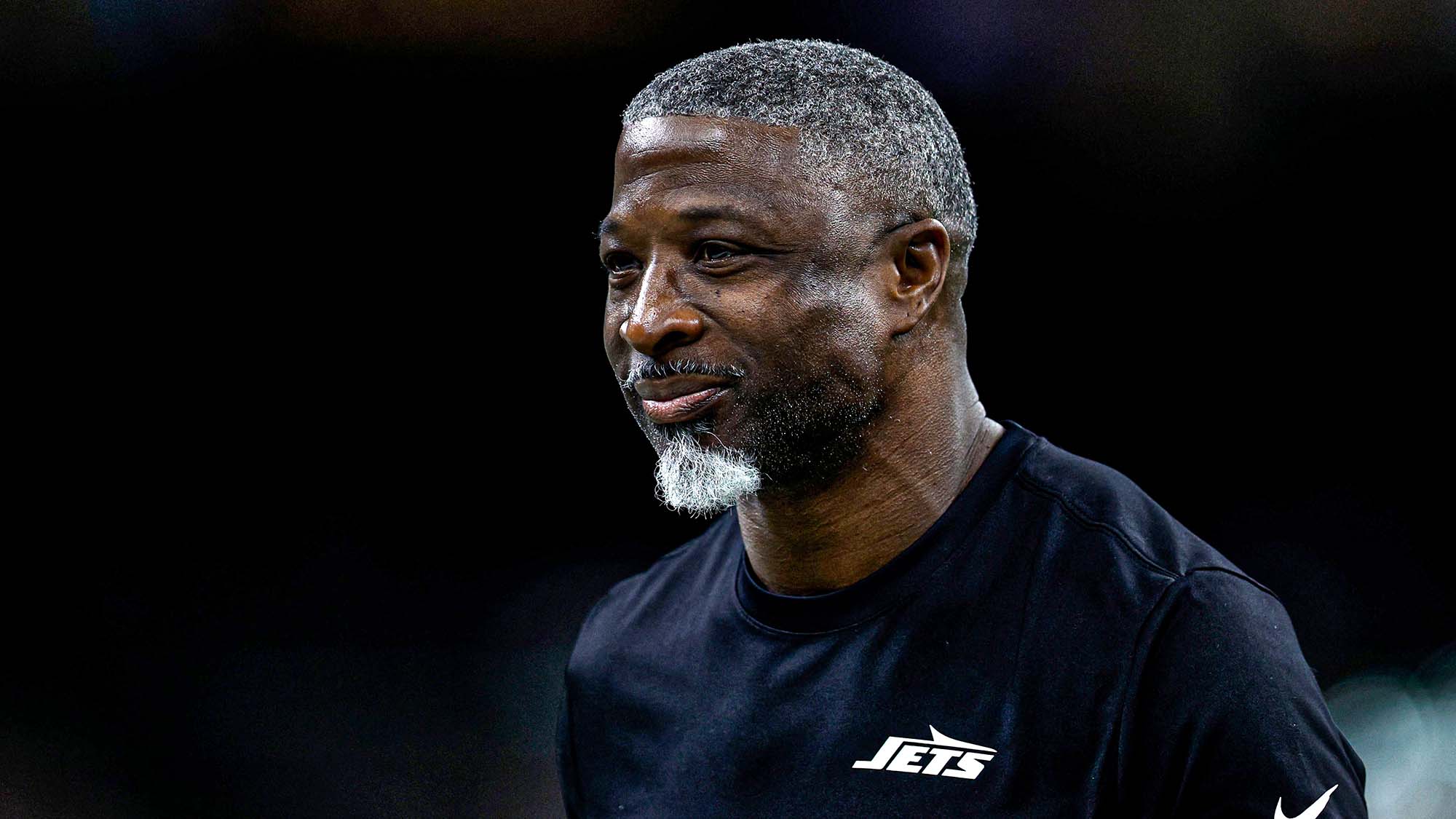
Step right up, New York Jets fans, and meet the many faces (and answers) of head coach Aaron Glenn!
Upset after a blowout win? The coach will give a rah-rah response to make you feel like he’s just as upset as everyone. Oh, no, the players are upset over the coach calling out their effort! Don’t you worry, he’ll walk back his comments 24 hours later.
One day after their recent 42-10 loss to the New England Patriots, Glenn retracted criticisms of the Jets’ effort. It felt like the latest example of a recurring theme in his first season as head coach: passionate answers one day, and grounded takes the next.
While that may seem like an oversimplification of the many issues the 3-13 Jets have faced all year, it’s worth wondering if the coach has been like this all season.
Spoiler alert: He has.
Today, we’ll meet the many faces and answers Glenn has flipped-flopped between, and determine whether the coach is trying to keep the peace in a lost season, or if he truly is over his own head.
1. Jets in win-now mode
Following his introductory press conference in January, Glenn made it abundantly clear that the team would be winning a lot more games than people expected.
“Get used to winning,” Glenn said. “That’s all I’ve been a part of my last couple of years and I don’t want to do anything other than that. Winning is all I know.”
On Oct. 7, though, Glenn altered those comments. It was not just because of the team’s winless start, but also because he realized that the expectations may have been too much for a team in need of talent.
“What you didn’t say is what I said, ‘I’m not thinking about the Super Bowl, I’m not thinking about playoffs, I’m thinking about building a foundation,’” Glenn stated. “That’s exactly what we’re doing.”
Getting fans excited during an introductory press conference, only to limit those expectations months later, is somewhat understandable. Glenn didn’t get to see the roster in action until August.
But should he have made “win-now” promises before evaluating the roster in person? Probably not.
It also wasn’t the first time the coach has altered comments like this, though.
2. The Justin Fields of it all
One of the biggest walk-backs from Glenn occurred at the quarterback position. The Jets’ coach has been going back and forth about the former first-round pick out of Ohio State from the very beginning.
At league meetings in March, Glenn confidently said the Jets had the answers to get Fields to play at a high level. They would simply allow him to “play quarterback.”
So, how did letting Fields “play quarterback” work?
It turned out the Jets gave Fields nine games, and the signal-caller did little to prove his worth. He had four games with under 50 net passing yards and was benched twice.
Why didn’t the Jets’ plan for Fields work out? Glenn’s answer was complex.
“There are a number of things,” he said on Nov. 19. “Obviously, offensively, you want your passing game to be better, and listen, that’s not totally on him. There’s a number of things that go into that. That’s myself, that’s the routes that’s ran, that’s
dropped balls, that’s including him.”
Allowing Fields to play quarterback didn’t work out. And the Jets didn’t really have an answer as to why, despite their strong commitment to Fields in the offseason.
That leads us to No. 3.
3. The duality of competition
Why didn’t Fields go through a quarterback competition? Why was there a position battle at the center position, but not at quarterback?
The answer, unfortunately, is one of Glenn’s many ever-changing explanations.
In March, Glenn said that while Fields was going to be penciled in as the starting quarterback, he would still have to compete every day in practice.
“So just because [Fields] is Quarterback 1 doesn’t mean that Tyrod’s not gonna be on this hill,” Glenn said. “Everybody has to have, you gotta have, a depth chart. That’s what this league is. But there’s gonna be competition. [Fields] knows that and Tyrod knows that. And that’s across the board. Every position on this team, there’s gonna be competition.”
So, what did that competition look like? Well, when healthy, the Jets didn’t give starter reps to any other player. Even when Fields struggled throughout camp, the organization remained focused solely on preparing him for the regular season.
Other positions received far different coaching when it came to competition. The center position, dominated by Joe Tippmann in training camp, wasn’t decided until the final week before the regular season because Alijah Vera-Tucker suffered a season-ending injury.
Glenn’s answer regarding his quarterback compared to other players on the roster was never consistent. And it backfired from the very beginning.
4. A team to be proud of
Aaron Glenn has been trying to build excitement around the team since his introductory press conference. Since that excitement has dimmed, though, the Jets’ coach has been walking back comments in the worst possible way.
Among the worst violations of this was his talk about pride.
On Sep. 2, the Jets’ coach had a simple goal for his team before the year began.
“I want to be a team where the fans will look up and say, ‘we’re proud of that team,’ and if they say that, I’ll be happy,” he said. “I’ll be happy, because within that, I know that wins will come.”
Two months later, though, he walked back those comments after a dismal start.
“I want this to be a team that the fans are proud of,” Glenn said. “But again, I’ve never said that we’re going to be proud of them right now. At some point, I want this to be a team that the fans are proud of. I still stick with that.”
It is another example of Glenn hyping up the fanbase only to move the goalposts as the losses piled up.
Is it the end of the world that Glenn is preaching patience? Probably not.
But it should be a given for NFL head coaches to be honest about where their team stands. Glenn has not done that—from the very beginning.
5. A lack of effort?
Most of Glenn’s walk-backs have been regarding the defense of players and the roster in general.
After Sunday’s loss to New England, though, the Jets’ head coach decided that enough was enough. Players were questioned for their effort and inability to put up much of a fight in a 42-10 loss.
“I always talk about how we come out and play with effort,” Glenn said. “Today was the one time I felt our effort wasn’t as good as it wanted to be.”
The coach’s comment came as a surprise to some in the locker room. Edge rusher Jermaine Johnson seemingly disagreed with Glenn, despite keeping a professional tone.
If Glenn wanted to instill some accountability with his comments, those hopes were quickly squashed when he walked his criticisms back on Monday.
“Getting a chance to look at it last night, and look at it again this morning, I will say this, effort was not the issue with that game,” he said. “I thought our guys played all the way to the very end. What really showed up is they did some things schematically
I thought that was challenging offensively and defensively that we really have to take a look at and try to hone in on and fix those things.”
So… is effort an issue, or is it not? Why was it suddenly an issue on Sunday immediately after the game, but not the case on Monday?
More importantly, if Glenn’s frustration is starting to bleed over after games, it raises a daunting question: What makes the players comfortable performing for a coach who is going to switch up answers from a week-to-week basis?
In fairness to Glenn, the walk-backs could be explained by his attempts to manage expectations with a limited roster.
But the bravado and hubris he walked in with is a good lesson for any coach: Don’t pound your chest when you haven’t played a game yet.
