
Attention, New York Jets fans: In case you have been living under a rock throughout this 2025 season, your team has an atrocious defense.
We are talking about record-setting ineptitude at all levels and across numerous metrics. Significant changes are necessary.
Aaron Glenn is returning as head coach, but a new defensive coordinator is on the way.
The 2025 defense belonged to Steve Wilks. Glenn said so himself on many occasions. Glenn did not want to interfere, as he had 100% confidence in his handpicked defensive coordinator.
Back in October, Glenn said, “I know that’s going to be the thing everyone says (that he should take play-calling away from Wilks), but I always go back to my first year in Detroit when we struggled on defense, too. Our head coach had a lot of confidence in me, making sure we get it right.
“And I feel the exact same way. I have a lot of confidence in Wilks. He’s done a lot of great things in this league as a defensive coordinator. And I’m going to allow him to do his job. I am. Once things change, the mentality about everything changes, as in: ‘Oh, he can coach.’ That’s what happened to me. I have all the confidence in the world in him.”
Glenn had trust and confidence in Wilks… until he didn’t. Historically bad production resulted in Wilks being relieved of his duties after Week 15 of his inaugural season as the Jets’ defensive coordinator.
Without knowing who will coordinate Glenn’s defensive squad in 2026, I think it is safe to assume that, after a Year 1 debacle on that side of the ball, Glenn may choose to put more of his own fingerprint on the unit, both in scheme and personnel.
Glenn said it himself during Tuesday’s season-ending press conference: “I like to be aggressive. … I want to make sure the [defensive coordinator] we do have, there’s a lot of synergy between us.”
So, what does an Aaron Glenn defensive prospect look like?
Glenn’s core defensive philosophies
When looking at the core defensive philosophies of Aaron Glenn’s defenses (based primarily on his tenure in Detroit and his influence from the Saints’ defensive tree), some prominent indicators stick out:
- Heavy doses of man coverage first, with match principles layered in. Long, physical corners who can press, disrupt, and contest rather than concede space
- Front multiplicity: odd and even fronts that field edge rushers with power profiles who are stout edge setters
- Bigger, more physical linebackers who are violent finishers with enough athleticism to succeed as blitzers
- Safeties who are defined less by position labels and more by traits that allow disguise, matchup control, and the creation of violence at the catch point
Below is a position-by-position breakdown of some prospects in the 2026 NFL draft who best fit the molds laid above. These players are tailor-made to succeed in an Aaron Glenn–style defense and could be key cogs in the 2026 New York Jets defensive renaissance.
Anthony Hill Jr., LB, Texas
Anthony Hill Jr. is a modern three-down linebacker whose game is built on elite speed, instant processing, and violent closing ability. He is not a traditional stack-and-shed thumper; he is a space eraser and pressure amplifier.
At 6-foot-3 and weighing 235 pounds, Hill has a sturdy build with exceptional burst and play speed. Hill delivers a weighty thud behind his pads to limit yards after contact. He plays with a quick trigger, excellent gap integrity, and downhill aggression unmatched by many prospects in the class.
Coverage is where Hill separates himself from most college linebackers in this class. Hill has great awareness in zone and is very trustworthy in man coverage. He can flip his hips and run vertically with seam or wheel routes when needed. Well-rounded LBs in Glenn’s system can allow his defense to stay in nickel without sacrificing matchups.
In Glenn’s defense, Hill profiles as a centerpiece second-level defender who enables aggressive man coverage and expanded pressure packages. Hill allows Glenn to keep his safeties aggressive and add pressure from all over without sacrificing any coverage integrity.
Hill can align as an MLB or as a WLB; it doesn’t matter. That flexibility allows you to play Hill alongside Jamien Sherwood (in place of Quincy Williams) and possibly at the Mike if you move on from Sherwood after 2026.
The former Glenn defender closest to a pro comp is (a smaller but quicker) Demario Davis. Both are violent finishers and elite processors who enable you to disguise much of what’s going on behind them.
It’s hard to pinpoint this early in the process, but for now, I’d expect Hill to go off the board on Day 2, somewhere between picks 35-65.
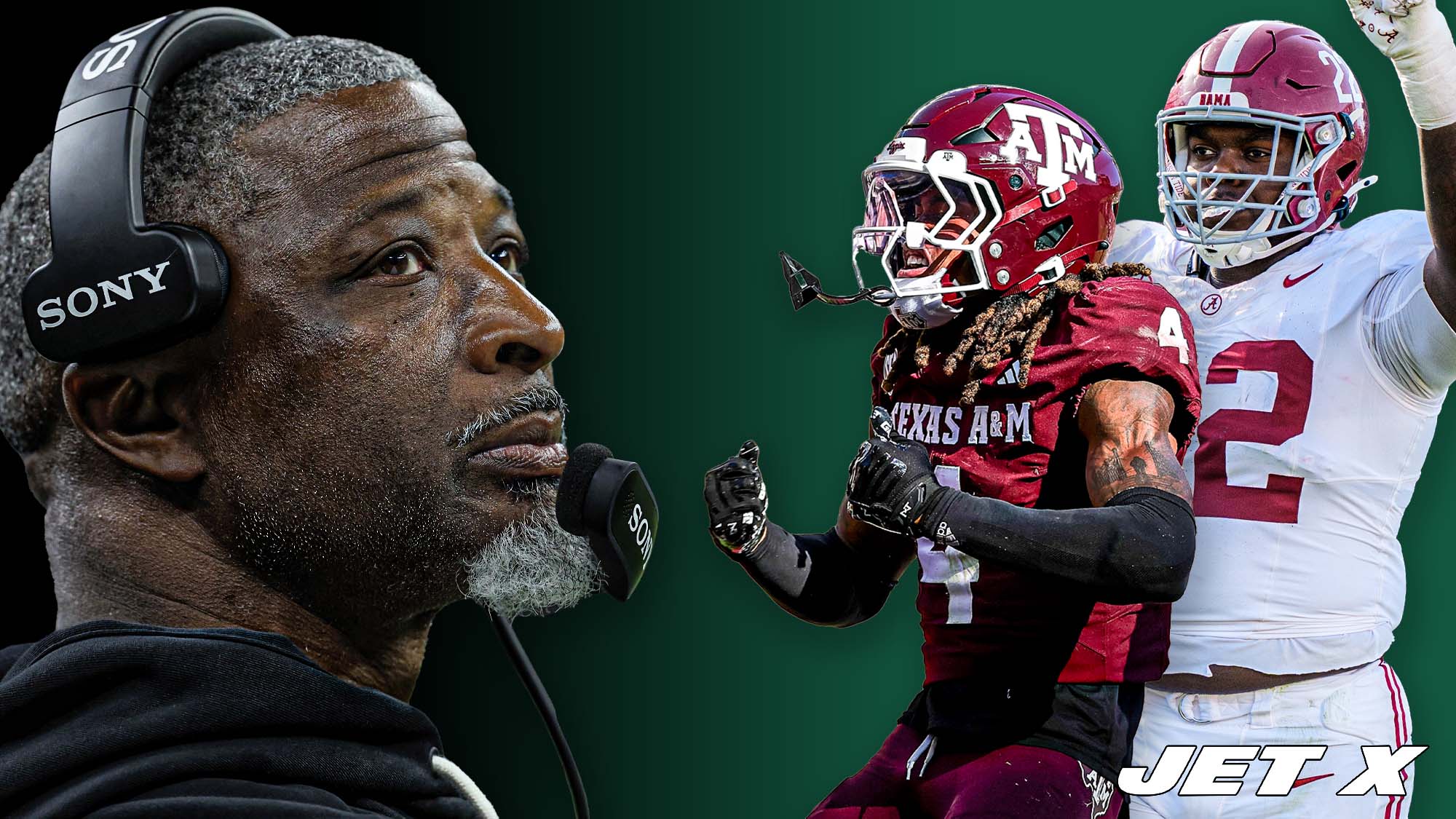
L.T. Overton, EDGE, Alabama
L.T. Overton is a strong, versatile front-seven piece. He’s not flashy, but AG values reliability, and you’ll get a lot of that with L.T. on your defensive line.
Overton is a power-based, scheme-versatile defensive lineman whose value lies in alignment flexibility, strength at the point of attack, and disciplined execution.
At 6-foot-5 and 285 pounds, Overton is not a pure edge-rush specialist and frankly should not be evaluated as one. While he does convert speed to power well, his job and role would be to stress protections, not to chase sack numbers.
He won’t be a favorite of those who rely on the box scores, but Overton fits the exact profile Glenn prefers on the edge: prominent, physical, assignment-sound defenders.
In Glenn’s defense, Overton projects as a foundational front-seven piece who enables multiplicity. He can align in base as a 5/7/9 tech in even fronts and a 4i in odd fronts, and can reduce down to offer interior pressure flexibility on passing downs. The inside/outside pass-rush versatility allows creativity with stunt/twist games up front and/or with zone blitzes.
The former Glenn defender closest to a pro comp is Trey Flowers. Both Flowers and Overton are high-motor, technically sound defensive linemen known for excellent run defense, strong hand usage, and versatility, though they lack elite athleticism and first-step burst.
Overton is likely a top-100 selection in this draft.
Kamari Ramsey, S, USC
Kamari Ramsey is a physical, downhill safety whose game is defined by his sense of urgency, tackling, and physicality.
Standing just over six feet and weighing 205 pounds, Ramsey has no problem putting his body directly into the line of fire. He is a phenomenal defender in space, seldom missing tackles and playing with subtly controlled violence.
Ramsey is not a pure post defender or a rangy center-fielder FS-type; his value lies in his short-area reaction, tackling reliability, and versatility in sub-packages. Ramsey brings a linebacker-like mentality in the run game. In a Glenn system that values DBs who tackle, this is a clear positive. He projects as a trustworthy run-fit defender in the NFL.
Ramsey’s ideal role might start as a third safety who is heavily involved in sub-package deployment and on special teams. He can man the post as the robber in man-coverage schemes and play down in the box in split-field alignments, as well as some NB versus big slots aligned in 11 personnel.
The former Glenn defender closest to a pro comp is Brian Branch, although Ramsey is not as twitchy an athlete. Branch is known as one of the most reliable safeties, capable of making runs from the back line; Ramsey shares many of these same attributes.
Ramsey’s skill set, combined with the fact that he is a 23-year-old player, may hurt his draft value come April. If the Jets are interested in giving 2025 fourth-round pick Malachi Moore some competition, Ramsey could probably also be landed on Day 3, where the Jets are projected to hold seven selections between rounds four and seven.
Will Lee III, CB, Texas A&M
A 23-year-old transfer from Kansas State, Will Lee III personifies what an “Aaron Glenn-type” corner really is. He is a competitive, assignment-sound boundary corner whose game is built on discipline, physicality, and route recognition rather than elite long speed. His value emerges in press-man coverage when he is allowed to disrupt releases, stay connected through routes, and play with vision and leverage.
Lee is a true boundary corner in every sense of the phrase. He has a prototypical press-man build, with almost 32-inch arms and a 93rd-percentile wingspan. Lee, standing 6-foot-1 and weighing in at nearly 200 pounds, has the appropriate size needed for a boundary corner in the Glenn scheme.
There is an evident willingness to play physically as well; this trait significantly boosts his fit under Glenn. His game exudes a high level of competitiveness not only in coverage but also in fitting the run. He does not avoid contact, understands run fits, and is a willing wrap tackler.
Lee checks nearly every box Glenn prioritizes at corner: press comfort, competitiveness, toughness, and discipline. While he may never be a highlight-reel athlete, he profiles as a dependable, long-term starter in a Jets defense built on man coverage and physicality. His role is a starting outside CB, and frankly, with the current state of the Jets’ roster, he could compete for a starting role from day one.
The former Glenn defender closest to a pro comp is Carlton Davis, with a slightly smaller frame. Davis is a true press-man specialist. When allowed to play tight and physical, he reduces route trees and forces QBs to hold the ball. This directly supports pressure-based defenses, such as Glenn’s. Lee should be available on day three come April’s draft.
The Three P’s
I think it is safe to say that Aaron Glenn may have to play a bigger role in the Jets’ defensive scheme, no matter who is named the defensive coordinator.
Glenn cannot just wipe his hands completely clean and attempt to play CEO as he did in 2025. His seat will get way too hot if the Jets start 2026 with another losing streak or if the defense looks unprepared and vanilla as they did in 2025.
With over $90 million in projected salary cap space, the rebuild plan will involve filling some of the defensive holes through free agency. However, the perfect blueprint for sustained success in the NFL is always grounded in the draft.
Glenn and general manager Darren Mougey will have plenty of opportunities to move up, move down, and bring in players who fit the three P’s demanded by Glenn’s scheme: press, pursuit, and power.
