

Intermediate passing.
It’s the key to unlocking the New York Jets’ offense in 2026.
On Thursday, we highlighted the excellent job that Jets first-year offensive coordinator Tanner Engstrand did in one particular area: scheming receivers open in the intermediate range (10-19 air yards).
In 2025, the Jets ranked fourth-best with 2.9 average yards of separation on intermediate passes, per NFL Pro. The top 10 is littered with high-level offenses and revered offensive minds:
- Seahawks (3.1)
- Bears (3.1)
- Bills (3.0)
- Jets (2.9)
- Ravens (2.9)
- Chiefs (2.9)
- Rams (2.8)
- Falcons (2.8)
- Saints (2.7)
- Eagles (2.7)
Unfortunately for Engstrand (and Jets fans burdened with watching the games), the separation did not amount to much. The Jets ranked 30th in the league with 645 passing yards on intermediate attempts.
That was due to nothing more than inept quarterbacking. The Jets’ signal-callers executed poorly on intermediate passes and hesitated to even attempt them.
According to Pro Football Focus, New York had the sixth-worst passing grade on intermediate pass attempts (62.0), indicating the Jets’ inaccuracy and poor ball placement in the intermediate area.
Worse, though, was the lack of attempts altogether. The Jets were tied with the Browns for the second-fewest intermediate pass attempts (79). Initial starter Justin Fields was the worst offender, as he attempted an intermediate pass on just 11.2% of his dropbacks (29 attempts on 260 dropbacks), the NFL’s lowest rate among 45 quarterbacks with at least 100 dropbacks.
New York’s quarterbacks left a ton of yards on the field through their poor work in the intermediate range. However, it leaves the Jets with intriguing potential entering the 2026 season under Engstrand’s leadership. While the results weren’t there yet in 2025, Engstrand’s opportunity creation laid the foundation for significantly better results in the future.
They just need a quarterback who will capitalize on the opportunities created for him.
The Jets will evaluate countless traits in each quarterback prospect they scout this offseason. Ultimately, though, if they want to find the best fit for their offensive scheme, the formula can be boiled down to one critical trait: intermediate passing.
Plug in a quarterback who is accurate on intermediate passes and loves to target them, and the Jets’ offense could explode overnight.
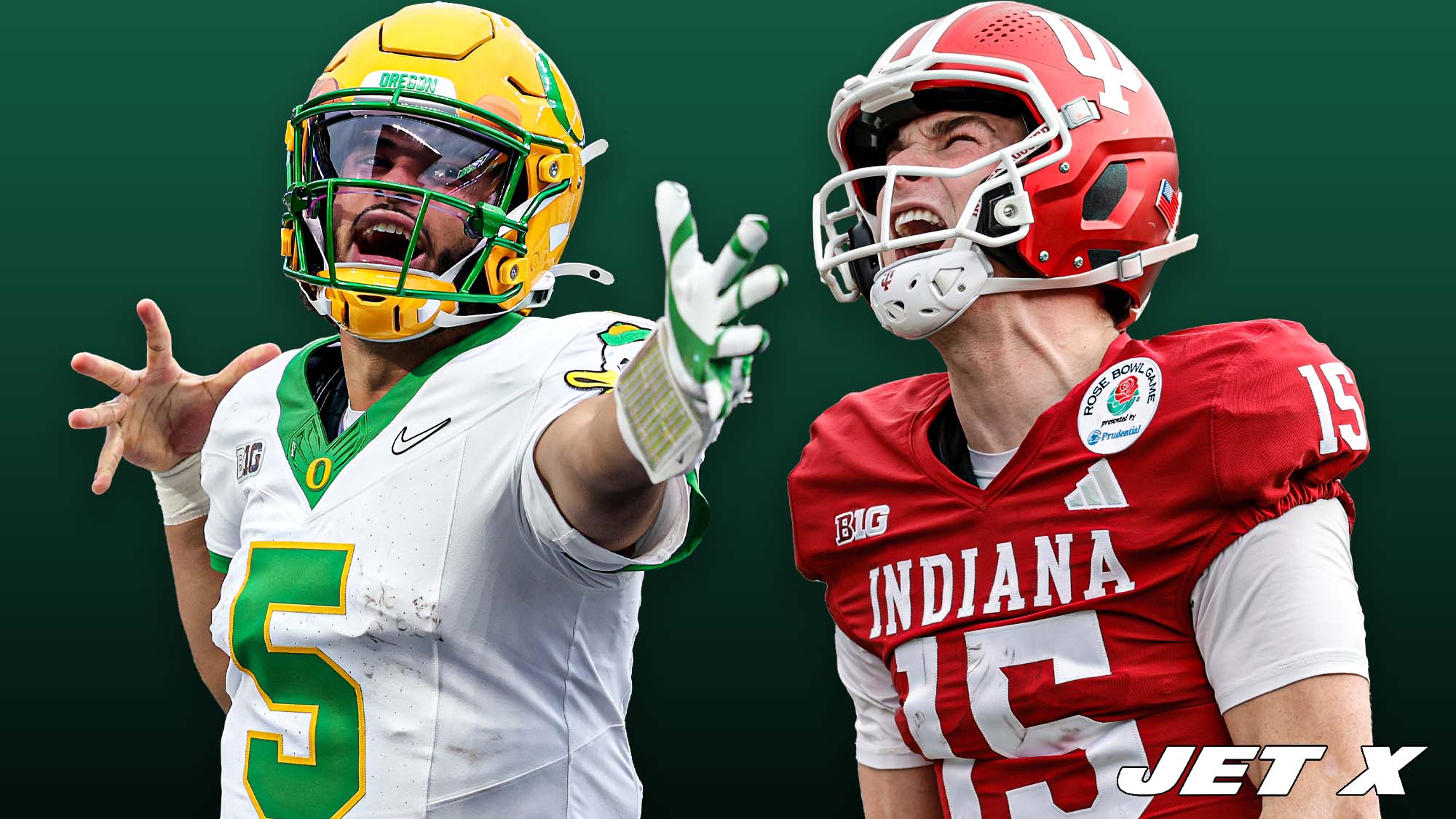
Without further ado, let’s compare the consensus top three quarterback prospects in this category: Fernando Mendoza, Dante Moore, and Ty Simpson.
Fernando Mendoza
The Heisman Trophy winner and consensus No. 1 quarterback prospect (although the latter title is hotly debated), Mendoza is a well-rounded player.
However, among the three levels of the field (short, intermediate, deep), the intermediate range is actually Mendoza’s least effective—from a statistical standpoint, at least.
Compare Mendoza’s rankings in the 2025 season (pre-Peach Bowl) at all three levels among 100 qualified FBS quarterbacks:
| Depth | Adj. Comp% | Yards/Att. | PFF Grade |
|---|---|---|---|
| Short (0-9 air yards) | 88.8% (7th) | 8.5 (4th) | 82.4 (3rd) |
| Intermediate (10-19 air yards) | 67.1% (20th) | 9.2 (67th) | 90.0 (19th) |
| Deep (20+ air yards) | 59.6% (3rd) | 19.1 (5th) | 95.3 (5th) |
Mendoza’s intermediate rankings are clearly the worst of the three.
The Indiana quarterback has some unorthodox splits. His accuracy on intermediate throws is surprisingly close to his accuracy on deep passes; Mendoza is less than 8% more likely to convert an intermediate pass than a deep pass. Additionally, there is less than a one-yard difference between his Y/A on short passes and intermediate passes.
When it comes to his frequency on intermediate passes, Mendoza is about average for an FBS quarterback. Intermediate passes represent 21.8% of his total pass attempts, which ranks 51st out of 100 qualifiers.
Overall, Mendoza’s profile as an intermediate passer isn’t mind-blowing. That’s not to say he still can’t be an excellent fit for the Jets based on his strengths in other areas, but he doesn’t have the intermediate production to project as a shoo-in solution to the Jets’ biggest issue in the passing game.
His rivals are much more appealing in this regard.
Dante Moore
If you’re in the camp that favors Moore over Mendoza for the Jets, this article will help your case.
Moore’s intermediate production (pre-Peach Bowl) stands out as a much bigger strength compared to Mendoza:
| Depth | Adj. Comp% | Yards/Att. | PFF Grade |
|---|---|---|---|
| Short (0-9 air yards) | 87.4% (9th) | 6.9 (29th) | 68.4 (48th) |
| Intermediate (10-19 air yards) | 68.2% (15th) | 11.6 (9th) | 91.5 (9th) |
| Deep (20+ air yards) | 62.7% (1st) | 17.9 (10th) | 98.8 (1st) |
The deep game is where Moore really shines, but he still possesses top-10 rankings in intermediate yards-per-attempt and intermediate grade.
Moore has also targeted intermediate passes slightly more often than Mendoza, representing 22.8% of his total pass attempts, placing 38th out of 100 qualifiers compared to Mendoza’s 51st (21.8%).
Moore’s combination of efficient production, quality performance through the eye test, and above-average frequency is unique for a Power Four quarterback. He was the only Power Four quarterback who ranked top-10 among 100 qualified FBS passers in intermediate yards-per-attempt and intermediate grade while also targeting intermediate passes on over 22% of their attempts.
That’s a mouthful, but the bottom line is that few quarterbacks from premier conferences can match Moore’s efficiency, flair, and frequency as an intermediate passer.
However, there’s another guy who might have him beat if we’re purely focusing on the eye test, even if he cannot match Moore’s efficiency.
Ty Simpson
In the public conversation, Simpson is the consensus QB3 with a fairly wide gap separating him from Mendoza and Moore.
However, the public might end up being wrong on this. Based on what Simpson shows on film and the context of his situation at Alabama, it would not be surprising if NFL teams grade him similarly to or better than Mendoza and Moore.
The challenge with evaluating Simpson is that his relatively poor supporting cast at Alabama tanked his metrics in comparison to Mendoza and Moore, who have each enjoyed much better support. That makes Simpson look like a clearly worse quarterback in most statistics, but there is always more to the numbers.
Of the top three quarterback prospects, Simpson’s team ran for the fewest yards per game (by far; Alabama was one of the worst rushing teams in the entire country), had the lowest-graded receivers, and allowed pressure at the highest rate.
Nonetheless, the intermediate range still checks out as Simpson’s best in all three categories, making him an intriguing fit for the Jets:
| Depth | Adj. Comp% | Yards/Att. | PFF Grade |
|---|---|---|---|
| Short (0-9 air yards) | 82.8% (32nd) | 6.0 (72nd) | 72.8 (30th) |
| Intermediate (10-19 air yards) | 65.7% (26th) | 10.1 (44th) | 92.8 (4th) |
| Deep (20+ air yards) | 45.2% (29th) | 12.6 (54th) | 90.1 (37th) |
Notice how in each category, Simpson’s PFF grade (which is calculated on a play-by-play basis through human analysis of the film) is substantially better than his yardage per attempt. This discrepancy indicates that Simpson’s eye test paints a more promising picture than his numbers, supporting the idea that his efficiency was dragged down by his supporting cast.
Thus, the fact that Simpson had the fourth-best grade on intermediate passes says a lot about what he displayed on film, even if the raw production wasn’t impressive. His 92.8 intermediate grade is better than both Moore (91.5, 9th) and Mendoza (90.0, 19th).
When it comes to frequency, Simpson was identical to Moore at 22.8% of his pass attempts (38th).
What sets Simpson apart in the intermediate area is his ability to deliver elite-level dimes while simultaneously avoiding killer mistakes.
Simpson led the nation with 11 “big-time throws” on intermediate passes, as charted by PFF. That’s more than Moore and Mendoza combined (five apiece). Simpson also had just three turnover-worthy passes in the intermediate range, half of both Moore and Mendoza (six apiece).
Stacking them up
Of the trio, Simpson is the highest-graded intermediate passer by PFF. He also had the most big-time throws and the fewest turnover-worthy throws, with both marks leading the trio by a wide margin.
Intermediate PFF passing grade:
- Ty Simpson (92.8, 4th)
- Dante Moore (91.5, 9th)
- Fernando Mendoza (90.0, 19th)
Intermediate big-time throws:
- Ty Simpson (11): 9.5% big-time throw rate (2nd)
- Fernando Mendoza (5): 6.3% big-time throw rate (8th)
- Dante Moore (5): 5.4% big-time throw rate (16th)
Intermediate turnover-worthy throws:
- Ty Simpson (3): 2.6% turnover-worthy throw rate (13th)
- Dante Moore (6): 6.5% turnover-worthy throw rate (64th)
- Fernando Mendoza (6): 7.5% turnover-worthy throw rate (78th)
When it comes to raw production, Moore came out on top, leading the trio comfortably in yards per attempt and adjusted completion percentage. Mendoza did not lead in any category, and he also had the lowest frequency of attempts.
Intermediate yards per attempt:
- Dante Moore (11.6, 9th)
- Ty Simpson (10.1, 44th)
- Fernando Mendoza (9.2, 67th)
Intermediate adjusted completion percentage:
- Dante Moore (68.2%, 15th)
- Fernando Mendoza (67.1%, 20th)
- Ty Simpson (65.7%, 26th)
It is also worth noting that Mendoza arguably received the best support on these passes. Mendoza’s receivers forced 10 missed tackles after the catch on intermediate receptions, more than Moore’s receivers (4) and Simpson’s receivers (3) combined. This likely added a significant chunk of production that Mendoza had nothing to do with, and yet, his intermediate numbers were still the least impressive of the pack, especially from a yards-per-attempt standpoint.
Simpson dealt with the most drops on intermediate passes with seven, compared to Mendoza’s six and Moore’s two.
Is Ty the Guy?
Purely based on their resumes in the intermediate part of the field, there is a case to be made that Simpson is the Jets’ best fit among the projected top three quarterback prospects.
Tanner Engstrand rose up the NFL ranks in a Detroit Lions scheme that was built around its intermediate passing game under Ben Johnson. In his first season with the Jets, Engstrand showed signs of replicating Johnson’s elite ability to scheme open receivers in the intermediate area. It’s no coincidence that Johnson’s Bears were one of just three teams that produced more separation in that part of the field than the Jets.
Intermediate passing is what will make or break the success of Engstrand’s scheme. And based on his rookie-year production when it comes to purely generating separation in that range, there is a lofty ceiling for the Jets’ offense if they can find a quarterback who thrives on intermediate passes; other parts of his game be damned.
Over time, the Jets can work with their young passer on any other warts in his game. But if he can simply hit the ground running as an intermediate passer, the Jets might be able to field a respectable offense based on that skill alone. It can be the springboard that allows the rookie to build confidence early in his career, setting the tone for year-over-year development as an all-around player.
Simpson arguably has the best intermediate resume in the 2026 quarterback class. It does not show up in all of his raw statistics, but after accounting for his supporting cast, his potential in that part of the field is evident.
Moore, though, also has intriguing potential in this area, with a more proven track record of production. The question is how much he benefited from his supporting cast to generate that production. It’s up to the Jets’ scouts to look beyond the numbers and use the eye test to evaluate the transferability of Moore’s intermediate skills to the NFL.
Mendoza’s lackluster production in the intermediate area is a real concern. With an elite coach and supporting cast, there isn’t much of an excuse for it. His short and deep numbers are pristine; he just isn’t as impressive in the middle of the field, simple as that.
Is Mendoza the right fit for Engstrand’s scheme? That’s a question the Jets will have to tackle throughout the coming months.
Given the appealing fit between Simpson and Engstrand, do not be shocked if the Jets legitimately consider selecting the Alabama product with the second overall pick.
