
Over the past two days here at Jets X-Factor, we’ve attempted to pinpoint reliable methods for predicting the odds of NFL success for first-round quarterback prospects.
We analyzed the 35 first-round quarterbacks from 2015 to 2024, collecting data on various metrics from their final college seasons. Then, we examined the correlation between each of those metrics and NFL success.
Three college metrics appeared to have the strongest correlation with NFL success:
- Deep pass attempt rate (percentage of total pass attempts thrown at least 20 yards beyond the line of scrimmage)
- Turnover-worthy throw rate (percentage of total pass attempts deemed worthy of being intercepted, per PFF)
- Scramble rate (percentage of dropbacks in which the quarterback tucked the ball and rushed)
Through our initial analysis, we identified the following thresholds as the ideal benchmarks to yield a high chance of success in the NFL:
- ≥15% deep pass attempt rate
- ≥3% turnover-worthy throw rate (yes, throwing more turnover-worthy passes has correlated with better NFL success)
- ≥7% scramble rate
Then, we analyzed how the consensus top-nine quarterback prospects in the 2026 NFL draft fared across those three metrics. All nine players failed to hit the ideal threshold in more than one of the three categories. Some failed to check even one of the three boxes, including multiple in the first-round conversation.
We found a relatively strong correlation between the number of those three boxes checked by a player and their future success in the NFL.
The more of those thresholds that a player met in their final college season, the higher their “overall rating” in the NFL (a 0-100 rating calculated by a combination of their career passer rating, adjusted EPA per play, and overall PFF grade; see the original article for further details).
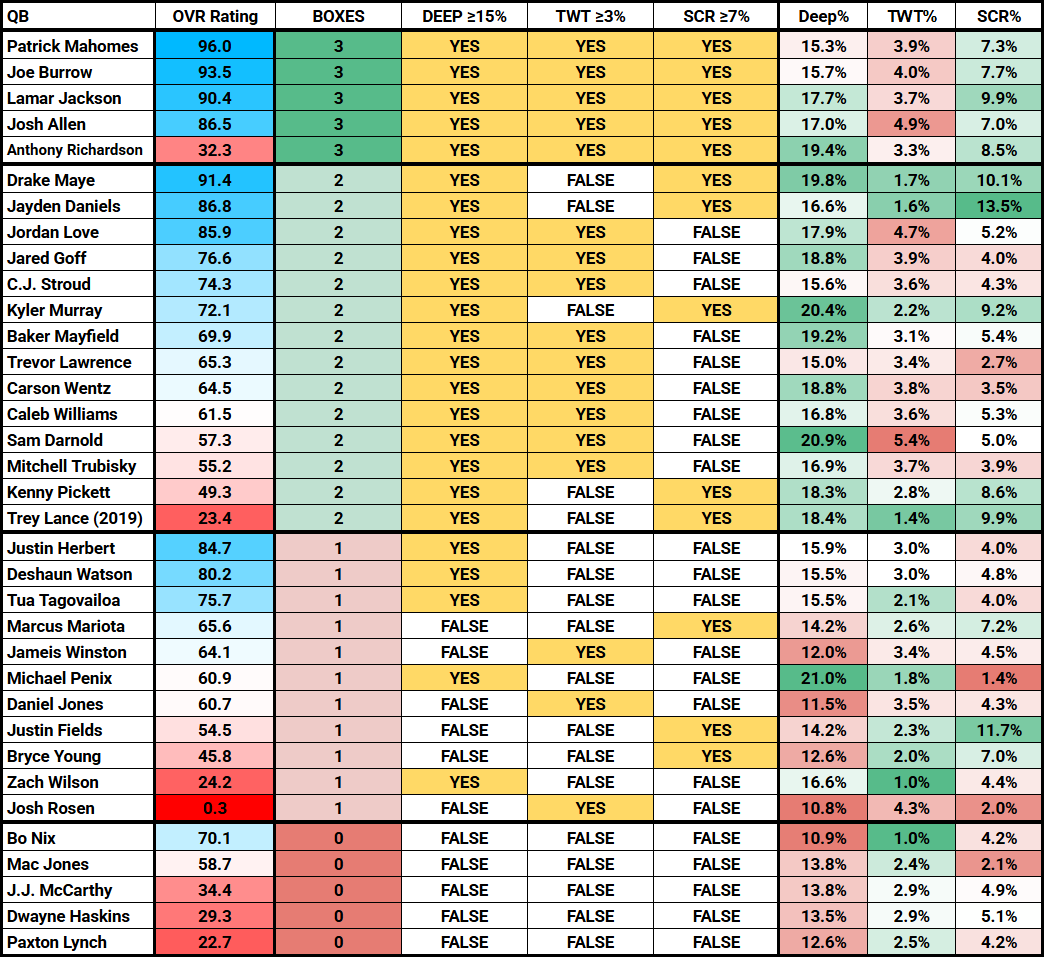

These were the average overall ratings (a representation of NFL success) for each group:
- 3 of 3 boxes checked: 79.8
- 2 of 3 boxes checked: 66.7
- 1 of 3 boxes checked: 56.1
- 0 of 3 boxes checked: 43.0
Given this data, it is concerning that some of the projected top quarterback prospects in the 2026 NFL draft failed to check more than one box. Indiana’s Fernando Mendoza and Alabama’s Ty Simpson checked one box apiece, while Oregon’s Dante Moore and Mississippi’s Trinidad Chambliss checked zero boxes.
I thought it would be interesting to take the analysis one step further. Using our 35-player sample of quarterback prospects from the past decade-plus, which prospects had the most similar profiles to the top 2026 prospects across these three critical metrics?
Let’s dive in.
Methodology
I calculated “similarity scores” between each of the 35 prospects in our data sample and four of the most widely discussed potential first-round targets for the Jets in 2026: Fernando Mendoza, Dante Moore, Ty Simpson, and Trinidad Chambliss.
Here’s how the similarity scores were calculated.
For all three of deep pass attempt rate, turnover-worthy throw rate, and scramble rate, I gave each prospect a 0-100 score, with the lowest number in the 35-player group getting a 0, and the highest getting a 100. I did the same for the four 2026 prospects.
In each metric, I compared how far away each 2015-2024 prospect was from the 2026 prospect in question. Then, I averaged their separation across all three metrics, yielding a single-number similarity score (the closer to zero, the more similar the prospects are).
For an example of how the calculation works, here is a breakdown of the numbers behind Mendoza and his closest comparison, Marcus Mariota.

Mendoza and Mariota were separated by 2.3 points in turnover-worthy throw rate, 5.0 points in scramble rate, and 2.0 points in deep pass attempt rate. Average those three numbers together, and you get a 3.1 similarity score. As you can see from the raw numbers (left side), it’s an accurate representation of how close the two prospects are in the three pivotal categories.
So, who were the top comparisons for Mendoza outside of Mariota?
Fernando Mendoza’s top comparisons
For clarity: These scores are not intended to identify prospects who are similar as overall players. We are solely evaluating similarity in these three particular metrics.
Here are the top five similarity scores for Mendoza:
- Marcus Mariota (3.1)
- Bryce Young (11.9)
- Justin Fields (12.9)
- J.J. McCarthy (13.0)
- Dwayne Haskins (13.4)
It’s not a promising group of comparisons for someone who might be the first overall pick.
Here’s a look at the Mendoza similarity scores for all 35 prospects:
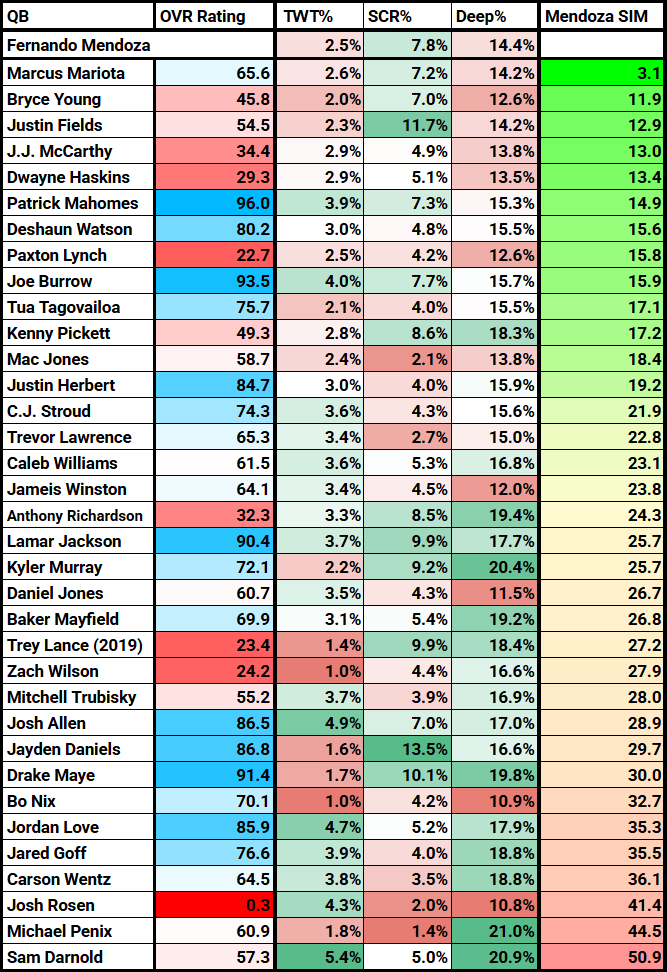
The good news for Mendoza is that just outside of his top five comparisons lies Patrick Mahomes.
The problem for Mendoza is that Mahomes reached all three of the benchmarks we established, whereas Mendoza only hit one. The two scrambled at a similarly high rate, while Mahomes isn’t too far ahead of Mendoza in deep pass attempt rate, but the main difference is that Mahomes threw significantly more turnover-worthy passes.
As counterintuitive as it may seem, that disparity is actually a bad sign for Mendoza’s NFL potential, at least based on the trends we’ve studied. Tossing more dangerous passes has been a positive indicator for first-round prospects; perhaps it signals their confidence, or maybe it shows that they did not play in a gimmicky college offense with plenty of easy throws schemed up for them.
Either way, it’s a proven positive to throw more turnover-worthy passes in college, and Mendoza is significantly behind Mahomes in that department.
Perhaps in the national championship, Mendoza will intentionally throw a bunch of passes to Miami defenders just to improve his standing in my silly models that I screenshotted off of Google Sheets.
Dante Moore’s top comparisons
Here are the top five similarity scores for Dante Moore:
- Dwayne Haskins (3.0)
- J.J. McCarthy (3.4)
- Paxton Lynch (5.5)
- Deshaun Watson (9.5)
- Marcus Mariota (10.3)
Moore’s profile is extremely similar to that of Haskins, McCarthy, and Lynch, who have combined for an average overall rating of 28.8 in the NFL. In terms of overall rating, they are three of the seven worst first-round quarterbacks among the 35 chosen from 2015 to 2024.
Moore can take solace in Deshaun Watson’s appearance in the top five. While Watson’s career was derailed by injuries and off-field drama, he was a star over the first four years of his career with the Houston Texans. Mimicking Watson’s first four years would be a great thing for any NFL quarterback; you just don’t want to copy what he did after that.
Mariota rounds out the top five. Watson is the only player among the top five who has displayed any semblance of star potential, and even he fizzled out quickly.
Here’s a look at the Moore similarity scores for all 35 prospects:
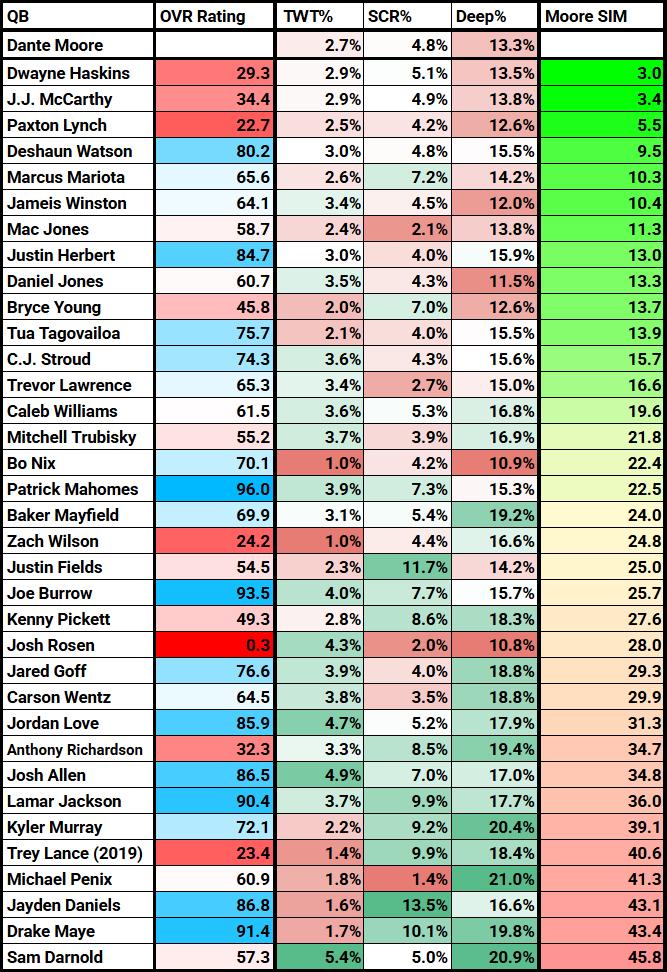
Moore’s profile is eerily similar to Haskins, McCarthy, and Lynch. All three players threw a slightly below-average rate of turnover-worthy passes, scrambled at a below-average rate, and threw deep passes at a well below-average rate.
Watson’s presence in the fourth slot gives Moore some hope, but after the top five, the next two players are Jameis Winston and Mac Jones. You have to go down to Justin Herbert at No. 8 to find an exciting comparison. Even then, Herbert threw deep significantly more frequently than Moore, which is crucial because deep pass attempt rate is the most predictive of these three metrics.
Of the top seven best quarterbacks in the 35-player sample (based on overall rating), none ranked top-16 in similarity to Moore. Most of the elite quarterbacks were among the least similar prospects to Moore.
If he does not return to Oregon to improve his profile before declaring for the draft, Moore would have to be a glaring outlier to succeed in the NFL.
Ty Simpson’s top comparisons
Here are the top five similarity scores for Ty Simpson:
- Dwayne Haskins (4.8)
- J.J. McCarthy (6.4)
- Marcus Mariota (9.7)
- Paxton Lynch (10.7)
- Jameis Winston (11.0)
We’re seeing a lot of consistent names popping up, and that’s because Mendoza, Moore, and Simpson are quite similar to one another in these three pivotal categories.
This is another underwhelming top-five. None of these five players have proven themselves to be franchise quarterbacks.
Beyond the top five, Simpson’s next-closest comparisons are Deshaun Watson, Bryce Young, Daniel Jones, and Justin Herbert.
Here’s a look at the Simpson similarity scores for all 35 prospects:
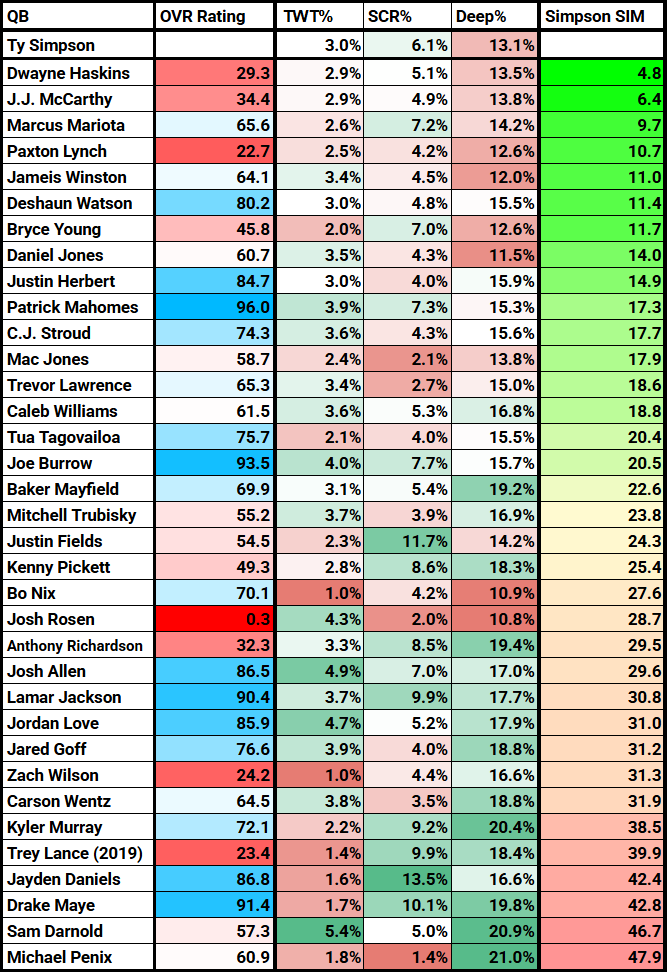
What’s really crushing Simpson is his lack of deep pass attempts. His turnover-worthy throw rate is just enough to meet the 3% benchmark, while his 6.1% scramble rate is not too far from the 7% benchmark. However, his 13.1% deep pass attempt rate is what separates him from the first-round hits and groups him with the misses.
Among the 12 closest comparisons to Simpson, there are four “hits” (70.0+ overall grade): Deshaun Watson, Justin Herbert, Patrick Mahomes, and C.J. Stroud. All four of those players exceeded the 15% benchmark for deep pass attempt rate. Meanwhile, all eight of the non-hits in Simpson’s top 12 closest comparisons failed to hit the 15% benchmark.
It speaks to the value of pushing the ball downfield in college. The more often a college prospect chucks bombs, the likelier he is to become an NFL star. Why is that the case? The reason is up for debate, but the correlation is impossible to ignore.
Trinidad Chambliss’ top comparisons
Here are the top five similarity scores for Trinidad Chambliss:
- Paxton Lynch (4.4)
- Dwayne Haskins (9.0)
- Bryce Young (9.0)
- J.J. McCarthy (9.4)
- Jameis Winston (10.4)
Of the four prospects in this article, Chambliss has by far the worst profile when it comes to these three metrics. With a 2.3% turnover-worthy throw rate, 4.9% scramble rate, and 12.3% deep pass attempt rate, he is nowhere close to any of the three ideal benchmarks.
In fact, Chambliss’ similarity score had the strongest correlation with NFL success among these four prospects. There was a correlation coefficient of 0.277 between Chambliss’ similarity score and NFL overall rating, meaning that the less similar a prospect was to Chambliss, the likelier it was that they succeeded in the league.
Here’s a look at the Chambliss similarity scores for all 35 prospects:
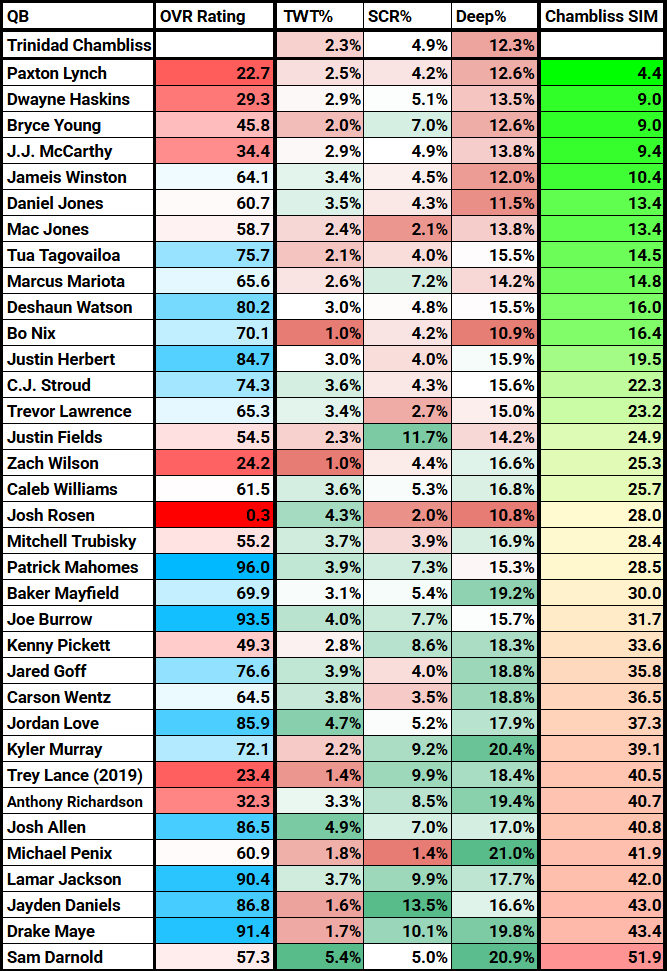
It seems that it would be a significant reach to take Chambliss in the first round.
Other quarterbacks
Here are the top five similarity scores for some of the other 2026 quarterback prospects.
Garrett Nussmeier, LSU
- 3.0% TWT
- 2.3% scramble
- 12.3% deep
- Josh Rosen (12.0)
- Daniel Jones (12.9)
- Jameis Winston (14.3)
- Mac Jones (16.2)
- Paxton Lynch (16.2)
Drew Allar, Penn State
- 2.6% TWT
- 10.8% scramble
- 8.2% deep
- Justin Fields (24.4)
- Bryce Young (29.4)
- Marcus Mariota (29.5)
- Paxton Lynch (33.3)
- Dwayne Haskins (35.3)
John Mateer, Oklahoma
- 4.1% TWT
- 6.1% scramble
- 12.7% deep
- Jameis Winston (12.0)
- Patrick Mahomes (13.3)
- Daniel Jones (13.4)
- Dwayne Haskins (14.5)
- Joe Burrow (15.0)
Carson Beck, Miami (FL)
- 1.9% TWT
- 6.5% scramble
- 13.3% deep
- Bryce Young (4.4)
- Marcus Mariota (10.2)
- Dwayne Haskins (12.1)
- Paxton Lynch (13.2)
- J.J. McCarthy (13.6)
Cade Klubnik, Clemson
- 2.2% TWT
- 3.7% scramble
- 12.4% deep
- Paxton Lynch (4.3)
- Mac Jones (10.5)
- Bryce Young (11.3)
- Tua Tagovailoa (11.7)
- Jameis Winston (12.6)
Takeaways
The numbers we’ve analyzed across these three articles seem to support the popular narrative that the 2026 quarterback class is quite weak. There isn’t a single quarterback who stands out as having a high chance of success based on their outputs in the most predictive metrics.
That does not mean any of these quarterbacks are guaranteed to fail. It simply means that a high percentage of quarterbacks with similar profiles have gone on to fail. There can always be exceptions.
Still, it’s wise for teams to play the odds. In the long run, if a team consistently makes decisions with high chances of success based on the information at their disposal, things should pan out for them over time. Any given pick can hit or miss based on sheer luck, but to achieve sustained success in the draft over an extended period, a sound decision-making process is necessary.
Will the Jets heed this advice and punt their quarterback pursuit to the future, or at least wait until after the first round to take a quarterback? Or will they force a first-round quarterback pick out of desperation, ignoring the clearly bleak odds of that decision working out?
Scouting the NFL draft is a fascinating science. Surely, every NFL team has created numerous models that are ten thousand times more complex than anything I could come up with. Yet, it is ultimately impossible for any of them to achieve the level of perfection that organizations are endlessly chasing.
Why? Well, the NFL, like any sports league, is a zero-sum game. That means for every success, there is an equivalent failure.
There is no world where every player can be successful.
Even if every team is using the same intelligently crafted models to inform their draft decisions, not every draft pick can pan out. It simply can’t happen. Every year, there will be an equal number of wins and losses handed out. Every time a good play is made, someone else on the field is the culprit for allowing it to happen.
For every slam-dunk draft pick, there has to be an equal and opposite bust. The law of averages deems it impossible for there ever to be an infallible formula for drafting football players.
So, at the end of the day, all teams can do is… well, heed the same advice that we’ve all gotten since we were four years old: try their best. Between the nerdy analytical models, the excruciatingly in-depth film reviews, and the good-old gut, teams combine all of the information at their disposal to make the most informed decision they can, and then, they just have to sit back and pray that things work out for them more often than not. It’s all you can really do.
But in a league where draft scouting becomes more and more detailed each year, it’s imperative to stay with the curve. While there will never be a substantial “edge” to be gained in a league where most of the 32 teams are following the same trends and have access to the same data and resources, it is possible to be behind the curve, putting yourself at a major disadvantage.
Projections like the ones we concocted in these articles are becoming a major driving force in the decisions teams make on draft weekend. They don’t always yield the best outcome, but they work out at a higher rate than rolling the dice. And that’s all that you can really hope for in the draft: to increase your chances by the slightest bit. If you ignore any type of information that can increase your chances of nailing a pick, you’re allowing the rest of the league to get a leg up on you.
The Jets have been behind the curve for well over a decade. By playing the odds, general manager Darren Mougey can get New York with the times.
Mougey must ensure the Jets adhere to an informed decision-making process on a yearly basis. They have to stay the course, even if it means passing on prospects they love or making decisions that are unpopular among the masses. What will burn this regime in the long run is the infamous “we can fix him” mentality.
This is the line of thinking that usually dooms old-school coaches and general managers in today’s information-driven league. They see a prospect, fall in love with the positives, and convince themselves they can fix the negatives, causing them to overlook obvious red flags. This is how players get overdrafted, and as teams stockpile these whiffs, they end up getting less impact out of their draft classes than the rest of the NFL over time.
Mougey and Jets head coach Aaron Glenn took a “we can fix him” approach at the quarterback position in 2025, committing to Justin Fields and making him their starter with no competition. It failed miserably. Was that a sign that the Glenn-Mougey regime will operate this way in the draft moving forward?
For Jets’ fans sake, they had better hope not, especially at the quarterback position.
A pragmatic decision-maker would see the numbers we looked at today and run for the hills to get away from these quarterback prospects. A “believer,” constricted by his hubris, would convince himself that he knows better the numbers and can coach up a guy to exceed expectations.
The Jets will understandably feel the pressure to take a quarterback early in this year’s draft. But if they get this pick wrong, it could set the franchise back another five-plus years, while probably costing Mougey and Glenn their jobs, as it did for Joe Douglas and Robert Saleh. Perhaps waiting one more year to pick the right guy is the smartest move when the odds deem that there is a pretty good chance the Jets would get it wrong by picking someone in the first round this year.
At least, that’s what the projections say. But what do the projections know? They’re just dumb numbers for dorks who have never strapped on a helmet. Football is played on a field, not a spreadsheet, dammit!
Have these projections reshaped your perspective on the 2026 quarterback class? Or are these nothing more than the ramblings of a nerd who needs to close out the spreadsheet and turn on the tape?
It will be interesting to look back on this article in a few years and see whether any of these quarterbacks buck the trends, or if the warning signs were right all along.
