
A lot will change between championship Sunday and the NFL draft, including the Senior Bowl, the combine, and pro days.
For now, though, here are three prospects that the New York Jets should be extremely wary of selecting in the first round of the NFL draft.
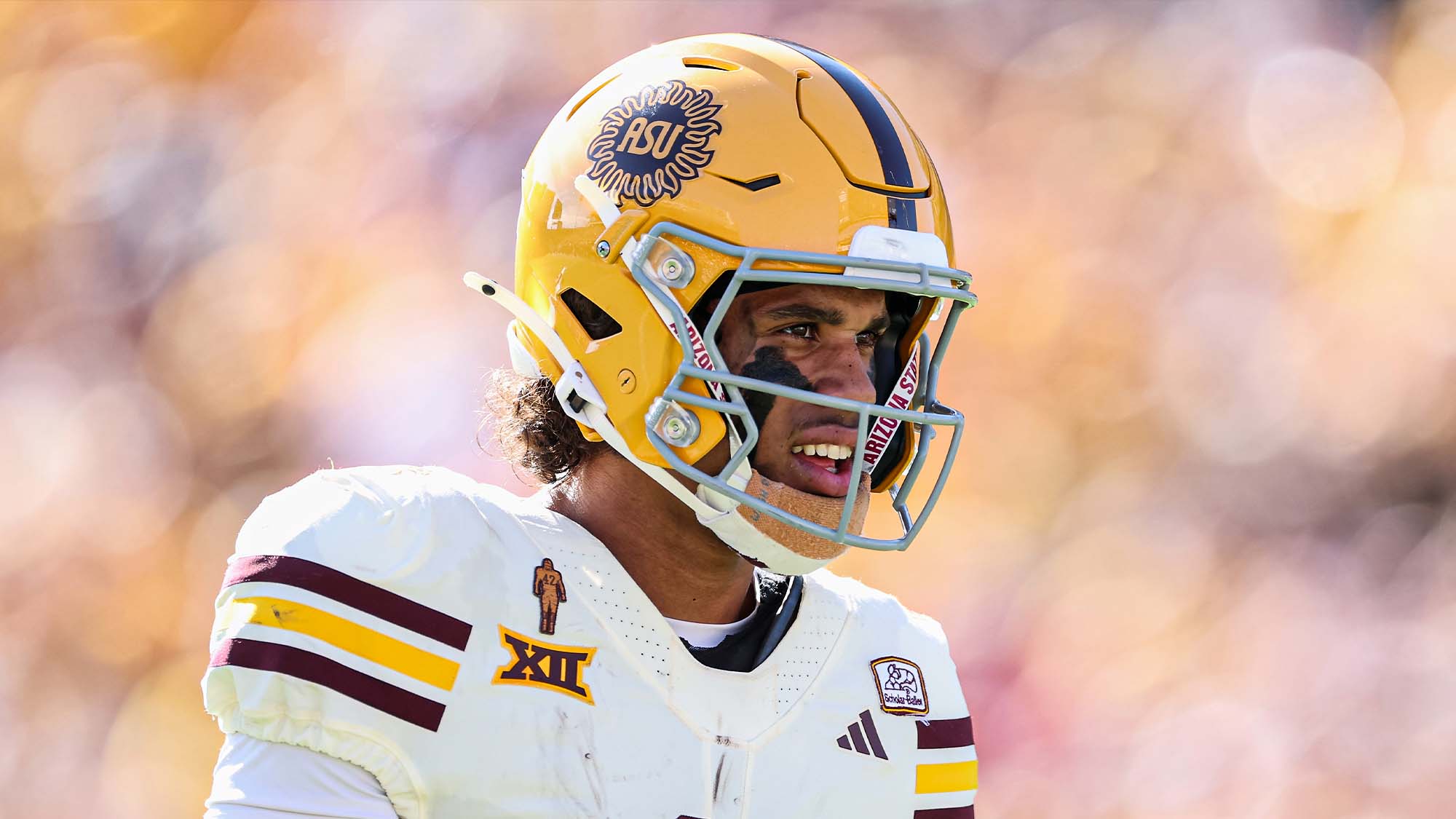
Jordyn Tyson, WR, Arizona State
- Consensus big board rank: No. 8 (WR2)
The 6-foot-2, 195-pound wideout burst onto the scene in 2024 as a redshirt sophomore, when he posted 75 receptions for 1,101 yards and 10 touchdowns (12 games). This put Tyson on the radar as a premier prospect entering the 2025 season.
Tyson’s production declined in his redshirt junior season. In nine games, Tyson had 61 receptions for just 711 yards, although he still hauled in eight touchdowns.
Tyson’s production was affected by a hamstring injury that he suffered in October, causing him to miss three games. Upon returning, Tyson was not the same player, producing at a much lower level than he did before the injury.
This extended a long track record of injuries for Tyson. In his 2022 true freshman year, while at Colorado, Tyson suffered a torn ACL, MCL, and PCL, which cost him the 2023 season. In 2024, he missed the College Football Playoff with a collarbone injury.
Tyson’s injury history and less-than-stellar production in his final college season make him an unappealing prospect relative to his stock as a potential top-10 pick.
Based on his 2025 performance in metrics that tend to correlate with NFL success for first-round wideouts, Tyson projects as having a low chance of becoming the superstar-type receiver that you’d hope to land in the top 10. With low marks in yards per route run (2.37) and contested-catch rate (43.8%), his production profile is less promising than multiple receiver prospects who are ranked lower on the consensus big board, like USC’s Makai Lemon and Washington’s Denzel Boston.
In fairness to Tyson, the hamstring injury affected his production, but it is hard to use the injury as an excuse when it adds to a long-standing track record of injuries.
While teams will remain intrigued by Tyson because of his 2024 season, it is crucial to be cautious with wide receiver prospects who peaked before their final college season. In 2020, the Eagles drafted TCU’s Jalen Reagor despite his yardage total dropping by 450 from his sophomore season to his junior season (in one fewer game). The man taken directly after him? Justin Jefferson.
Injury-prone with less-than-ideal production in 2025, Tyson is someone to stay away from in the top half of the first round.
Trinidad Chambliss, QB, Ole Miss
- Consensus big board rank: No. 44 (QB3)
A late riser thanks to his magical run in the College Football Playoff, Trinidad Chambliss is sneaking into first-round conversations.
However, it has a lot more to do with the lack of talent in this year’s quarterback class than it does with Chambliss himself.
Across the board, Chambliss does not profile as the type of quarterback prospect who should be chosen in the first round. He is listed at a generous 6-foot-1 and 200 pounds, and he is a six-year college player who played his first five seasons at Division II Ferris State.
Chambliss transferred to Ole Miss in 2025 and had an efficient season, tossing 22 touchdowns to three interceptions while adding eight scores on the ground.
Even at Ole Miss, though, Chambliss didn’t show the stuff that usually translates to success for highly drafted passers. Chambliss does not meet the ideal threshold in any of the three metrics that correlate the closest with NFL success for first-round quarterbacks since 2015: deep pass attempt rate, turnover-worthy throw rate, and scramble rate. This seemingly gives him a low chance of succeeding at the next level relative to your average first-round prospect.
If the Jets love Chambliss, they can wait and see if he lasts beyond the first round. This is not the type of prospect that demands a first-round investment, though. He is undersized, is relatively old for a first-rounder (will be 24 in Week 1), did not break out until his sixth season, has limited Division I starting experience, and does not excel in metrics that matter for NFL projection.
Ty Simpson, QB, Alabama
- Consensus big board rank: No. 20 (QB2)
Staying with the quarterback theme, the Jets would also be wise to steer clear of Ty Simpson.
To be clear, Simpson is a much more viable first-round prospect than Chambliss. Simply based on his film, Simpson offers plenty to work with, and it could even be said that he is underrated by fans and draft analysts.
However, there are too many red flags associated with Simpson to justify the Jets using a first-round pick on him while they still have countless roster holes to fill. That goes for the No. 2 slot and No. 16.
First and foremost, Simpson is coming to the NFL with just 15 college starts under his belt. That is a bright-red flag. Since 2015, the only quarterbacks to be taken in the first round with under 20 college starts are Kyler Murray, Trey Lance, Mac Jones, Dwayne Haskins, Anthony Richardson, and Mitchell Trubisky.
It wouldn’t be a wise bet to hitch your wagon to the next player in a group like that.
Simpson also looks underwhelming in the same three correlative metrics that we alluded to for Chambliss; he does not fare quite as poorly as the Ole Miss product, but the outlook is still daunting.
Among first-round quarterbacks chosen from 2015 to 2024, the five closest comparisons to Simpson, based on their performance across three of the most correlative metrics for first-round QB prospects (deep pass attempt rate, turnover-worthy throw rate, and scramble rate), are Dwayne Haskins, J.J. McCarthy, Marcus Mariota, Paxton Lynch, and Jameis Winston.
In many ways, Simpson would be an outlier if he became a good starter in the NFL. Whether they love his film or not, the Jets should trust in what history is telling them.
