
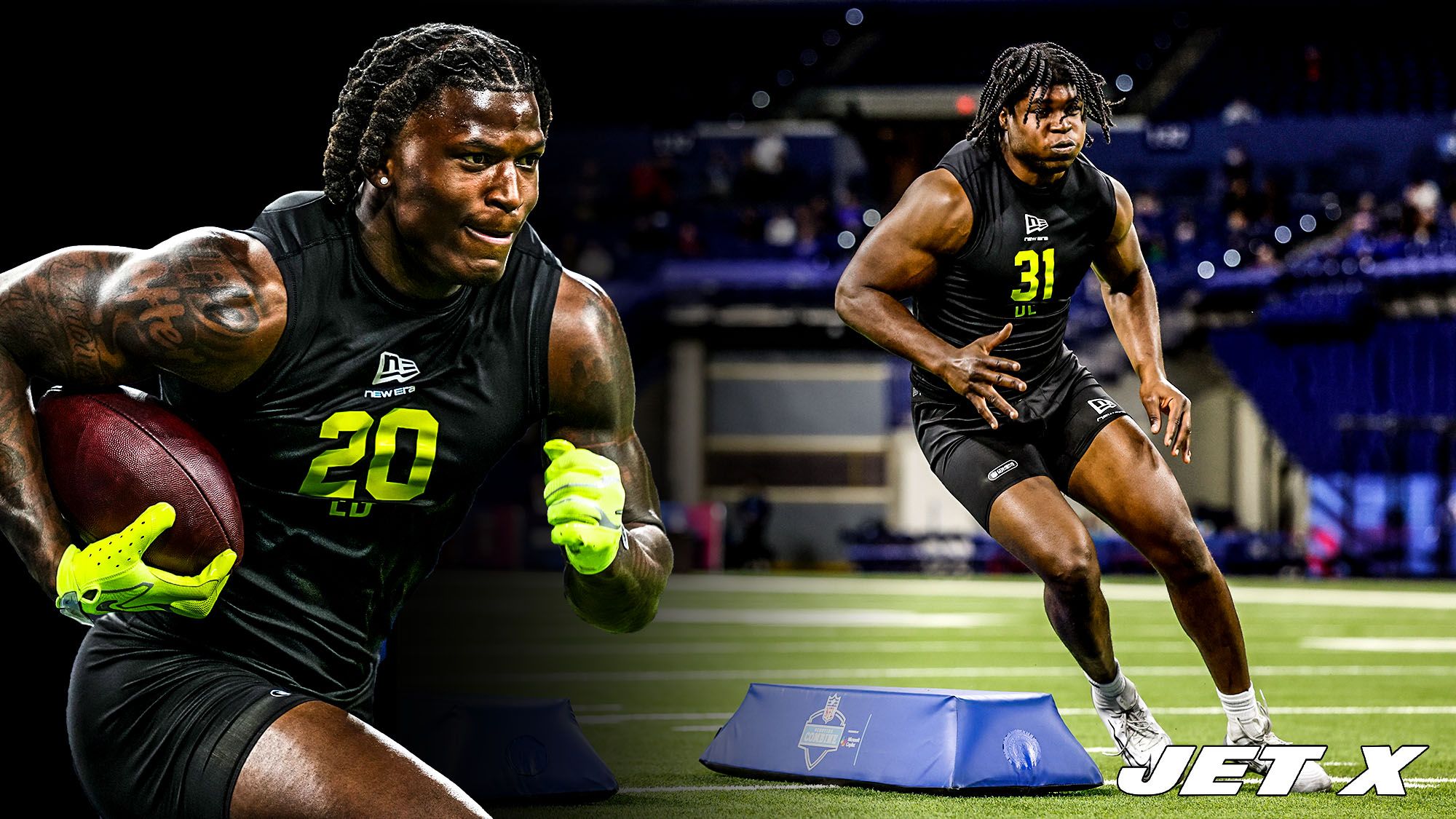
Despite having already argued it in late January, it’ll have to happen again. Only this time, instead of the calls for Rueben Bain Jr., another name is shortsightedly being shouted over the only appropriate New York Jets’ selection at No. 2.
The only two possible ways somebody could earnestly believe David Bailey is the better prospect than Arvell Reese are as follows:
- The analyst is only considering the pass-rush skill set at the EDGE position.
- The analyst is frightened without having the comfort of watching Reese play full-time EDGE at Ohio State.
That’s it. Either of those ideas, or a combination of the two, represents the lone reasoning behind any human being actually believing Bailey should be the New York Jets’ pick at No. 2 (over Reese).
My good people, it’s not even close.
David Bailey often works to get around run-game blocks. Arvell Reese has no problem taking them head-on (when necessary).
That alone is a tremendous starting point for analyzing the two players.
Comfort often rules emotions
Especially in New York Jets land, the idea of comfort rules all emotions. Hey, how could it be any different after experiencing 15-straight playoff-less seasons?
For this reason, many confused fans pine for David Bailey over Arvell Reese.
What those folks are essentially saying is, “Yes, let’s draft the known quantity in Bailey, the guy for whom evidence exists as a pass-rusher, over the player who may have a higher ceiling but feels so much more uncomfortable.”
Do you realize what this means?
Drafting Bailey potentially doubles up on the one-dimensional EDGE. New York’s lone near-starting-caliber EDGE defender is Will McDonald, whose skill set will never be confused with a versatile player at the position.
The Texas Tech product only showcases just one potentially elite trait at the NFL level: pass-rushing. That’s literally it. Not even the Red Raiders were confused about this, leading to plenty of occasions when Bailey didn’t even play on balanced (potential rush-first) downs.
Don’t get it twisted: The claim isn’t that Bailey is horrible against the run, or that he’s a complete bum in the all-around game; it’s instead about the very real idea that only his pass-rushing ability is elite enough to fit into the valuable territory of a No. 2 overall selection.
That’s the key here. The No. 2 selection must be viewed in the rarest of fashions.
Due to Reese’s absurd all-around ability that can lock down the entire side of his field — EDGE squeeze, 1v1 in the flat, chasedown against receiver screens, rushing the passer, etc. — he’s the clear-cut choice for the Jets.
It’s such a non-competitive matchup that, not only is Reese’s ceiling exponentially higher than Bailey’s, but his floor is as well. How does an argument begin for Bailey to be the safer choice than Reese, when the latter’s do-it-all versatility gives him that many more avenues to make an elite-level impact at the next level?
It’s not that Bailey should be avoided entirely. I’d certainly draft the kid; it would just never happen at No. 2.
Bailey is too one-dimensional for No. 2
When watching Bailey on tape, there’s a lot to dislike. His highlights are good-looking, but that’s usually due to a highlight reel jam-packed with passing downs he can take advantage of in a 1v1 fashion (pure pass-rushing).
When genuinely analyzing his game, however, he cannot even dare dream of approaching Reese. His movement is anything but fluid, and he cannot play in space effectively at the NFL level.
Here’s the worst part: Bailey will absolutely be a non-entity against the point-of-attack (rushing concepts straight at him) as soon as he sets foot on the professional field. Sure, he can chase down the line from the backside, but a guy like this, who a team plans to play on every down, will be regularly exposed.
Hey, Jets fans: How has your team’s defense fared as McDonald saw more playing time? Nobody’s claiming it’s as easy as blaming McDonald, only that his apparent one-dimensional ability is a crippling factor in playing team defense.
Other than the 40-yard dash, the combine did Bailey no favors. His stiffness and rigidness are tough to ignore when watching him in any change-of-direction drill.
By the numbers
Meanwhile, Reese’s raw attributes and all-around game scream “elite” in every way. In fact, a tremendous argument could be made that Reese is already the better pass-rusher, despite his inexperience at the spot.
Per Pro Football Focus, David Bailey played 623 total snaps this past season (14 total games), with 554 of those coming at EDGE. Meanwhile, Reese accumulated 651 total snaps (also 14 games), with 144 coming at EDGE.
Breaking it down further, to purely pass-rush snaps, here’s how the stats break down:
- Bailey: 380 pass-rush snaps: 15 sacks and 81 pressures
- Reese: 119 pass-rush snaps: 8 sacks and 27 pressures
Reese saw just 31.31% of the pass-rush opportunities Bailey did from EDGE this past season, and yet his sack output is 53.33% of the way there. Moreover, Reese’s pressures would project out to 86.23, had he experienced 100% of the 380 total pass-rush snaps Bailey experienced (while finishing with 81 pressures).
Guess what Reese’s sack number would be? Here’s the answer: 22.36.
Projecting out the numbers looks like this, head-to-head:
- Bailey: 15 sacks and 81 pressures on 380 pass-rush snaps
- Reese: 22.36 sacks and 86.23 pressures on 380 pass-rush snaps (projected out per the math)
To recap: Reese does not have nearly the same opportunity to refine his pass-rushing craft, yet his numbers project to be better than Bailey’s when given the same number of pass-rushing opportunities. Is that correct?
Oh, all while doing it in the Big Ten.
Pass-rushing changes
Today’s NFL isn’t what it used to be. The rise of much quicker passing via the three-step drop has led to an overhaul of how defensive coaches think about the game.
No longer can defensive play-callers simply tell Reggie White, “Hey, big fella, go get the quarterback any way you can.”
No. No. No. That’s not how it works.
Sure, there are pure passing downs that allow EDGE rushers to pin their ears back and use whatever lane they want — en route to a potential sack — but it’s become much more convoluted.
Not only have the pass-rushing chances decreased, thanks to how much quicker the ball is being released, but the mobile quarterback forces entire defensive lines to play conservative contain rules. Quite literally, teams that play Lamar Jackson often place their four-man defensive line into a patient squeeze contain on every single play.
Granted, specific situations allow the defensive coordinator to game something up front and/or give his best pass-rusher freedom to go hog-wild, but game-planning rules must obey such a strict pocket contain against certain quarterbacks.
Reese is what 2026 is about
Folks, the secret is out, and it’s been widely available for quite some time: All-around ability is the thing that gives defenses the best ability to thrive in today’s climate.
Arvell Reese is a versatile monster who can do it all.
From possessing freaky strength at 243 pounds that allows him to play more violently than anybody in this player pool, to shutting down receivers and backs in 1v1 space opportunities (as a front-seven player), the kid had to have been created in a lab somewhere — specifically designed to anchor an NFL defense in the year 2026, a landscape that demans speed, quickness, and open-field ability from 9 of 11 defenders (save for the interior big heavies).
This is why the old-school John Lynch-type strong safety is extinct. This is why NFL safeties and linebackers are asked to be equipped with speed and man-coverage ability.
This is also why, when folks view the EDGE position so narrowly-minded that all they think about is the glorified yet overrated number known as “sacks,” they run into tremendous trouble.
The New York Jets would absolutely be committing football malpractice by selecting David Bailey over Arvell Reese in the 2026 NFL draft.
Oh, and don’t worry; the film sessions on both players — along with Caleb Downs and Sonny Styles (the only appropriate other yet lesser considerations at No. 2) — are coming.
