

The New York Jets’ roster looks drastically different from how it did on Monday morning.
As a result, many returning players have a more treacherous route to playing time than they did when they woke up on Monday.
The Jets’ first wave of roster additions has left one notable player in limbo.
Will McDonald’s future in New York is blurry
Even before the Jets made any moves, Will McDonald entered the 2026 offseason in a precarious position with the Jets. His first season under Aaron Glenn was anything but a smooth transition from Robert Saleh’s scheme.
After breaking out to the tune of 10.5 sacks, two forced fumbles, and three pass deflections in 2024, McDonald dropped to 8.0 sacks, no forced fumbles, and no pass deflections in 2025 (although he played two fewer games). Half of those eight sacks came in one game against a Browns team that ranked as the NFL’s worst in pass protection, per Pro Football Focus’ pass-blocking grade.
Most alarmingly, McDonald dropped 30 spots on the leaderboard in total pressures. He tied for 13th among edge defenders with 61 total pressures in 2024, only to place 43rd with 42 total pressures in 2025.
All the while, McDonald remained one of the lowest-graded run defenders in the NFL. His 41.4 run defense grade from Pro Football Focus was the worst among edge defenders with at least 500 defensive snaps. This was a continuation of his 2024 struggles against the run (39.5 grade).
On top of that, McDonald was one of the least reliable tacklers in football, regardless of position. His 30.3% missed tackle was the fifth-highest among the 347 defensive players to log at least 500 snaps.
When Aaron Glenn took over play-calling, presumably signaling a transition to a scheme similar to the one he ran in Detroit, McDonald already seemed like a potential misfit, especially after a down year in 2025. The Jets’ early free agency moves further supported the idea that they do not see McDonald as a core defensive piece.
The Jets signed two edge defenders to eight-figure salaries, Joseph Ossai and Kingsley Enagbare. To be fair, they just traded Jermaine Johnson, opening an extra hole that needed filling. But the Jets are still projected to take an edge defender with the second overall pick, which would push McDonald another rung down the depth chart.
When it’s all said and done, the Jets will arguably have three edge defenders slotted above McDonald on the depth chart for New York’s base 3-4 packages: Ossai, Enagbare, and the second overall pick.
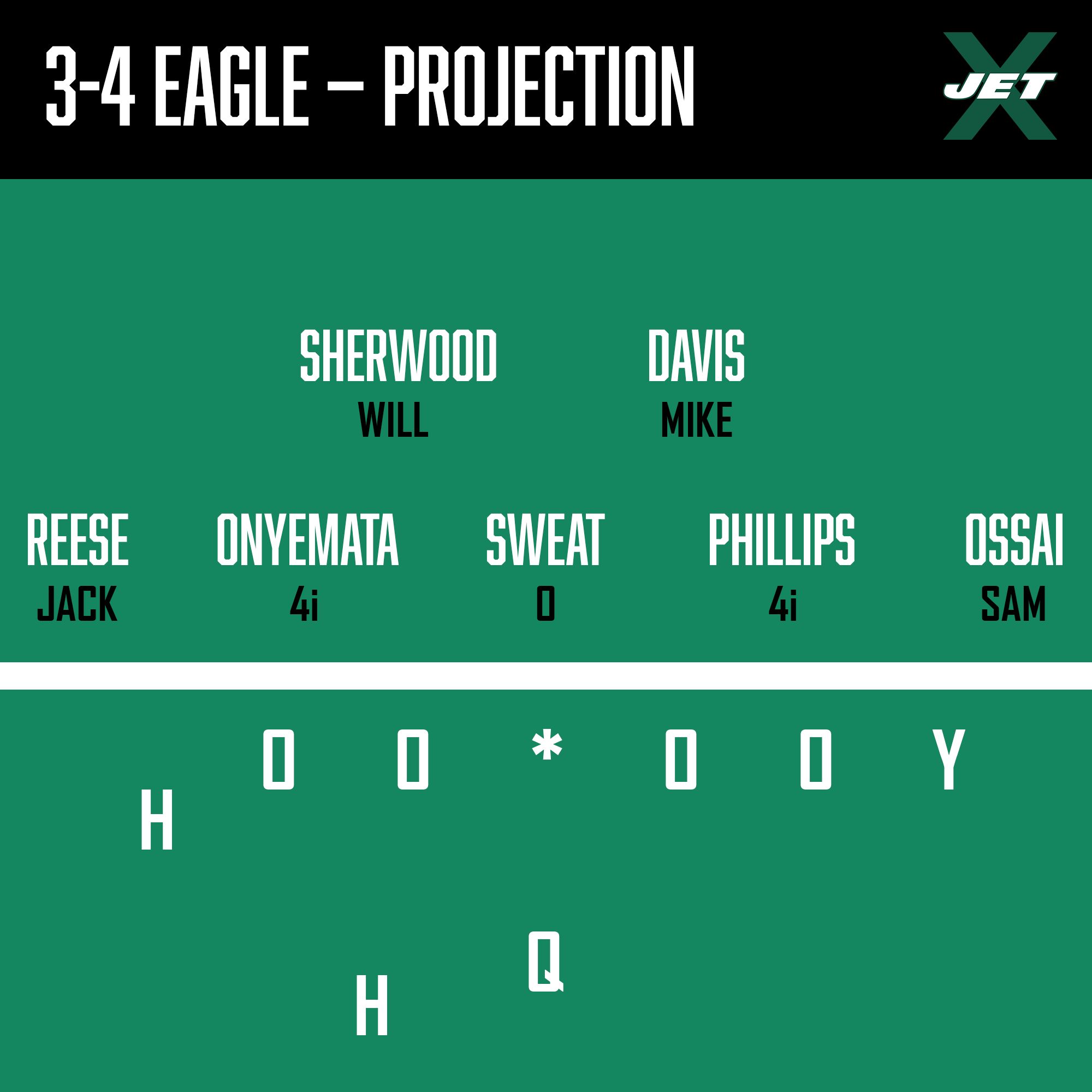
Ossai and Enagbare are not necessarily good enough players (or expensive enough investments) to preclude McDonald from winning a starting spot and resuming his trajectory from where it left off in 2024. It would be a stretch to say that those signings mean that McDonald no longer has a chance of becoming a star in New York.
However, given that both players are at least 13 pounds heavier than McDonald, New York may view them as better fits for Glenn’s vision than McDonald. They are more reliable run defenders, with the size and aggression to set the edge that McDonald lacks.
That makes them better fits for a coach who seems to prioritize two-gapping principles (read-and-react rather than attack). Glenn also values defensive linemen with the versatility to handle multiple roles, which is another box that both Ossai and Enagbare check, as both have more experience dropping into coverage than McDonald.
As things stand, with Ohio State’s Arvell Reese projected to be the Jets’ penciled-in second overall pick, McDonald is on track to enter the season as a third-down specialist. It’s a role that he would likely thrive in, even if it isn’t exactly what you’d hope to get out of a top-15 draft pick.
For now, all we can do is speculate. Soon, though, the Jets will send a message regarding how they feel about McDonald’s future with the team. They have until May 1 to decide on his fifth-year option for the 2027 season.
Jets general manager Darren Mougey sounded optimistic but non-committal when talking about McDonald at the NFL Scouting Combine.
“(We) feel really good about Will and that being a possibility,” Mougey said.
If the Jets accept McDonald’s option ($14.5 million for 2027), it would signal that they still view him as a core part of their defensive plans. What remains to be seen, however, is precisely what his role will be in those plans.
Are the Jets okay with committing to McDonald long-term as a pass-rush specialist? Or, perhaps they still think he can be more than that, with their recent free agent pickups simply being hedge bets in case he doesn’t reach that ceiling.
But if the Jets decline McDonald’s option, it would send a clear message that he simply is not viewed as a fit in a revamped defensive scheme led by Glenn and Glenn only. That may even open the possibility of trading him.
Where does McDonald go from here?
McDonald entered the 2026 offseason as one of the Jets’ most polarizing players. New York’s recent free agency moves have only widened the spectrum of outcomes that he could ultimately deliver.
On one hand, we have a speed demon with an arsenal of pass-rush moves who racked up 10.5 sacks, over 60 pressures, multiple strip-sacks, and a plethora of drawn holds in just his second NFL season.
On the other hand, we have one of the game’s weakest run defenders and tacklers in a defensive scheme that prioritizes those skills heavily, all after a third season in which his pass-rush production declined.
McDonald could go down as one of the best pass rushers the Jets have ever had. He could also become an afterthought who eventually gets booted, ultimately resulting in him becoming either the Jets’ next great “what-if” or their next notorious bust.
His outlook with the team feels as hit-or-miss as his typical rep on the field. He might throw the cleanest spin move you’ve ever seen, roasting the left tackle for a crushing strip-sack within 2.5 seconds, or he might run himself out of the play to allow a 50-yard run into his gap.
Are the Jets willing to live with the misses to reap the hits?
