
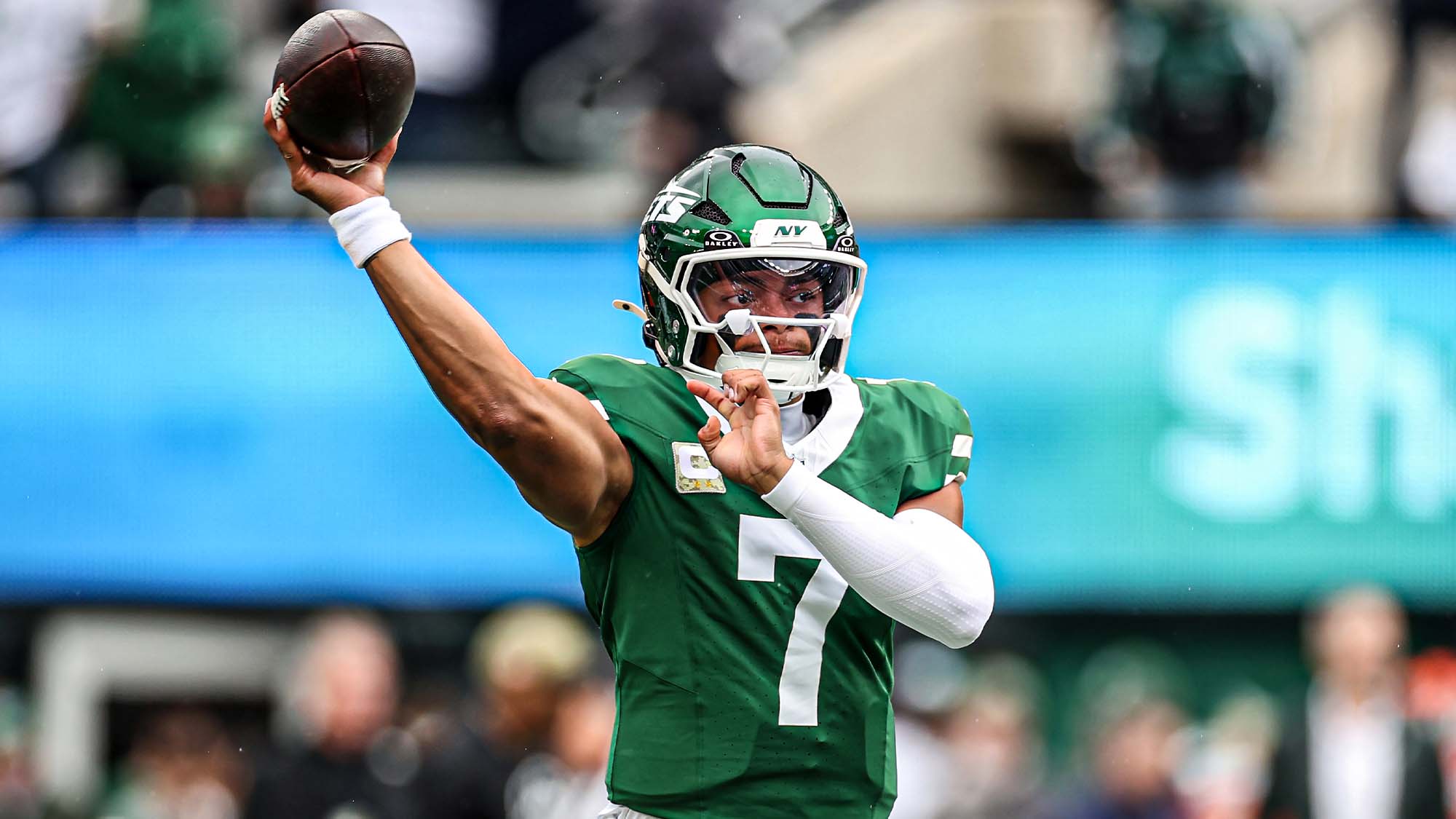
The New York Jets have traded Justin Fields, just as we predicted at Jets X-Factor less than an hour before the deal went down.
Fields is off to the Kansas City Chiefs, where he will have an opportunity to start in Week 1 for the injured Patrick Mahomes. The Jets have received a 2027 sixth-round pick in exchange for Fields, a return they will gladly accept for a quarterback who failed to net 100 passing yards in four of his nine starts this past season.
Alongside the incoming draft pick, the deal also features important salary cap ramifications for the Jets.
To facilitate the trade, New York will pay $7 million of Fields’ $10 million guaranteed base salary for the 2026 season.
While this sounds like the Jets are doing the Chiefs a favor, it is actually quite the opposite. Because Kansas City was willing to take on $3 million of Fields’ guaranteed base salary (rather than make New York assume the entirety of it), the Jets have saved more cap space by trading Fields than they would have by releasing him.
If the Jets released Fields, they would have been on the hook for his $10 million guaranteed base salary and his $12 million in remaining signing bonus money. That’s $22 million in total. That money could have been spread out differently depending on whether the Jets released him pre- or post-June 1, but it would have been $22 million in total dead money either way.
Instead, the Jets are only on the hook for $7 million of Fields’ guaranteed base salary. They will still be responsible for the $12 million in remaining signing bonus money, which brings Fields’ dead money to $19 million.
This means the Jets have saved $3 million in immediate cap space by trading Fields ($19 million in dead money) instead of releasing him ($22 million in dead money).
Compared to his previous cap number when he was on the roster, the Jets are saving $4 million on their 2026 cap sheet by trading Fields. He was due to have a $23 million cap hit and will instead have a $19 million cap hit after being traded. If Fields were released pre-June 1, the Jets would have saved only $1 million, as his cap hit would have been $22 million.
A post-June 1 cut would have yielded $10 million in 2026 cap savings for the Jets, but that is only because it would have pushed $9 million in dead money to 2027.
Another important note is that the Jets no longer owe any money to Fields beyond the 2026 season. Before the trade, Fields was due to have his $9 million in remaining signing bonus money accelerate onto the 2027 cap. Instead, the Jets are already paying that out in 2026, so they will no longer be attached to Fields after this season.
Add it all up, and the Jets saved $13 million by trading Fields. His 2026 cap hit has been reduced by $4 million compared to his projected cap number beforehand, while the Jets will also be free from the $9 million he was projected to be owed in 2027 since the trade accelerated that money onto the 2026 cap.
To recap, the Jets’ $13 million in total savings come from the $10 million in non-guaranteed 2026 base salary that has been cleared, and the $3 million in guaranteed salary that Kansas City agreed to pay.
Toss in a sixth-round pick, and it’s a deal well worth it for a Jets team that had no plans for Fields anyway.
