

Scheme fit is one of the most underrated factors of the NFL draft.
Any given prospect could be much higher on one team’s board than another team’s board simply based on how well they fit into each team’s projected scheme. This factor is often what explains why a prospect is drafted far earlier or later than fans expect.
The New York Jets are likely to select a quarterback at some point in the 2026 NFL draft. As they evaluate their options, scheme fit will be paramount. There aren’t any slam-dunk prospects in this class, so each team’s quarterback rankings will depend greatly on scheme fit.
We can only speculate what the Jets’ offensive scheme will look like in 2026 under new offensive coordinator Frank Reich. However, we can use Reich’s historical tendencies as a guideline.
Based on Reich’s past tendencies as a play-caller, which 2026 quarterback prospects could be considered the best scheme fits for the Jets?
4 levels of the field
Here is a look at how often Reich’s teams targeted each level of the field across his six most recent seasons as an NFL head coach (2018-23):
- Behind line of scrimmage: 14.8% (2025 NFL average: 15.4%)
- Short (0-9 air yards): 45.9% (2025 NFL average: 44.1%)
- Intermediate (10-19 air yards): 21.8% (2025 NFL average: 20.8%)
- Deep (20+ air yards): 9.8% (2025 NFL average: 11.3%)
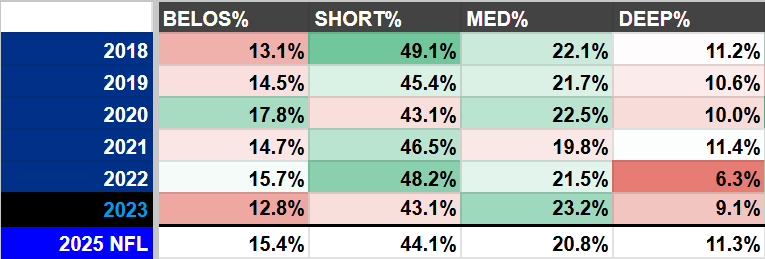
Reich clearly prefers the short and intermediate areas of the field, at the cost of fewer checkdowns/screens and fewer deep shots. If he plans to uphold these tendencies in New York, the Jets should be looking for quarterbacks who are at their best in the short and/or intermediate areas.
One way we can identify the best fits in this regard is to analyze the Pro Football Focus grades generated by each prospect on their throws to each area of the field.
PFF’s grades are a solid all-encompassing metric for the purpose of this study. They account for accuracy, attempt difficulty, big-time throws, turnover-worthy throws, and more contextual factors that would be missed if we relied on a metric like passer rating or completion percentage. What we want to do is quantify players’ talent in each specific part of the field, and this is the best available number to do that.
On that note, here is a look at the Pro Football Focus grades at each target depth from 11 different quarterback prospects.

Given that Reich targeted short throws 1.8% more often than the 2025 NFL average and intermediate throws 1.0% more often, the Jets would be wise to target quarterbacks who are at their best in those two areas.
Only three of the 11 listed quarterbacks exceeded the group-average grade in both the short and intermediate areas: Fernando Mendoza, Ty Simpson, and Diego Pavia.
Mendoza, of course, is not in play for the Jets. Simpson, though, is very much in play. Pavia is a late-round option.
For Simpson, this is an encouraging sign regarding his hopes of convincing the Jets to draft him early. He is the highest-graded intermediate passer of the group, which would bode well in a Reich offense that loves in/dig routes. Simpson’s short passing was not quite as pristine as Mendoza’s, but it was still better than most of the class.
Pavia, meanwhile, emerges as an interesting Day 3 target. His stock is low due to his 70 starts across six college seasons and a 5-foot-10 frame, but the Heisman Trophy runner-up was razor-sharp on short and intermediate throws, which could capture Reich’s heart.
Meanwhile, no one else on this list stands out when it comes to maintaining efficiency across the short and intermediate areas.
Taylen Green is an excellent intermediate thrower, while Luke Altmyer is strong in the short area, but they each failed to impress in the other area. Every remaining quarterback, including players like Carson Beck, Garrett Nussmeier, and Drew Allar, had a below-average combined short/intermediate grade.
What does it mean?
If the Jets discover more data like this in their analysis of the 2026 quarterback class, it could be enough to convince them that it would be worthwhile to select Simpson early instead of waiting to take one of the lower-ranked quarterbacks. As large as the overall talent drop-off already is between Simpson and the pack (he is 46 spots ahead of the QB3 on the consensus big board), there is a similarly large drop-off in scheme fit with the Jets.
The data we looked at today strengthens the argument that using an early second-round pick on Simpson would be a better value than, say, using a fourth-round pick on Beck or Allar, even given the investment discrepancy.
But are these numbers enough to make Simpson a justifiable first-round investment?
That seems to be the looming dilemma in the Jets’ quarterback pursuit as the NFL draft draws near.
If Simpson makes it to the second round, New York may have a hard time passing up on him. The million-dollar question is whether the Jets love Simpson enough to either select him at No. 16 or trade back into the first round to secure him.
Today’s data supports the case for that type of aggressive Simpson pursuit, but is it enough to override red flags such as his lack of college starts and his poor second half of the 2025 season?
Simpson continues to become a more polarizing prospect by the day.
