

On Wednesday, we broke down three luck-based factors that need to bounce the New York Jets’ way for them to make a playoff push in 2026.
This time, we’ll be focusing on New York’s top five “swing factors,” i.e., controllable elements with a wide spectrum of possible outcomes. Each of them will play a central role in determining the team’s overall ceiling.
If the Jets can get at least three of these five swing factors to yield the best-case outcome, New York’s 2026 season could be more fruitful than many people expect.
1. Olu Fashanu’s Year 3 leap
When the Jets selected Olu Fashanu with the 11th pick in the 2024 draft, the hope was that he could develop into an elite pass-blocking left tackle. Fashanu was the consensus OT2 in the class, and he was often mocked as a top-five talent in the draft as late as February.
Going into Year 3, Fashanu is the type of player who should still have an upward trajectory in front of him. He mostly redshirted his rookie season, starting just five games at left tackle. After starting all 17 games in 2025, Fashanu enters the 2026 season as a 23-year-old player with 22 starts of experience.
That leaves Fashanu poised for a major Year 3 leap, especially with his blue-chip talent level.
So far, Fashanu has been a solid, albeit unspectacular starter for New York. In 2025, his 69.2 overall grade at Pro Football Focus ranked 17th out of 31 qualified left tackles. He placed 24th as a run blocker (57.1 grade) and 15th as a pass blocker (74.5 grade).
This level of production makes Fashanu one of the Jets’ greatest swing factors in 2026. He’s only provided them with mid-tier production for a starting left tackle thus far, but with his age, experience, and talent level, there is no limit to how much further up the charts he could climb. There is plenty of untapped impact to be found here.
If Fashanu can jump to the level of a top-five left tackle in 2026, especially in pass protection, it would considerably raise the Jets’ offensive ceiling.
Fashanu is one of the Jets’ top avenues to in-house improvement on offense.
2. Armand Membou’s Year 2 leap
The Jets will also be hoping for a major leap from the other member of their starting tackle duo, Armand Membou. Between the two former first-round picks, the Jets are overflowing with growth potential.
While Membou was selected a year after Fashanu, they enter the 2026 season at a similar stage in their development.
After starting all 17 games in his rookie year, Membou is only five starts short of Fashanu’s career total at left tackle. Membou is also at a similar level from a production standpoint; his 72.7 overall PFF grade ranked 14th out of 32 qualified right tackles in 2025.
Membou recently turned 22 years old. The experience and production he has amassed at this early stage of his career suggest he has a very high chance of continuing to trend upward. Throw in his absurd athletic profile, and Membou has a legitimate chance to become one of the best right tackles in football, if not the best.
On paper, the Jets’ offensive line inspires more confidence than any other position group on the roster, but to this point, that confidence has more to do with the assets invested in the unit than its actual production. New York’s offensive line was average at best in 2025—a big step forward, but not where this unit needs to be for the Jets to become a contending team, especially given how much capital they have put into it.
Fashanu and Membou are talented prospects who have performed well for young players. But neither has been a star just yet. The Jets are still waiting for them to reach the ceilings they were drafted for. That’s okay, though—neither player has even started their 25th career game.
This year, they will. The hope is that they can each hit the lofty ceilings that got them drafted in the top 11.
If both reach their ceilings, the Jets could have one of the best offensive lines in the NFL. But even if only one of the two has a breakout year while the other remains “solid”, the unit will take a noticeable jump.
While the Jets injected their defense with a tremendous influx of outside talent, they will be largely counting on in-house development to improve the offense. Fashanu and Membou have the most room for growth among the team’s returning offensive players.
3. David Bailey’s instant impact
While the Jets did an immense amount of work on the veteran market to bolster their pitiful defense, their weak pass rush was largely overlooked.
After ranking 32nd in pressure rate (15.1%) and 31st in sacks (26), the Jets’ most noticeable additions to their pass rush were edge rushers Joseph Ossai and Kingsley Enagbare, who have combined for just 26 sacks in 129 career games (3.4 per 17 games).
Ossai and Enagbare are useful rotation players who can stop the run and provide a decent level of pass rush consistency. However, neither player will move the needle for a team that was as poor at getting after the quarterback as the Jets were. Thrown into a situation like this, they aren’t going to perform any better.
The Jets need a game-wrecker to open things up for Ossai, Enagbare, and the rest of the pass rush. The player with the best chance of being that game-wrecker? That would be David Bailey, their No. 2 overall pick.
For a rookie with obvious concerns against the run, Bailey will be under immense pressure to make an immediate impact. From the minute he arrived in Florham Park, he had the highest pass-rush ceiling of any defender on the roster.
There are multiple reasons to expect that Bailey will be counted on to provide high-level production right off the bat.
First and foremost, Bailey is already going to be 23 when the season begins, which is on the older end for an early first-round pick; he is the only player selected in this year’s top 10 who will be 23 on Sept. 1. Plus, as a No. 2 draft choice for a team that doesn’t have any proven stalwarts blocking his path to playing time, the expectation should be that he helps the team immediately.
Add in the fact that the Jets chose Bailey over a younger, less developed prospect in Arvell Reese, mostly because of Bailey’s more proven track record of production, and it’s clear that Bailey will be expected to carry a heavy load from Week 1.
If Bailey hits the ground running, the Jets’ defense will instantly have the ceiling to become one of the league’s best units.
After this offseason’s additions, New York is stacked with run-stopping talent; the main concern is how limited their overall ceiling might be due to the lack of difference-makers in the pass game. But if their No. 2 pick instantly delivers star-level pass-rush production, the entire picture will suddenly look much rosier.
The realistic expectation is that Bailey has a merely “solid” rookie year before ascending to superstar levels in either his second or third season. But, again, we’re talking about a 23-year-old who was deliberately chosen over a similarly rated prospect because of his NFL-readiness. There is a ceiling for Bailey to be a star from Day 1. If he hits it, everything changes for the Jets’ defense.
4. Jamien Sherwood’s bounce-back attempt
Jamien Sherwood was impressive enough in the 2024 season to earn a three-year, $45 million contract extension from a general manager who did not draft him. While that deal was already a slight overpay at the time, it still speaks volumes about how highly New York valued him.
Sherwood did it all in 2024. He was an active play finisher, ranking fourth among linebackers with 59 defensive stops. The former safety was also sound in coverage. Sherwood allowed zero touchdowns, and his 435 yards allowed were only the 26th-most among linebackers despite him playing the 12th-most coverage snaps (558).
Considering that Sherwood was just 25 years old entering the 2025 season, it felt like a safe bet that his 2024 production would be sustained moving forward.
The risk, though, was that Sherwood only had one year of strong production to his name. The 2024 season was his first as a starter after he spent his first three years playing sparingly.
The one-year-wonder concerns came to fruition in 2025, as Sherwood’s production declined significantly in all of the areas where he previously shone. In the same number of games (with 47 more defensive snaps), Sherwood dropped from 59 defensive stops to 48 (15th among LBs), while spiking from 435 yards allowed to 578 (7th-most among LBs). He also allowed four touchdowns in coverage.
The stark difference between Sherwood’s last two seasons leaves him with a wide spectrum of possible outcomes in 2026. We’ve seen Sherwood put up elite numbers at his position, and we’ve seen him play so poorly that he was benched before the halfway point of the season.
Playing next to a high-floor veteran in Demario Davis, Sherwood’s ceiling creates the potential for New York to have one of the league’s best linebacker duos in 2026. If they get the 2024 version of Sherwood, his rangy play style will perfectly complement the more physical Davis to form a dynamic pairing in the middle of the defense.
But if the Jets get the 2025 version, they’ll have a pair of exploitable linebackers in coverage, causing them to get smoked by running backs and tight ends in the passing game on a weekly basis. Most likely, the Jets would not wait long to bench Sherwood for someone like Francisco Mauigoa or Mykal Walker.
The separation between Sherwood’s ceiling and floor is among the largest of any player on the Jets’ roster, and perhaps in the NFL.
5. Rookie pass-catching production
Despite coming off a season in which their passing attack was so atrocious that it failed to hit 60 yards in four games and never managed to hit 250 yards in a game (yes, those are real numbers), the Jets didn’t do much of anything to improve it through the veteran market.
New York did not add a single (notable) wide receiver, tight end, or running back through free agency or trade. Besides the quarterback swap from Justin Fields to Geno Smith, the only veteran move that even somewhat affects their passing offense was the signing of left guard Dylan Parham, and even he is just filling the shoes of John Simpson.
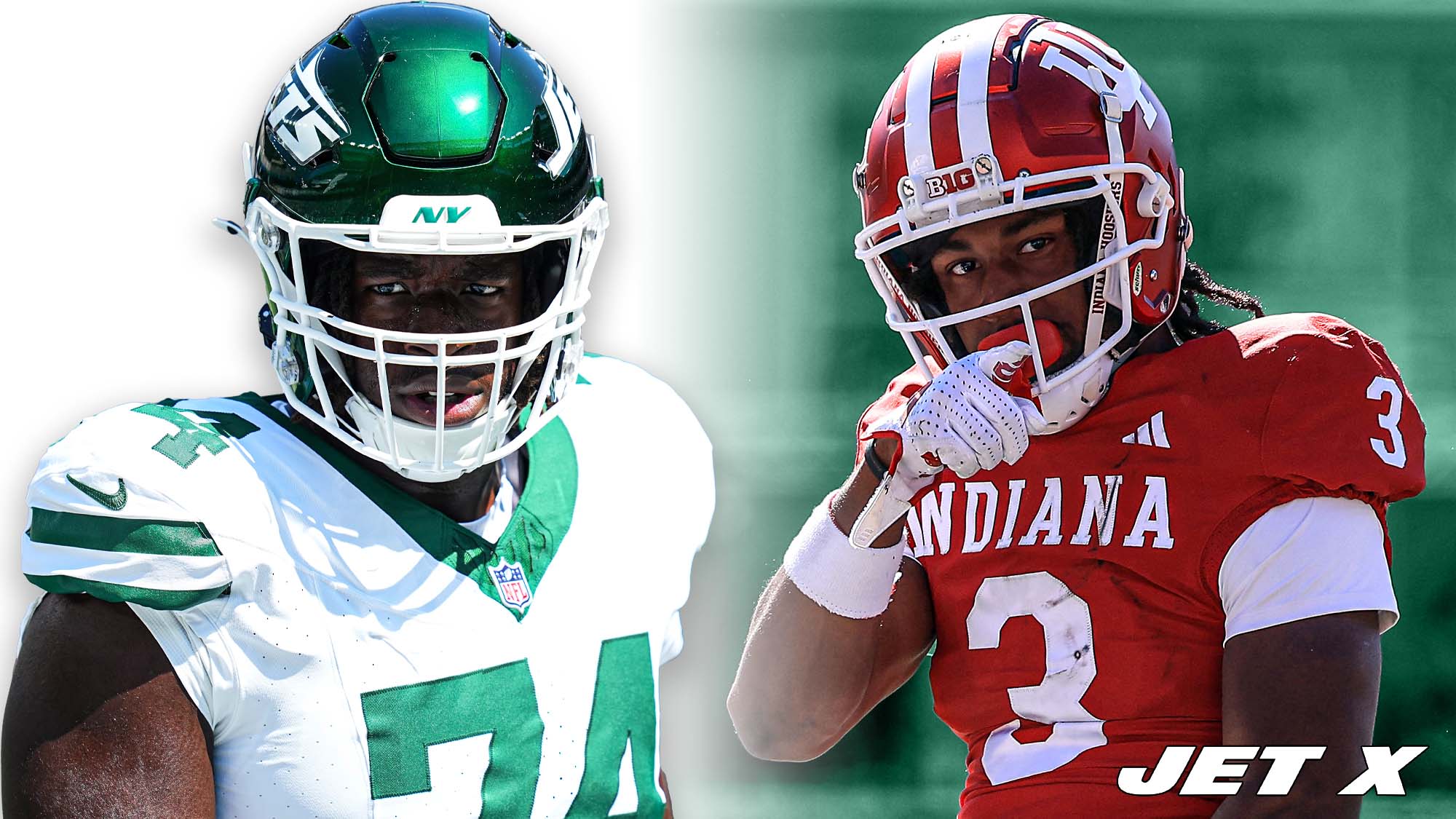
But New York made up for it on draft weekend, when they boosted their aerial weaponry with a nearly unprecedented pairing of picks. By choosing tight end Kenyon Sadiq with the 16th pick and wide receiver Omar Cooper Jr. with the 30th pick, New York became the first team since the 1969 Los Angeles Rams to choose a tight end and a wide receiver in the first round.
Over the long haul, New York’s selections of Sadiq and Cooper will significantly raise the team’s ceiling compared to where it was pre-draft. The question is how much Sadiq and Cooper can help them in 2026.
There is a likely scenario in which the Jets walk onto the field in Week 1 with Sadiq as their TE1 and Cooper as their WR2. That’s a ton of trust to place in two members of your rookie class.
By choosing not to add any new veterans to their skill-position group, the Jets are gambling that Sadiq and Cooper will be ready to handle hefty workloads as rookies. There aren’t any stopgaps who can be trusted to hold the fort down while the rookies develop at their own pace, which is a high-risk proposition for the team’s short-term hopes of winning games.
While most rookies require at least one season before they are ready to be quality starters, there are always a few exceptions each year. Just this past season, tight ends Tyler Warren (817 yards), Harold Fannin (731 yards), Colston Loveland (713 yards), and Oronde Gadsden II (664 yards) each made instant impacts for their teams.
At wide receiver, we saw players like Tetairoa McMillan (1,014 yards), Emeka Egbuka (938 yards), and Luther Burden (652 yards) step directly into key roles.
The odds of selecting two rookies who can make that kind of impact are long, but the Jets are counting on it. If they are lucky enough to have both Sadiq and Cooper play like solid starters in Year 1, their offense will look night and day compared to last year.
But there is also a scenario in which the Jets regret putting too much on Sadiq and Cooper’s plates, causing New York to suffer through an ugly offensive season due to two of their main targets being rookies who aren’t ready to handle their featured roles.
New York could have opted for a safer route by pairing their draft investments with high-floor stopgap veterans, giving them a trusty, mid-tier fallback plan in case they quickly find that Sadiq and Cooper aren’t ready to be starters yet. Instead, they are going for the high-ceiling, low-floor route by putting all of their chips in on Sadiq and Cooper right away.
It will either be the anchor of the Jets’ best offensive season in years, or a disaster that could have been foreseen.
