

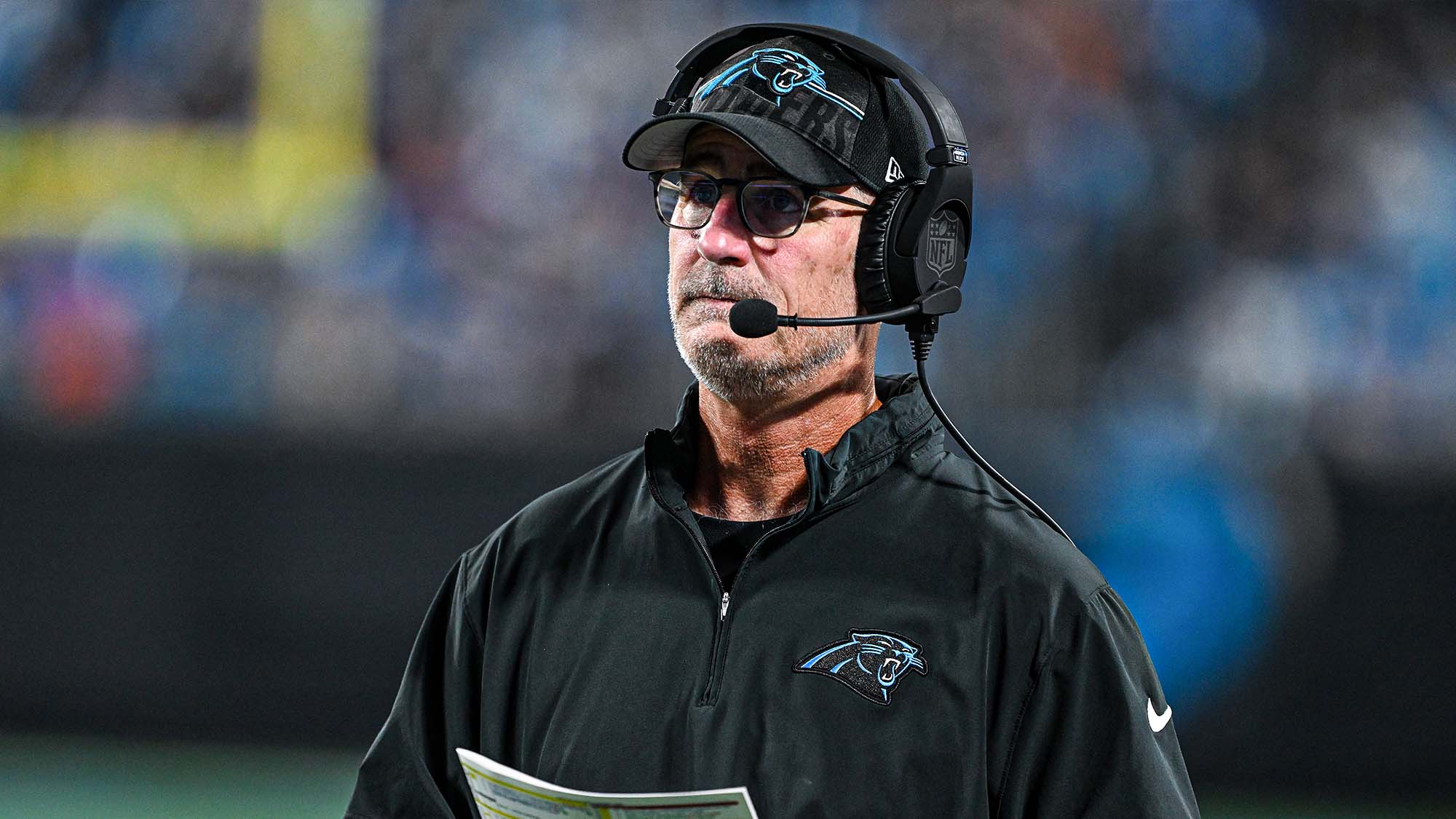
The New York Jets’ greatest X-factor of the 2026 season is 64 years old.
That’s right: Frank Reich, who was drafted by the Buffalo Bills 41 years ago, is the key to New York’s success.
For as long as the Jets have been searching for a franchise quarterback, they have also been searching for a franchise offensive mind. Their latest experiment, Tanner Engstrand, was canned before the first-time OC had a chance to build on his debut season. Before Engstrand, coaches like Nathaniel Hackett, Mike LaFleur, and Adam Gase all failed to cut it as the Jets’ offensive mastermind.
In a league where many believe that offensive coaches have begun to carry more weight in on-field success than the players themselves, it behooves the Jets to locate a quality offensive play-caller. Their lack of one over the past 15 years has been a primary reason for their playoff drought. On a weekly basis, the Jets have lost the X’s-and-O’s battle, making life even tougher on their weak rosters (particularly, their weak quarterbacks).
At age 64, Reich will probably not be the Jets’ long-term solution in the offensive coordinator role. Still, as the Jets’ most experienced offensive play-caller in many years, he has a chance to stabilize the ship and set course for a culture of offensive stability that can be maintained after his exit.
At least, that’s the goal. Whether or not Reich can achieve it, after being fired in-season at his last two NFL stops, is another question.
A fascinating piece of play-calling data could give us some clues to help answer it.
Frank Reich’s pass-run tendencies by field position
On Thursday, the X/Twitter account Football Insights (@fball_insights) shared a set of charts detailing the run-pass tendencies of each team’s offensive play-caller—at every spot on the field.
The charts display how often a play-caller chooses to pass the ball relative to the league-average expectation (adjusted for field position, clock, score, down/distance, etc.) at every yard marker of the field from their own 10 to the opponent’s goal line.
The X-axis indicates field position. The far left is the team’s own 10-yard line, and the far right is the opponent’s goal line.
The Y-axis indicates pass rate over expected. The higher on the Y axis, the more often the team passed relative to expectation at that part of the field. The lower on the Y axis, the more often the team ran relative to expectation at that part of the field.
Without further ado, here is a look at the numbers for each play-caller across the league, with Reich highlighted.

This yields some interesting takeaways for Reich.
When backed against the wall, Reich has preferred to pass more than average. He is one of the more aggressive play-callers when it comes to passing inside of his own 20-yard line. Successful offensive coaches like Andy Reid, Ben Johnson, Kyle Shanahan, and Matt LaFleur are among the play-callers who pass more than expected around their own 10-yard line.
But starting from about his own 20-yard line, Reich has gradually leaned more and more on the run game as he creeps toward the red zone. There’s an approximately 60-yard zone between the 20s in which Reich’s pass rate over expected has gradually decreased. By the time he hits the opponent’s 20, Reich runs the ball about 8% more often than expected.
Once Reich hits the red zone, his pass rate begins to shoot back toward league-average, creeping upward all the way up to the goal line. By the time he gets to the 1-yard line, Reich employs an approximately league-average run-pass split.
What does all of this mean for the Jets?
For one thing, Geno Smith could be given chances to hit some big-time field-flipping shots down the field. Reich has an above-average pass frequency inside of his own 10-20, which is a part of the field where defenses typically expect the offense to lean toward the run. This means Reich could have ideal opportunities to dial up play-action and set up vertical shots with ample room for Smith to loft the ball in front of speedy receivers like Garrett Wilson and Adonai Mitchell.
As for Reich’s run-heaviness between the 20s, the takeaways are mixed.
The good news is that it should position the Jets to be an effective clock-milking team when trying to ice a late lead. If the Jets have a strong defense and run game that presents the offense with consistent fourth-quarter leads, Reich can be counted on to scheme up methodical drives between the 20s.
The bad news is that it could make the Jets somewhat predictable. Between the 50 and the opponent’s 20, Reich’s pass rate over expected dips dramatically. Defenses have extensive data telling them to expect runs in this part of the field. If Reich doesn’t switch up his tendencies, he could find himself running into a lot of brick walls in opponent territory, causing promising drives to end in field goal attempts.
On the other hand, it gives Reich a chance to throw curveballs at his opponents.
Coaches who have become accustomed to stopping Reich’s offenses in a certain way could be caught off guard if Reich comes out as an aggressive, pass-first coach outside of the red zone. Against defenses that stack the box in anticipation of a run-first approach in this area, Reich will have chances to take shots and end drives with touchdowns before the Jets even have to worry about the red zone.
This, of course, is where Reich’s willingness to adapt will come in. If he is a set-in-his-ways 64-year-old coach, the Jets will probably pay the price. But if he is coming to New York with an open mind, ready to right the wrongs that led to his demise in Indianapolis and Carolina, he has a chance to surprise many of his opposing coaches.
Finally, Reich’s red-zone play-calling seems to be a good sign. Once he gets past the 20, Reich gradually pumps up his usage of the pass until his run-pass split is right around league-average near the goal line. This is the type of unpredictability you want to see in a part of the field where the results of plays are often determined in milliseconds based on the dueling play calls.
It is also imperative for Reich to make adjustments in the red zone based on the players at his disposal.
If the Jets’ red zone pass game struggles early in the season, but they learn that their offensive line and running backs can power the ball into the end zone at will, then Reich would be wise to lean heavier on the run. But if the Jets continuously get stuffed on the ground, while weapons like Mason Taylor and Kenyon Sadiq make them unstoppable through the air, then Reich should lean pass.
Ultimately, Reich will likely make adjustments to these tendencies based on the Jets’ talent, recommendations from other coaches on the staff, and changes to his own philosophies that have developed over the years, particularly since he has had the chance to mull over his failures in Carolina.
It would be mildly surprising if Reich came out and showed the exact same tendencies that he did with the Chargers, Eagles, Colts, and Panthers, when he was working with far different players in far different circumstances, especially since much of this data comes from many moons ago.
Nonetheless, as we attempt to get a feel for what Reich’s vision of the Jets offense might look like, this type of data is valuable. It paints an easily understandable picture of what Reich has done in the past.
Some of Reich’s strategies have worked wonders, and some haven’t. In 2026, his goal is to find the perfect formula for a Jets franchise that hasn’t sniffed a league-average offense in over a decade.
Maybe that formula looks just like the line graph we saw above, and maybe it doesn’t. Either way, we now have a solid visual of what Frank Reich’s typical play-calling flow looks like.
