
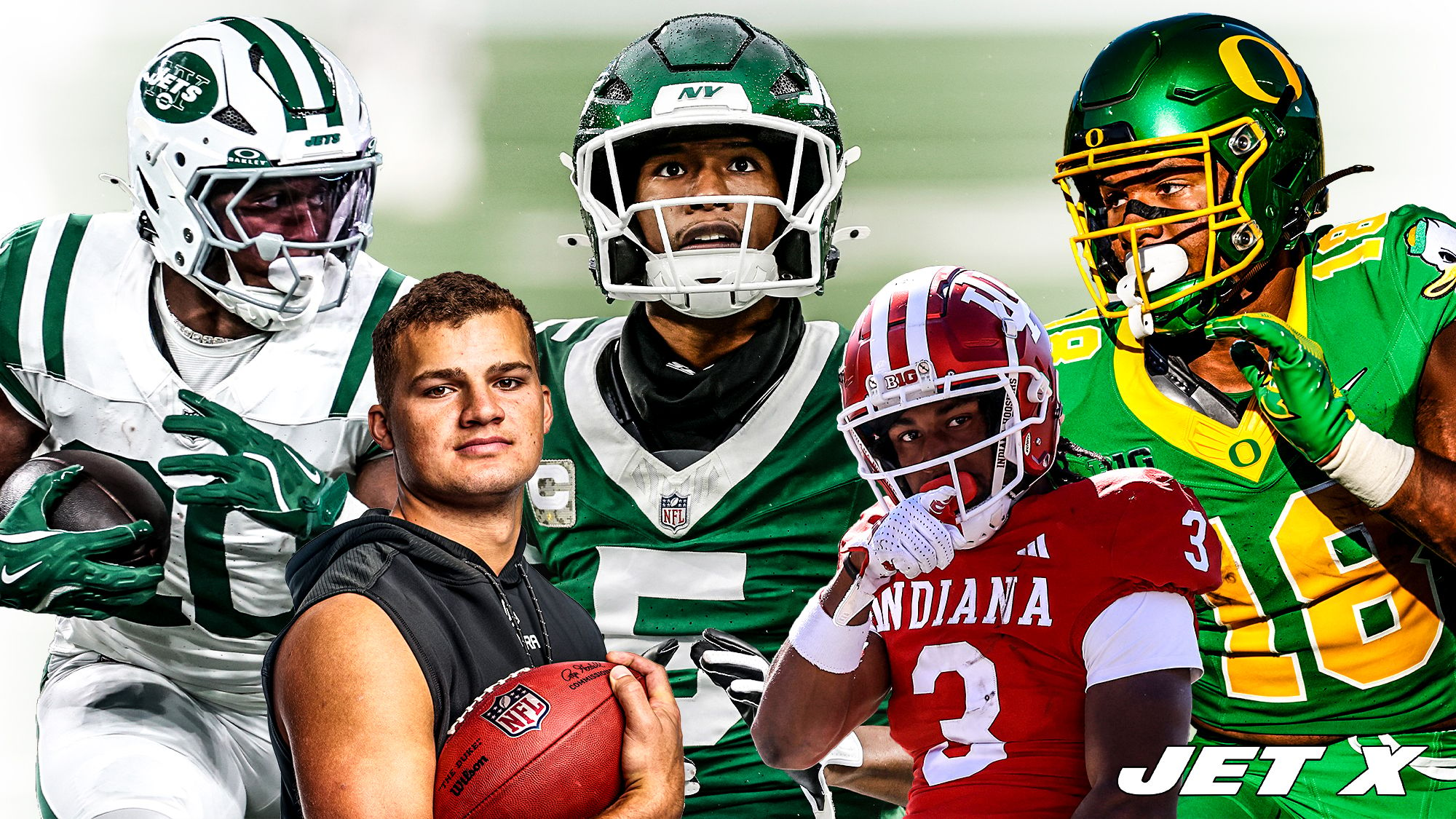
As the calendar pushes toward June, the New York Jets find themselves in unfamiliar territory. In the days following the Jets’ decision to lock up Breece Hall on a multi-year extension, national media members actually suggested the team might now have too many mouths to feed.
Once the initial shock wore off, those close to the Jets quickly realized how refreshing the idea actually was. Supporters of the franchise haven’t felt that way in a long time, or ever, if we’re being perfectly honest.
The architect of this offensive unit is general manager Darren Mougey, but the person tasked with making it all fit now falls on seasoned offensive coordinator Frank Reich.
How Reich deploys his many offensive weapons is set to represent one of the strategic questions that define the 2026 season.
Inventory
The Jets now boast weaponry that features a true WR1 in Garrett Wilson.
The team’s top target accounted for 30.4% of targets in 2025, ranking second in the NFL. Wilson heads into year five with the most support he’s had at this point in his career.
Breece Hall is widely considered an underutilized dual threat who has eclipsed 1,300 scrimmage yards in three of his four NFL seasons. Former second-round pick AD Mitchell ranked second in the NFL at creating separation on vertical routes as a rookie.
Second-year breakout candidate Mason Taylor posted a 78.6% contested catch rate, second among all NFL tight ends behind only George Kittle.
Rounding out the group are rookie first-rounders Kenyon Sadiq, who led all FBS tight ends in receiving touchdowns at Oregon, and Omar Cooper Jr., who scored 13 times for Indiana.
The distributor will be a familiar face in Geno Smith. On paper, this is the most exciting weapons group Reich has had the opportunity to work with as the offensive play-caller.
Scheme
Historically, Reich has leaned heavily on 11 personnel (3WR 1RB 1 TE), using it over 70% of the time during his six years as a head coach, with it peaking over 80% in his most recent stop.
The addition of Sadiq would make you think there will be a shift toward more 12 personnel — two-tight end looks. The route concepts will favor the personnel he’s inheriting, relying heavily on drags and digs.
The rub is as follows: Reich must adapt from a route-concept standpoint regarding the number of go and post routes, which favor Mitchell and potentially Wilson.
The second issue is Reich’s historical lack of pre-snap motion, which was a miniscule 28% in 2023, which would’ve ranked last in the NFL in 2025. The potential for Reich to thrive will come from his willingness to funnel targets to the running backs.
X-Factor
The clear indicator of Reich’s willingness to adapt was the drafting of Kenyon Sadiq. The move symbolizes a shift toward the NFL’s current trend, which relies heavily on 12- and 13-personnel sets.
Interestingly, defenses have often remained in Nickel, as they did in 2025, with over 60% in that year. Traditionally, Nickel matches up with 11 personnel, but forward-thinking architects are more often using the five-defensive-back look against 12 personnel — as long as the defensive versatility affords that right.
Sprinkle in passing coordinator Seth Ryan’s time in Detroit with Ben Johnson — who led the league in 12 personnel usage over the last two seasons — and it’s easy to spot the coaching vision.
Versatility and variability will allow the offense to attack the defense regardless of personnel deployed. If the defense decides to go big in Base, they can attack the seams. If they choose to stay in Nickel, the run game should be able to take advantage.
Utilization
Now comes the fun part: How will Reich use these weapons to get the most out of them?
We should expect to see a large number of targets allocated for Wilson. Ja’Marr Chase paced the league in targets with 185. Expect Wilson to comfortably be in the 155 to 170 range, with a share of 28-30%, is nonnegotiable.
Hall has eclipsed 90 targets once in his career. If Reich sticks to his roots, I expect that to be his floor, with Hall representing a legitimate weapon in the screen and intermediate pass game.
Taylor, playing the traditional Y role in the offense, should see a slight uptick in targets from the 65 he saw in his rookie year. The tricky part comes when you factor in roles for Cooper Jr and Sadiq, who both saw over 300 snaps in the slot last season, with 591 and 331, respectively.
With Sadiq being the projected F (moving tight end and/or H-back on occasion), we should see plenty of pre-snap motion, screen usage, and perimeter blocking designs. A healthy 60 target share for Sadiq is well within range in year one.
Cooper Jr.’s route tree is perfectly matched for Reich’s style, and his RAC (and YAC) ability will only further the need to get the ball in his hands, early and often. Peg the Hoosier for 55 touches in year one, and watch him work.
His experience out wide in 2024 shows he’s capable of the alignment variation.
Moving forward
We know the personnel, the playcaller, and potential roles for the weapons. Early on, we should see a commitment to pre-snap motion.
A conservative number would be 40%, which would land the Jets in the bottom third of the league.
Reich does not need to become Ben Johnson, but this offense would benefit from the man adopting modern trends.
Bottom line: How Frank Reich chooses to deploy the most talented skill group the New York Jets have had in a decade will determine the 2026 season.
