
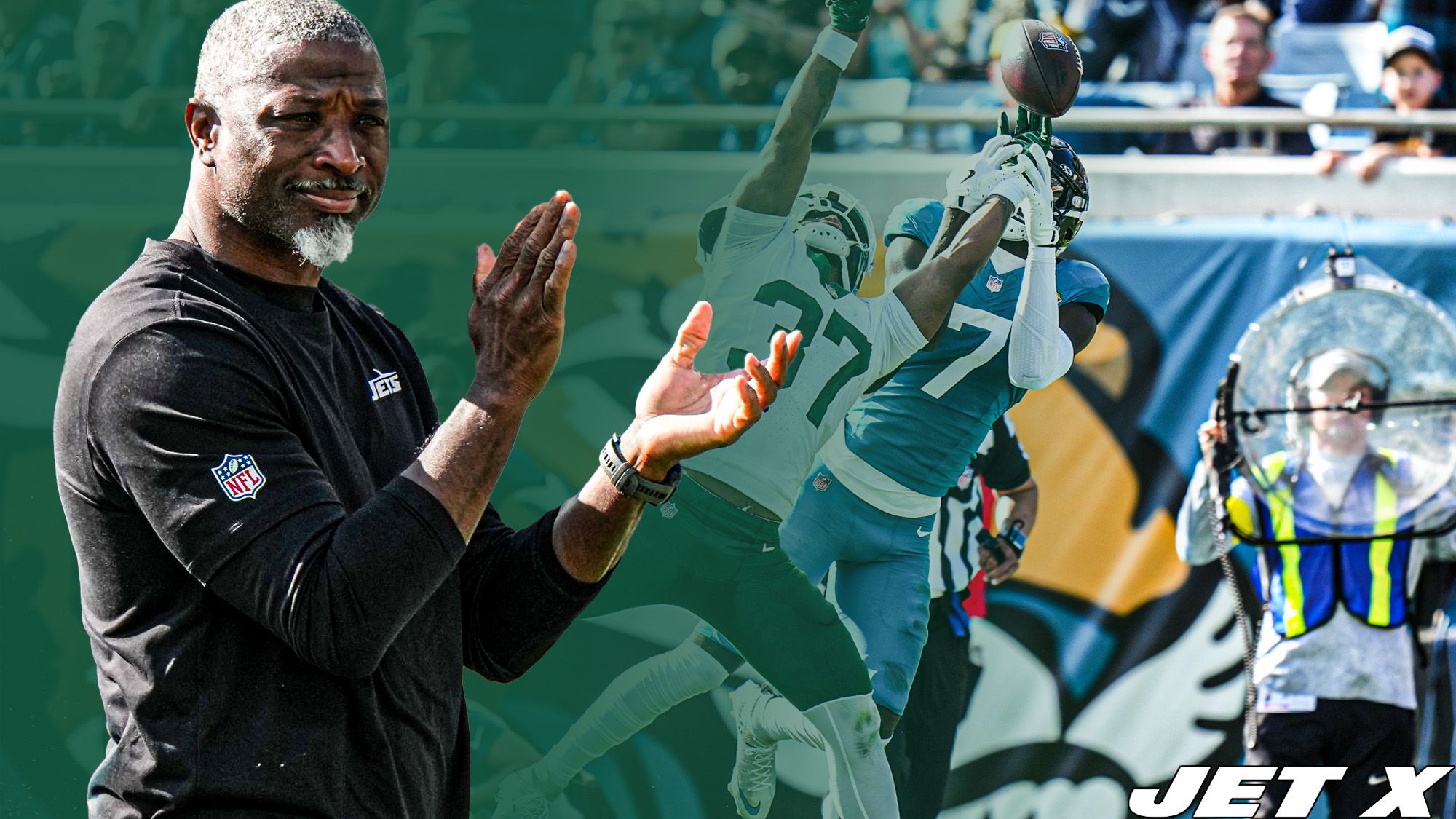
During their ugly 3-14 season in 2025, the New York Jets made history. Once again, though, it wasn’t for the right reason.
I know fans are tired of hearing it, but Gang Green became the first team to go an entire season without logging an interception. It was one of the many reasons their defensive unit was among the league’s worst.
Now, entering 2026 with a new defensive play caller in head coach Aaron Glenn and a revamped unit at all three levels, the Jets are eager to flip the script this year.
Understanding the Jets’ defensive struggles last year
Last season, the unit’s struggle to record an interception was just one of several reasons it ranked at the bottom of the NFL.
It all starts up front. The Jets’ defensive line play was ugly last season, both on the inside and outside. The team allowed the league’s fourth-most rushing yards per game (139.5) while tallying just 26 sacks, ranking 31st.
The team’s struggles regarding rushing the passer, though, could also be partially attributed to poor secondary play.
As our Joe Blewett pointed out, a dip in production from defensive linemen like Will McDonald may have had less to do with his ability and more with lapses in the secondary. When opposing receivers get open more quickly due to poor coverage, quarterbacks get the ball out faster, which limits sack opportunities and overall pressure.
How the Jets upgraded up front and in the secondary
The Jets made a flurry of notable moves up front and in the secondary this offseason to re-tool the unit.
Up front, the team signed defensive tackle David Onyemata in free agency alongside edge rushers Kingsley Enagbare and Joseph Ossai, while adding No. 2 overall pick edge David Bailey in the NFL draft and fourth-round lineman Darrell Jackson Jr., who can play both inside and outside. They also traded for DT T’Vondre Sweat from the Tennessee Titans in exchange for Jermaine Johnson.
In the secondary, the Jets signed cornerback Nahshon Wright, who led cornerbacks last season with five interceptions, and safety Dane Belton, while also trading for Minkah Fitzpatrick, one of the league’s top defensive backs, in exchange for a second-round pick. During the draft, Gang Green also selected Indiana’s D’Angelo Ponds at No. 50 overall, who is expected to play both nickel and boundary corner for the team.
It is safe to say that the Jets’ defense entering 2026 is a lot stronger than it was heading into last season.
When will the Jets snap their INT drought?
If anyone had told me the Jets would go the entire 2025 season without recording an interception, I would have thought they were crazy. I would have thought the Jets had a better chance of fielding a top-five defense than going an entire season without a pick.
Not only was their defense supposed to be the team’s backbone, but going a full season without an interception is an NFL record. No team has ever done that before in league history.
While the Jets’ defense is nicely constructed entering the 2026 season, don’t expect the squad to turn into an interception machine right away. A lot of it has to do with matchups.
The first four quarterbacks the Jets are expected to face to open the season, Cam Ward, Jordan Love, Jared Goff, and Caleb Williams, didn’t throw many interceptions last season. Each threw under 10 INTs while finishing in the bottom 12 of interception rate among 36 qualified signal-callers.
It appears Gang Green’s best opportunity early on to snap the horrid streak is in Week 5 at home against the Cleveland Browns. Last season, Shedeur Sanders led 38 qualified quarterbacks in turnover-worthy play rate (5.7%) while tossing seven touchdowns against 10 interceptions.
If the Browns ultimately roll with Deshaun Watson as their starting QB, he also poses a favorable opportunity. In 2024, throughout just seven games, he logged five turnover-worthy plays and three interceptions.
He also held onto the ball for a while, as his 3.05-second average time to throw ranked fourth among 40 qualified QBs. If the Jets are able to apply pressure, they can consistently force him to make contested throws under pressure, increasing the chances of landing a pick.
At the end of the day, it is still a guessing game. Nobody could have predicted the Jets would go an entire season without an interception.
What does matter, though, is that New York appears better positioned to generate takeaways than they were entering last season.
