


No, I am not a prophet. I cannot tell you precisely how many interceptions the New York Jets will get in 2026.
What I can do is use the information at our disposal to come up with a reasonable projection of how many interceptions the Jets should be expected to get. After an offseason loaded with additions that directly address their interception problem, New York suddenly has an intriguing outlook in that department.
Without further ado, let’s see how the Jets’ offseason moves have altered their outlook in the interception department.
Projecting the Jets’ 2026 interception total
The first step to this projection is estimating how many passes the Jets will defend. From there, we can estimate the percentage of those pass plays that will result in interceptions, through a breakdown of every key Jets defender’s ball skills.
In 2025, the Jets’ opponents ran 578 pass dropbacks, the sixth-fewest. They were on the lower end since they trailed by a wide margin in many second halves, but they weren’t quite at the bottom because their pass defense was so easily exploitable that opponents would spam passes on them in the first half. The Jets faced the second-most dropbacks in the first half (340) and a league-low 238 in the second half.
Given the improvements that New York made on the defensive side of the ball in the offseason, it is safe to assume they will spend less time trailing in the second half, and that their pass defense will be improved enough to discourage teams from over-relying on the pass in the first half.
With all of that said, it likely still won’t be an elite pass defense that buries teams in deep holes and forces them into pass-heavy mode in the second half, so even with some progress, the Jets will probably not climb too high on the list. The highest teams in opponent dropbacks are usually elite teams that spend a lot of time in the lead.
All things considered, it is fair to expect New York to jump to around the middle of the pack in opponent dropbacks. The 2025 league average for total opponent (and team) dropbacks was 619, so we’ll roll with that as our baseline number.
With that decided, the next step is to accumulate the career interception skills of the Jets’ primary coverage defenders.
Let’s say that this will be the Jets’ back-seven lineup in Week 1 (this is arbitrary; there are many other ways this can shake out in the summer, but for the sake of this exercise, we’ll just roll with it):
- S Minkah Fitzpatrick (On field for 100% of pass snaps)
- S Dane Belton (80%)
- S Malachi Moore (20%)
- CB1 Brandon Stephens (100%)
- CB2 Azareye’h Thomas (100%)
- CB3 Nahshon Wright (20%)
- SCB D’Angelo Ponds (60%)
- LB Demario Davis (100%)
- LB Jamien Sherwood (100%)
- LB Mykal Walker (20%)
Next, we’ll project how many interceptions each of these players should be expected to get over 619 opponent dropbacks, by multiplying their projected snap count by their career interceptions-per-pass-snap average.
For instance, Minkah Fitzpatrick is projected to be on the field for all 619 of those dropbacks (100%), and he is averaging 0.00467 interceptions per pass snap (21 on 4,465 snaps) in his career, so he should be expected to get about 2.9 interceptions (0.00467*(1.0*619).
In the case of rookie slot cornerback D’Angelo Ponds, we’ll use his college average. For second-year players Azareye’h Thomas and Malachi Moore, we’ll combine their rookie-year numbers with their college numbers to get a larger sample size.
Here are the results.
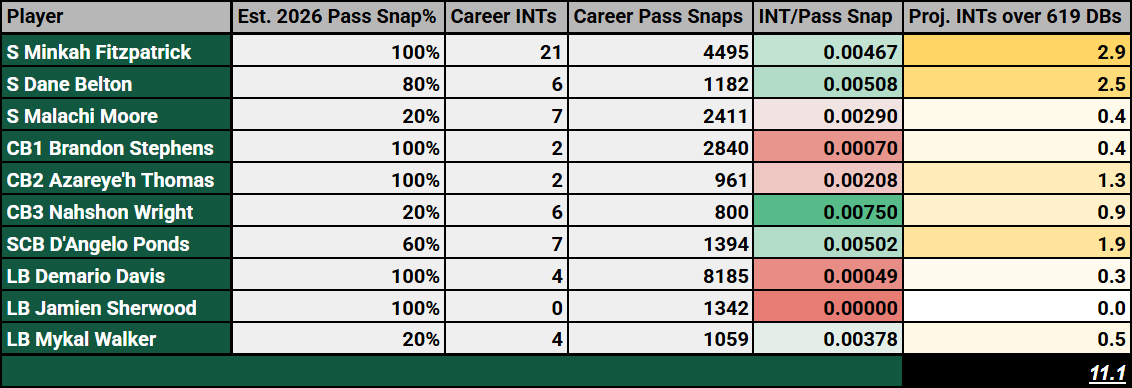
Based on these projections, the Jets should be expected to get about 11 interceptions in 2026. That would have tied them with the Browns and Ravens for the 16th-most in 2025. The league average was 11.9.
There is one more factor to consider, though: The pass rush.
While the coverage defenders’ ball skills obviously play a large role in a team’s interception total, the back end relies heavily on the pass rush to tee up favorable opportunities for them. Even the best ball hawks can’t nab takeaways if the pass rush is yielding too many clean pockets, whereas an average defensive back can be made to look like a ball hawk if a dominant pass rush continuously forces quarterbacks into reckless decisions.
The Jets’ pass rush was terrible in 2025. They ranked 29th in sack rate (4.8%) and 32nd in pressure rate (15.1%).
It’s difficult to project where the unit will rank in 2026, as the Jets are counting heavily on a rookie, David Bailey, to lift them up. The second overall pick was the primary addition to New York’s defensive line and will carry a massive weight in his rookie year. If he isn’t dominant right away, the defense will suffer. That’s just how the unit is built; there is very little proven pass-rush talent.
It is also worth noting that the Jets traded away a starting edge rusher, Jermaine Johnson, for a run-stopping nose tackle in T’Vondre Sweat (although Johnson’s pass rushing was well-below-average in 2025, coming off an Achilles injury).
New York did sign a pair of free agent edge rushers in Joseph Ossai and Kingsley Enagbare, although both players are better known for their run defense and have generally been mediocre against the pass.
One thing the Jets could have going for them is a full season of defensive tackle Jowon Briggs in a starting role. For the second half of 2025, he joined Chris Jones and Jeffery Simmons among the top three interior pass rushers in the NFL across most meaningful metrics. If Briggs can do that over a full 17 games, it will provide a huge boost to New York’s pass rush numbers compared to last season.
But it’s also worth noting that the Jets had Quinnen Williams for the first half of 2025, so even if Briggs has a full year of excellent pass rushing, it would essentially replicate the combined production that he and Williams provided over 17 games last year. With no other major additions to the pass-rush talent of New York’s interior defensive line, the unit’s ceiling isn’t much higher than last year, unless Darrell Jackson Jr. is a phenom out of the fourth round.
All things considered, the outlook for New York’s pass rush is still quite bleak. Unless Bailey is an immediate superstar or Will McDonald unlocks a new level (unlikely, given that he will already be 27 and has less help around him than ever before), this will likely still be one of the weakest pass rushes in the NFL.
With New York’s pass rush still looking like a bottom-five unit, it would make sense to take our initial projection of 11.1 interceptions and turn it down a couple of notches. A weak pass rush would mean that all coverage defenders should be expected to generate interceptions a bit less frequently than they typically have in their careers.
Given this, it probably makes more sense to expect the Jets to pick off around 9-10 passes. In 2025, 9.5 interceptions would have placed between 22nd (five teams: Arizona, Kansas City, New England, New Orleans, Denver) and 23rd (two teams: Miami and the N.Y. Giants).
But the 11.1 mark is a solid baseline, with the pass rush playing the X-factor role. If the Jets’ pass rush can reach league-average territory, the Jets could very well pick off 11 passes, which would put them in the middle of the pack—a huge leap after getting zero. And if New York’s pass rush can somehow be above-average, the Jets can soar well above 11 interceptions.
The Jets will get an interception this year. That much is guaranteed. How far they soar above zero will come down to the pass rush. In the back end, the Jets have done a solid job of improving their collective ball skills from essentially non-existent to approximately league-average.
That puts the fate of their interception total in the hands of the pass rushers.
