
Daniel Jeremiah, a former NFL scout and current draft analyst for NFL Network, has established what he believes is the championship foundation for every team.
According to Jeremiah, these 12 spots (across five key roles) need to be filled:
- 1 quarterback
- 3 offensive playmakers
- 3 quality offensive linemen
- 2 pass rushers
- 3 defensive playmakers
How are the Jets shaping up after the 2026 offseason?
QB (1)
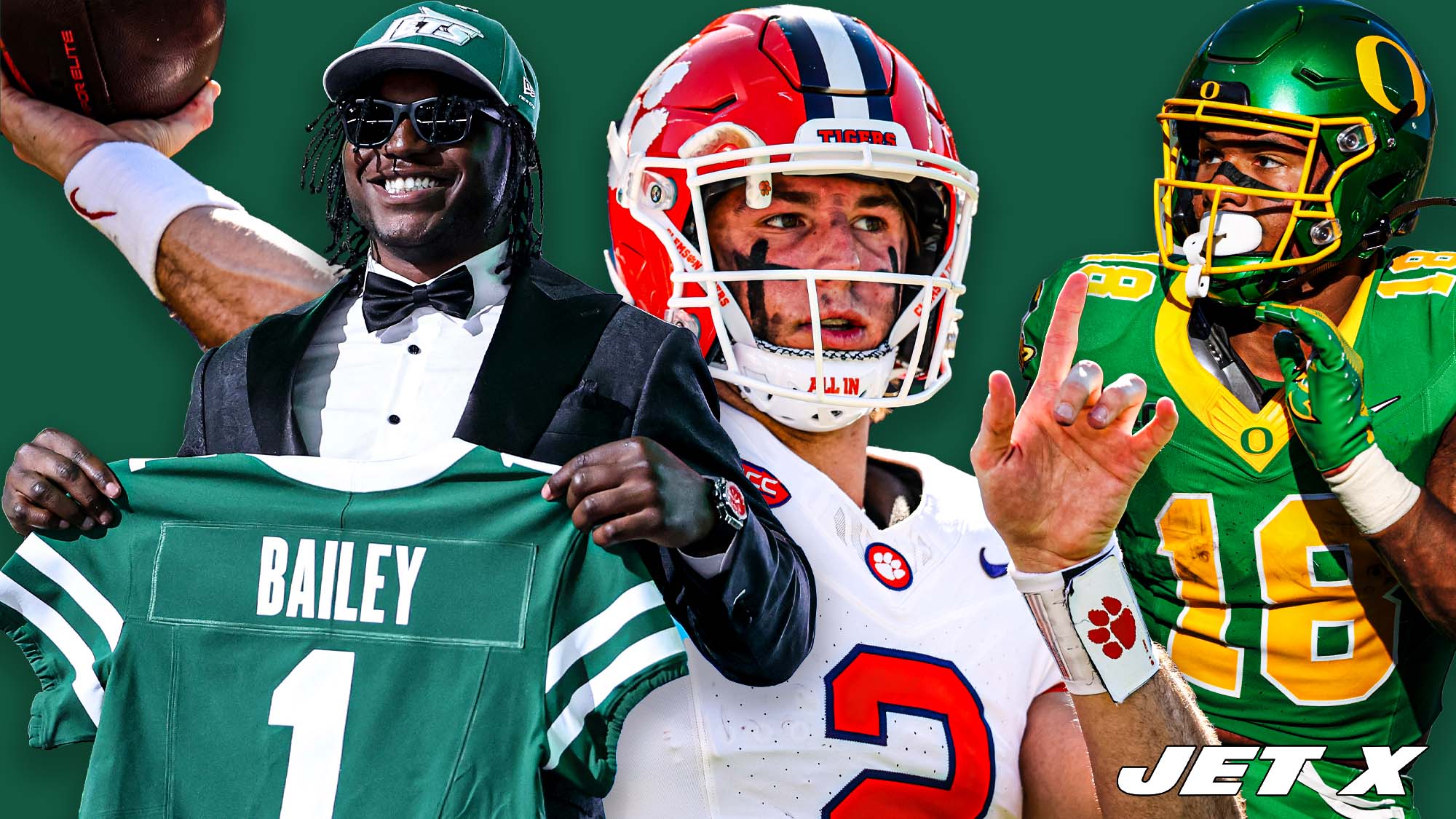
Barring Cade Klubnik being one of the greatest fourth-round picks in NFL history, the Jets’ franchise quarterback is probably not on the roster.
Geno Smith will not be that guy, either. While Smith is far more capable of delivering a solid season that many people realize—one good enough to anchor a potential wild card push—it would be a stretch to say he is capable of leading a Super Bowl team.
The Jets are hoping that Smith can be the bridge quarterback who helps to eliminate their losing culture and put them on the precipice of title contention, just as he did for the Seattle Seahawks. Most likely, New York will take a big swing on a quarterback in 2027.
The organization has the assets to pursue just about any available quarterback moving forward. They are armed with three 2027 first-round picks and $92.4 million in projected 2027 cap space (sixth-most, per Spotrac), plenty of ammunition to maneuver the board on draft weekend, swing a blockbuster trade for a veteran, or make a splash free agent signing.
Offensive playmaker (3)
We can easily check two of these boxes with Garrett Wilson and Breece Hall.
Each among the highest-paid players at their positions before turning 26 years old, Wilson and Hall are among the brightest young playmakers in the NFL. Their box-score stats may not back it up to the degree that some people would consider “superstar level”, but that isn’t their fault. The eye test says enough about how much of a difference each player makes with the ball in their hands.
The Jets need a third playmaker to meet Jeremiah’s threshold. Fortunately, they are loaded with under-25 prospects who have the potential to fill the role.
The lead contenders are 2026 first-round picks Kenyon Sadiq and Omar Cooper Jr. However, 2025 second-round pick Mason Taylor and 2024 second-round pick (acquired via the Colts) Adonai Mitchell are wild cards who also have high enough ceilings to emerge as dangerous weapons.
Quality offensive linemen (3)
It is interesting that Jeremiah settled on 3 as the number of quality offensive linemen that is necessary for a team to be competitive. This will likely stir up plenty of debate over what the ideal offensive line looks like, within realistic roster-building constraints.
Many people say an offensive line is only as strong as its weakest link. This logic would imply that the main goal is to collect five linemen who are at least average, regardless of how many are stars or even just “quality”.
Some people might argue that every offensive line is bound to have at least one weak link due to the difficulty of collecting five good ones. In that case, four quality starters might be the realistic goal.
Jeremiah, though, thinks only three “quality” linemen are necessary, so we’ll roll with that as the benchmark for the sake of this article. Let’s assume that “quality” means “above average”.
It might not be definitive in league circles just yet, but the Jets should feel confident that they have three quality linemen in Armand Membou, Olu Fashanu, and Joe Tippmann. Perhaps other teams around the league want to see more starts from the young trio before labeling them as “quality” just yet, but based on their solid performances in 2025, they are all on a trajectory to become definitively above-average starters, perhaps even among the best at their positions.
Free agent pickup Dylan Parham has also ranked as a top-half starting guard in each of the past two seasons.
New York should be set here.
Pass rusher (2)
With the duo of Will McDonald and David Bailey, the Jets could potentially have these spots filled in 2026.
It all depends on how quickly Bailey reaches his lofty ceiling, and whether McDonald can improve his run defense enough to remain a three-down player. McDonald also saw his pass rush numbers dwindle in 2025 compared to his second season, although that could have been due to a bad secondary that allowed the ball to come out quickly.
Don’t forget about Jowon Briggs on the interior, who rushed the passer like a superstar after the Quinnen Williams trade. New York hopes that Briggs can maintain that production for a full season.
It might be fair to say that the Jets have either 1.0 or 1.5 top-end pass rushers heading into 2026. They could come out of the season with as many as three, but there are plenty of unknowns with Bailey, McDonald, and Briggs.
Defensive playmaker (3)
“Defensive playmaker” is a somewhat vague label, especially since it’s separate from “pass rusher”. We can assume that Jeremiah is talking about a back-seven player who frequently generates negative results for the offense, whether it’s takeaways, pass breakups, or tackles for loss.
In linebacker Demario Davis and safety Minkah Fitzpatrick, the Jets have two of the league’s best playmakers at their respective positions over the past decade. The question is what both of these players have left in the tank at this stage of their careers, but they still yielded high-end production in 2025.
Outside of Davis and Fitzpatrick, New York is relying entirely on projection.
Cornerbacks Azareye’h Thomas and D’Angelo Ponds each have the potential to fill one of the defensive playmaker slots, but they have a combined five NFL starts. Free agent pickups Dane Belton and Nahshon Wright have displayed a nose for the football, but neither has been consistent enough as an overall player to stake their claim to consistent snaps.
There is also Jamien Sherwood, who may have been considered a defensive playmaker after his breakout 2024 season, but endured a steep fall-off in 2025.
Even if Sherwood bounces back, though, he isn’t much of a “playmaker”, as his career resume features zero interceptions, zero fumble recoveries, one forced fumble, and 22 tackles for loss in five seasons (39 starts). Sherwood could be a solid starter, but the bar for a core defensive playmaker seems to be a little higher than the ceiling he has shown thus far.
At best, the Jets have two defensive playmakers in Davis and Fitzpatrick, but it might be realistic to expect that at least one drops from the level of a top-end playmaker in 2026. Looking to the long-term future past 2026, it is unlikely that either will consistently be a top-end playmaker.
The Jets still have a lot of work to do in this department. Still, they have some intriguing prospects who could fill the role, and the hope is that at least one of those prospects will break out in 2026.
Checklist
Based on Jeremiah’s concept of a championship foundation, this is the remaining checklist for the New York Jets on their road to building a Super Bowl contender:
- Find a franchise quarterback.
- Develop one more offensive playmaker outside of Wilson and Hall.
- Ensure Fashanu, Membou, and Tippmann stay on an upward trajectory.
- Develop at least 2 top-end pass rushers between Bailey, McDonald, and Briggs.
- Find at least 1 defensive playmaker outside of Davis and Fitzpatrick for the short term, and at least 3 for the long term.
Simple enough, right?
