

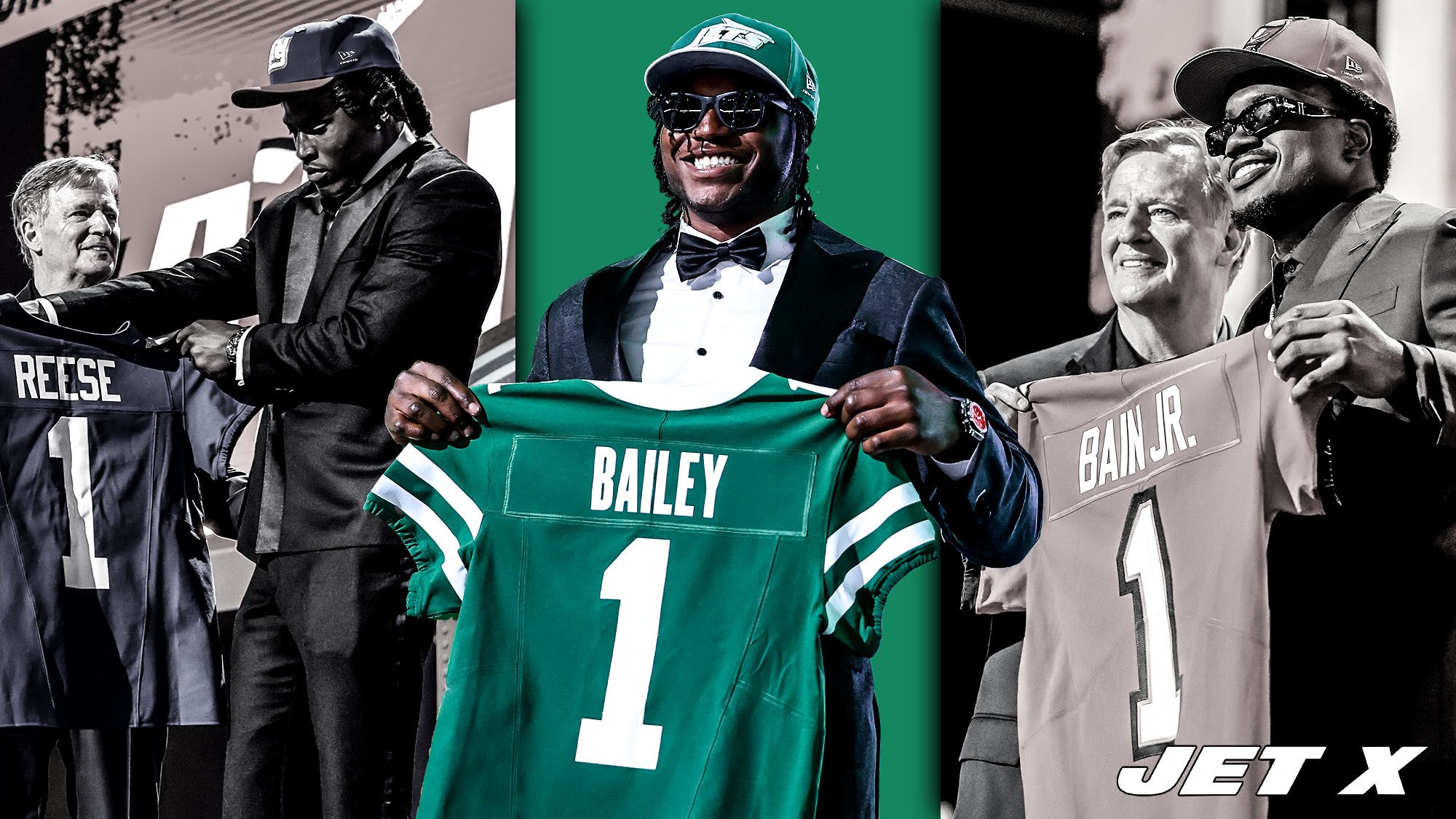
It’s not often that the No. 2 overall pick arrives with modest expectations. The seemingly endless buildup to the 2026 NFL draft was littered with narratives associated with how “weak” the class was as a whole.
Another overused line was how there were no sure-fire standouts or fewer first-round-graded prospects than usual. Every Twitter scout and armchair general manager took the industry line and ran with it.
I get it: We’re all in the content game, and the rent was due. But if you dared to look deeper, you’d see this was a draft that savvy front-office personnel were salivating over.
For the New York Jets, it was seemingly always a two-headed race, and fans will tell stories of the great David Bailey vs. Arvell Reese debate in the many years to come. Ultimately, the Jets chose Bailey, and he should not be looked at as a consolation prize.
Better yet, he shouldn’t even be viewed as a co-favorite to bring home individual hardware at year’s end; he should instead be the runaway favorite to win NFL Defensive Rookie of the Year.
Is David Bailey actually underrated?
Most NFL fans will be the first to admit that they do not watch much college football — at least not until the College Football Playoffs come around. If you dive even further, you’ll see that Bailey’s lone year at Texas Tech wasn’t a one-year wonder, but rather a culmination of a highly touted prospect finally being aided by a strong supporting cast, allowing his full potential to shine through.
Coming out of high school, Bailey just missed being considered a five-star prospect, which is the highest distinction a prospect can achieve. Fielding offers from Alabama, USC, and Oklahoma, among others, he chose to early enroll at Stanford and secured a starting spot in his true freshman season.
While no one will confuse Stanford with a football powerhouse, securing a starting job as a true freshman shows promise from day one. After three modest seasons of play in which Bailey was asked to do more than he would at the next level, he was able to improve his sack totals each year, topping out at 7.5 his junior year.
After a coaching change, Bailey entered the transfer portal in 2025. Texas Tech wins the bidding war, and the rest is history.
David Bailey’s production
Bailey dominated the Big 12 from the opening snap and registered one of the most productive seasons by an edge rusher in the conference’s history — one that once housed future Hall of Famers Myles Garrett and Von Miller. Generating 14.5 sacks, 19.5 tackles for loss, and 81 pressures isn’t just impressive; it’s pure dominance.
The numbers keep getting more impressive the deeper one dives into the statistical pile.
Bailey had a share of a sack in 11 out of 14 games, a 96th percentile pass-rush win rate, and an 85th percentile run-stop rate, while becoming only the third edge to win over 40% of his true pass rush sets. He accomplished this in addition to taking home Big 12 DPOY honors, while being a unanimous All-American.
So where was the disconnect? Well, the film showed areas for improvement, specifically in the run game when teams attacked him head-on.
Like most prospects entering the NFL, he’s not perfect, but that shouldn’t be the sole reason to fully hop off the Bailey train. NFL edge players are paid handsomely to be elite at getting after the quarterback and causing disruption, and Bailey undoubtedly checks those boxes.
Bailey separates from the field
As it currently stands, most sportsbooks see Rueben Bain Jr. and Arvell Reese as close opponents to win the Defensive Rookie of the Year in 2026.
Bain Jr. is a quality pass rusher, but he was the No. 15 pick. He lands in a deeper Tampa Bay edge rotation behind veterans who’ll absorb early down snaps.
His trust curve will be slower simply because the draft slot demands less. Bain will get his snaps in passing situations, but he won’t lead the position group in them.
Arvell Reese went No. 5 to the Giants and was projected mostly as an off-ball linebacker in their defense. The Giants have three veteran edge rushers ahead of him on the edge depth chart.
Reese is a fantastic player, but pass-rush snaps are going to be scarce, and it’s tough to win Defensive Rookie of the Year as a part-time edge, part-time second-level linebacker.
The Opportunity
Bailey has the opportunity to help usher in a turnaround of his second program in as many years.
The 2025 season is one that the organization and fans would like to quickly forget. The Jets finished dead last in sacks with 26, and rarely pressured the quarterback.
An injection of talent, coupled with Aaron Glenn taking over the defensive play-calling duties, gives optimists hope of seeing a world where Bailey is set up for instant success.
Aaron Glenn, the head coach, left much to be desired in year one, but he can win back a large portion of the fanbase by calling a strong defensive game. If you wanted to drum up a scheme that fits Bailey’s game, you’d end up close to what Glenn is aiming to do.
Attacking the line of scrimmage, winning one-on-one matchups, and letting your edge rushers hunt is precisely what the Jets head coach has in mind. Glenn summed it up himself when explaining his style to reporters all the way back in 2022.
“It is a more aggressive style of defense, and I want to be able to take advantage of every player, their ability as much as I can,” per the official Detroit Lions website.
That same philosophy worked wonders for then-rookie Aidan Hutchinson, whom the Lions took in the same draft slot as Bailey, oddly enough. Hutchinson finished the year with 9.5 sacks.
Glenn was uber-aggressive during his time with Detroit, dialing up pressure against certain opponents almost 56% of the time. Their pressure menu featured blitzes, D-line stunts, delayed safety blitzes, and simulated pressures designed to disguise four-man rushes as blitzes.
Glenn didn’t always ask his Edges to win one-on-one; he could create favorable matchups.
Why DROY is a safe bet
History is on Bailey’s side. Five of the last 10 players to win the award have been edge rushers, with only two surpassing double-digit sack totals (Joey Bosa in 2016 and Micah Parsons in 2021).
Look even further, and you’ll notice the league rewards disruption rather than maintaining run-gap integrity. Will Anderson Jr. and Jared Verse won the award with seven and 4.5 sacks, respectively, but their pressures created and splash plays stood out.
Voters and fans want to see splash plays and disruption; no one has won the award because they have consistently set the edge.
Most rookies need a perfect storm of opportunity, scheme fit, and draft capital to win DROY. Bailey has all three, owns the highest draft slot of any defender in this class, and features the FBS-best production backing up a top-35 high school recruiting pedigree.
All of this is piled onto the fact that his athletic prowess is undeniable. Plus, he has a head coach who’s already produced a DROY pace season with this exact archetype, and he walks into a defensive room that finished last in the AFC in sacks.
The market sees four rookies in a tight DROY race. The tape sees one.
New York Jets edge defender David Bailey isn’t a co-favorite; he’s the favorite by a country mile. And by December, everyone else will know it too.
