

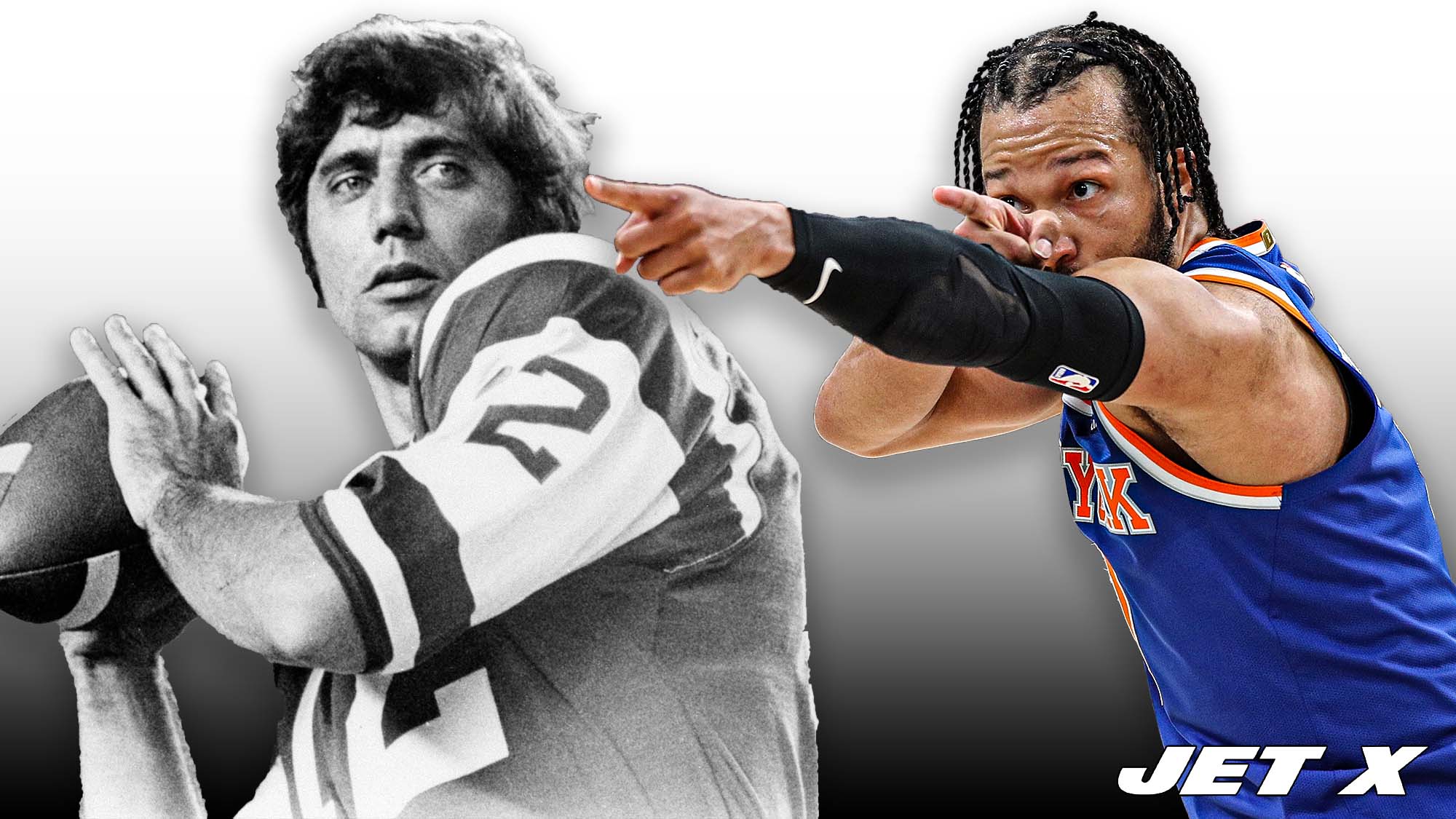
Jalen Brunson was named Finals MVP as he led the New York Knicks to their first NBA championship in 53 years. He tied Michael Jordan for the most points in a road closeout game in Finals history (45). The Knicks’ captain also became the first player in NBA history to win NBA Cup MVP, Eastern Conference Finals MVP, and NBA Finals MVP in the same season.
With a run like that, you will be instantly tossed into some prestigious conversations.
In the NBA world, debates are raging about where Brunson ranks all-time among Knicks players, point guards, and NBA players in general. But in the New York sports world, Brunson’s ranking among all-time New York legends is a hot topic.
On X/Twitter, Jets fan NYJ Matt proposed a debate: Who ranks better on the list of all-time New York athletes: Jalen Brunson or Joe Namath?
As of this writing, 63.6% of voters have chosen Brunson over the Jets’ lone Super Bowl-winning quarterback.
Let’s settle the debate.
What does this mean?
First off, we have to understand what it takes to rank higher on this list.
Is it based on which player ranked higher among players at their position during the prime of their career?
Is it based on which player had the more dominant peak? Or is it based on which player had the more productive career cumulatively?
Is it based on playoff success?
Is it based on the player’s impact on his sport and franchise?
Is it simply based on how beloved and legendary the player is in New York?
The best method is to consider all of these questions.
With that in mind, let’s make the case for each player.
The case for Joe Namath
The guarantee.
The swagger.
The fur coats.
Joe Namath is widely known as one of the “coolest” players in sports history. He is one of the earliest quarterbacks to bring individuality, style, and bravado to the game, traits that define today’s stars.
So, when it comes to ranking Namath all-time among New York athletes, his off-field persona and aura have to be considered as big pieces of the pie. Those traits may have nothing to do with his play, but they certainly contribute to his prestige.
As a player, Namath is one of the most polarizing quarterbacks in league history. You will hear some people claim that he was flat-out mediocre due to his 50.1% completion rate and 173-to-220 touchdown-to-interception ratio. Others point to his championship ring, No. 1-pick pedigree, and five Pro Bowls to paint him as one of the all-time greats.
The answer lies somewhere in the middle.
Namath’s completion percentage and interception-proneness have to be put into context; the league averages in both categories were much different in Namath’s era than they are today. Passing attacks were more vertical and more aggressive, leading to lower completion percentages and more interceptions.
However, even relative to the league averages of his era, Namath’s completion percentages and interception totals were poor. From 1966 to 1974, he had the second-most interceptions (156) and the 28th-ranked completion percentage (50.8%) out of 53 quarterbacks with at least 500 pass attempts.
What made Namath special, though, was his arm.
Namath became the first quarterback in league history to reach 4,000 passing yards when he accumulated 4,007 in 1967. The league had never seen a quarterback who passed at such a high volume with such high efficiency; that year, Namath led the league in pass attempts (491, the third-most ever) and yards per pass attempt (8.2).
Along with his explosive arm, Namath was elite at avoiding sacks. He had a sack rate of just 4.3% in his Jets career; for instance, in the 1968 championship season, Namath was sacked just 15 times in 14 starts, posting a 3.8% sack rate. This is an extremely overlooked aspect of what made Namath a legitimately great quarterback despite his shortcomings.
The combination of Namath’s downfield prowess and sack avoidance made him a dominant quarterback for his era when it came to yards-per-play efficiency. From 1966 to 1974, he averaged 7.14 net yards per pass attempt (Y/A adjusted for sacks and sack yardage), the best mark in the NFL among 53 qualified passers (min. 500 pass attempts).
Namath changed the mold of what a star quarterback looked like. Following his emergence, teams around the league wanted a gunslinger like him (without the interceptions, of course).
It is also crucial to note the historical significance of Namath’s 1968 championship. Not only does it remain the only title in Jets history, but the Jets’ massive upset over the NFL champion Baltimore Colts in Super Bowl III helped prove that AFL teams could compete with NFL teams before the leagues officially merged in 1970. It didn’t directly cause the merger (which had already been agreed upon two years earlier), but it certainly eased public skepticism about whether the AFL was a legitimate league.
Jalen Brunson is a superstar. But he didn’t quite change the sport of basketball the way that Namath changed the sport of football, and that’s where Namath’s case lies.
Brunson has a strong case, too, though.
The case for Jalen Brunson
Where Brunson creates the most distance from Namath is through postseason success and impact on championship contention.
Namath only made two playoff appearances in his 12-year Jets career, compared to Brunson’s four in four seasons with the Knicks. While Namath went 2-0 in the 1968 Super Bowl run, he went one-and-done in the Jets’ 1969 title defense, throwing no touchdowns and three interceptions.
While Namath was named MVP of Super Bowl III, with his pre-game guarantee being more famous than any moment from the game itself, Namath was not actually the main reason why the Jets won. New York won by a score of 16-7, with Namath throwing zero touchdowns.
To Namath’s credit, he threw zero interceptions. But the Jets won because of their defense, which picked off four passes and held the Colts to 7 points after they came in averaging 29.2 points over their previous five games.
Brunson’s story is completely different. He was the main reason why the Knicks won the championship.
Brunson was named the MVP of both the Eastern Conference Finals and the NBA Finals. Whereas Namath did not put a single point on the board in the Jets’ closeout win, Brunson had 45 points, tying Michael Jordan for the most on the road in a Finals closeout game in NBA history. Not only that, but he did it against a player in Victor Wembanyama who many believe will go down as the greatest defensive player in NBA history.
This is not the first time that Brunson’s playoff accomplishments have put him in exclusive company with the GOAT. For multiple years before his legendary closeout game, Brunson was already dropping postseason points at a level that has only been matched by Jordan.
In 2024, Brunson joined Jordan as the second player ever to post over 285 points and 65 assists in the first eight games of a playoff run. He also became the first player since Jordan to have four consecutive 40-point playoff games, and the fourth player all-time, with Jerry West and Bernard King being the others.
When it comes to clutch scoring in the playoffs, Brunson and Jordan are in their own tier when it comes to the blend of volume and efficiency.
You never hear Namath’s name mentioned in conversations with Tom Brady and Joe Montana, do you?
Brunson is also on track to build better career longevity with the Knicks than Namath ever had with the Jets. It can be argued that Namath’s peak in 1968-69 put him higher on the quarterback rankings than Brunson’s current ranking among NBA players, but Namath’s injuries prevented him from spending much time at the height of his superpowers. Brunson has already made a stronger cumulative impact.
In 12 years with the Jets, Namath led the team to the playoffs just twice, and he only had four healthy seasons with an above-.500 record as a starter. Brunson has already done both four times in just four seasons.
Brunson has also already recorded three All-Star appearances to Namath’s five Pro Bowls, doing it in eight fewer seasons.
The debate
Namath’s advantages are:
- Transcendent play at his position
- Lasting off-field legacy
- Impact on NFL history
Brunson’s advantages are:
- All-time great playoff dominance
- Consistent annual production
- Consistent team success
Who you pick is ultimately a matter of preference, depending on which things you value most on a list like this.
For me, though, give me Brunson.
Some may say it is recency bias, but I actually think there is a degree of bias that could go in the other direction, too. Time cements legends. Namath has become immortalized over decades and decades, which can cause the power of his legacy to outweigh the actual production we saw on the field. In a few decades, Brunson will have the same immortality, storybook status, and lasting off-field legacy; it’s just harder to see someone in that way when they are still playing.
That’s not to disparage Namath’s play. As we broke down, he was a better player than his modern-day critics give him credit for, and he had an indelible impact on the future of the quarterback position. If he had stayed healthy, this could have been a different conversation today.
But Namath was only in the playoffs twice, and he didn’t even have much of an impact on the game that he is best remembered for. Brunson, meanwhile, cemented the Knicks’ championship with a performance that puts him in exclusive company with a player who many consider to be the greatest to ever step on a court—and it wasn’t even close to the first time he played at that man’s level. It was a performance that had become so normal for Brunson that it did not shock anybody.
Brunson’s impact on changing the point guard position, the sport of basketball, and the future of the NBA will not be the same as Namath’s in those respective areas. So, if those things are valuable to you on this kind of all-time list, it is fair to put Namath above Brunson.
However, when it comes to pure on-court/field dominance, both in terms of longevity and rising in the biggest moments, Brunson is clearly the better player, whereas Namath’s legacy is slightly inflated by factors unrelated to his actual play.
