

NFL players don’t need to play every down to make a major impact on games.
There are numerous jobs on the football field. Some players are talented enough to master multiple jobs, and those are the guys who handle every-down starting roles on an annual basis. Others are solid enough to be jacks of all trades, even if they are a master of none, allowing them to be counted on as placeholder starters.
Certain players, though, may be a master of one trade but weak in most others, preventing them from being trusted as starters.
Sometimes these are the players who flip games, not the starters.
Football is unique in that it allows players with specialized roles to still be incredibly valuable. Unlike basketball, where every player has to play both ends of the court and guard one through five, or baseball, where every position player has to hit, field, and run, football allows players to settle into extremely specific roles in which they are only asked to focus on their strengths.
Picture a situational pass rusher who is only asked to pin his ears back and get the quarterback on third-and-long, like the 2022 version of the New York Jets’ Bryce Huff. Think of all the dominant run-stuffing nose tackles we’ve seen over the years, such as Damon “Snacks” Harrison, or bruising goal-line backs who are primarily asked to get one or two yards.
The ability for football teams to rotate their lineups on every single play allows them to field the best lineup for any given situation. That means players who are not multi-dimensional can have their weaknesses hidden and their strengths highlighted by being placed in a role where they are on the field only when their skill set makes them an asset.
Here are three Jets players who could thrive in this type of role in 2026.
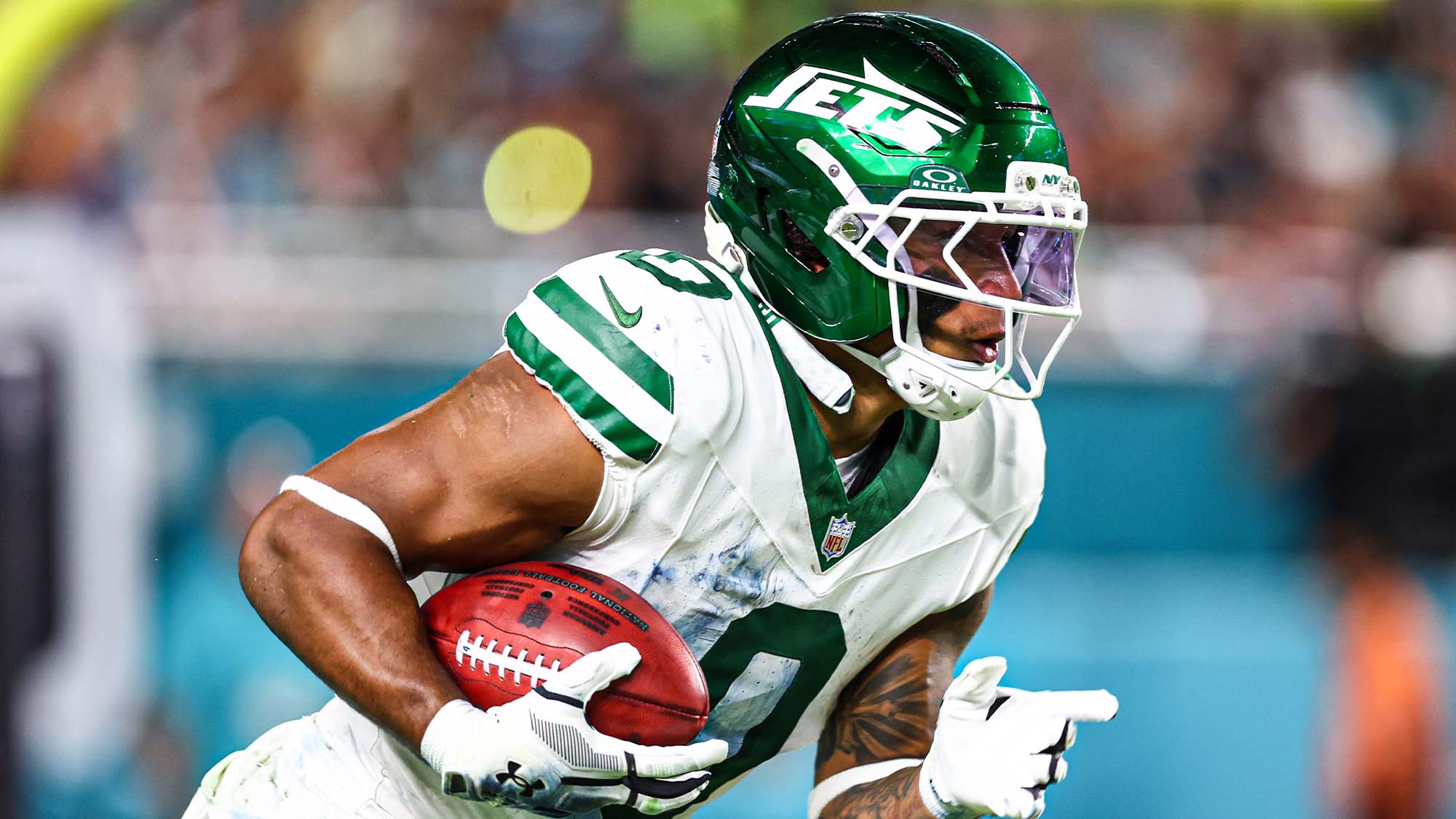
RB Braelon Allen
Braelon Allen was already known as a massive bruiser at the running back position when he entered the NFL at 6-foot-1 and 235 pounds in 2024.
Recently, though, Allen revealed to reporters that he is set to enter the 2026 season at… 250 pounds.
Arguably, this shift makes Allen less viable as the Jets’ potential RB2, but it could make him more dangerous in a specialized role.
Allen is averaging just 3.7 yards per carry in his career. His longest run across 110 carries went for just 20 yards. Those are not the numbers you want to see from the player who would be asked to step up as the starter if Breece Hall went down. You need better efficiency and more explosiveness from a running back who might be trusted to carry a heavy workload.
Now that Allen is 15 pounds heavier than he was when he came into the league, he probably isn’t getting any more explosive.
However, he might be even more unstoppable in a short-yardage role, which is an area where he has already thrived.
In his career, Allen has converted 12 of 15 rush attempts (80.0%) on third or fourth down with two or fewer yards to go. That’s well above the NFL average of 70.7% and is also ahead of Breece Hall’s 73.7% mark (19 of 26) over the same span.
Tack on another 15 pounds, and Allen just became that much harder to stop from getting one or two yards in a gotta-have-it situation. He should be on the field any time the Jets are facing short-yardage on third or fourth down.
But the Jets might be better served with Isaiah Davis in the RB2 role. Davis is a more effective receiver out of the backfield and has shown more explosiveness as a rusher.
Allen, though, could still flip games by establishing himself as a near-automatic answer on the goal line or fourth-and-short.
OT Max Mitchell
Max Mitchell has mostly struggled in his career as a backup tackle for the Jets.
However, the Jets experimented with Mitchell as a sixth offensive lineman in 2025 and found some positive results.
Mitchell played 73 offensive snaps in 2025, with six of those coming at left tackle and 66 as a “tight end” (sixth lineman). New York usually ran the ball out of these packages, as 52 of Mitchell’s 73 snaps were run plays (71.2%).
In this role, Mitchell performed quite well, earning a 78.9 run-blocking grade from Pro Football Focus.
It led to positive results when the Jets’ best running back was behind him: Breece Hall averaged 4.8 yards per attempt across 32 carries with Mitchell on the field, which was better than his 4.3 yards per attempt without Mitchell. Hall also gained at least four yards on 46.9% of his carries with Mitchell on the field, compared to 41.2% when he was off.
Using Mitchell as a sixth lineman is a productive wrinkle that the Jets should not hesitate to tap back into this season.
DT Darrell Jackson Jr.
Rookie fourth-rounder Darrell Jackson Jr. is labeled as a defensive tackle, and rightfully so, as he is listed at 6-foot-5 and 315 pounds.
However, Jets head coach Aaron Glenn revealed that he sees Jackson playing the “big end” role in New York’s defense, stating that Jackson will play plenty of snaps at 5-technique (over the tackle’s outside shoulder) and 4-technique (head-up over the tackle).
You don’t often see 315-pounders in this role. It’s a unique job for a player like Jackson, but it makes plenty of sense given his resume at Florida State.
Jackson played a hefty chunk of snaps at nose tackle for the Seminoles in 2025, but in 2024, he was deployed further outside, seeing a much higher percentage of snaps at three-technique with some occasional looks at 4 or 5-technique. And in 2024, Jackson produced much better as a pass rusher, posting 30 pressures and 3.5 sacks compared to 14 pressures and 1.0 sack in 2024.
Jackson’s run-stopping production was more impressive in his nose tackle role, although that is to be expected. The fact that he was more productive as a pass rusher when being deployed further outside shows that he has legitimate pass-rushing chops, especially for a player of his size.
With his frame, Jackson will naturally be a sturdy edge-setter if the Jets line him up at 5-tech. His size is the main reason they would put him in that spot; he would be part of big lineups intended to stop the run.
But his 2024 season at Florida State suggests he could also be a competent pass rusher in that role, which is critical—the defense cannot survive with a stocky edge defender who won’t create any pressure if he gets caught on the field for a pass play. If that were the case, they would just put their five biggest defensive tackles on the line on every first down. That’s not how it works, though. Offenses would just audible to a pass and throw bombs from clean pockets.
This “big end” role could be Jackson’s path to the field as a rookie, and it’s a role where he is uniquely equipped to make an impact.
New York has a logjam at defensive tackle; Jowon Briggs, T’Vondre Sweat, David Onyemata, and Darrell Jackson will all be demanding snaps between the tackles. Jackson’s path to snaps seems to lie at defensive end, and as surprising a role as that may seem for a player of his size, he is prepared to succeed in it.
