
New York Jets training camp is in full swing, which means it’s time for fans to refresh X/Twitter for play-by-play updates regarding which guy in shorts ran past another guy in shorts.
While it is always fun to have some semblance of on-field action back in the NFL news cycle, fans would be wise to take training camp updates with a grain of salt. In many ways, the results of camp practices carry little weight when it comes to predicting what will happen on Sundays.
As Jets fans track what’s going on in Florham Park over the next few weeks, here are three of the main things to avoid overreacting to.
1. How running backs look on rush attempts
If there is one position that cannot be evaluated by fans based on training camp updates, it’s running back.
The crux of the running back position is being able to avoid getting tackled. So, what could possibly be learned about a running back in an environment where he is not allowed to be tackled?
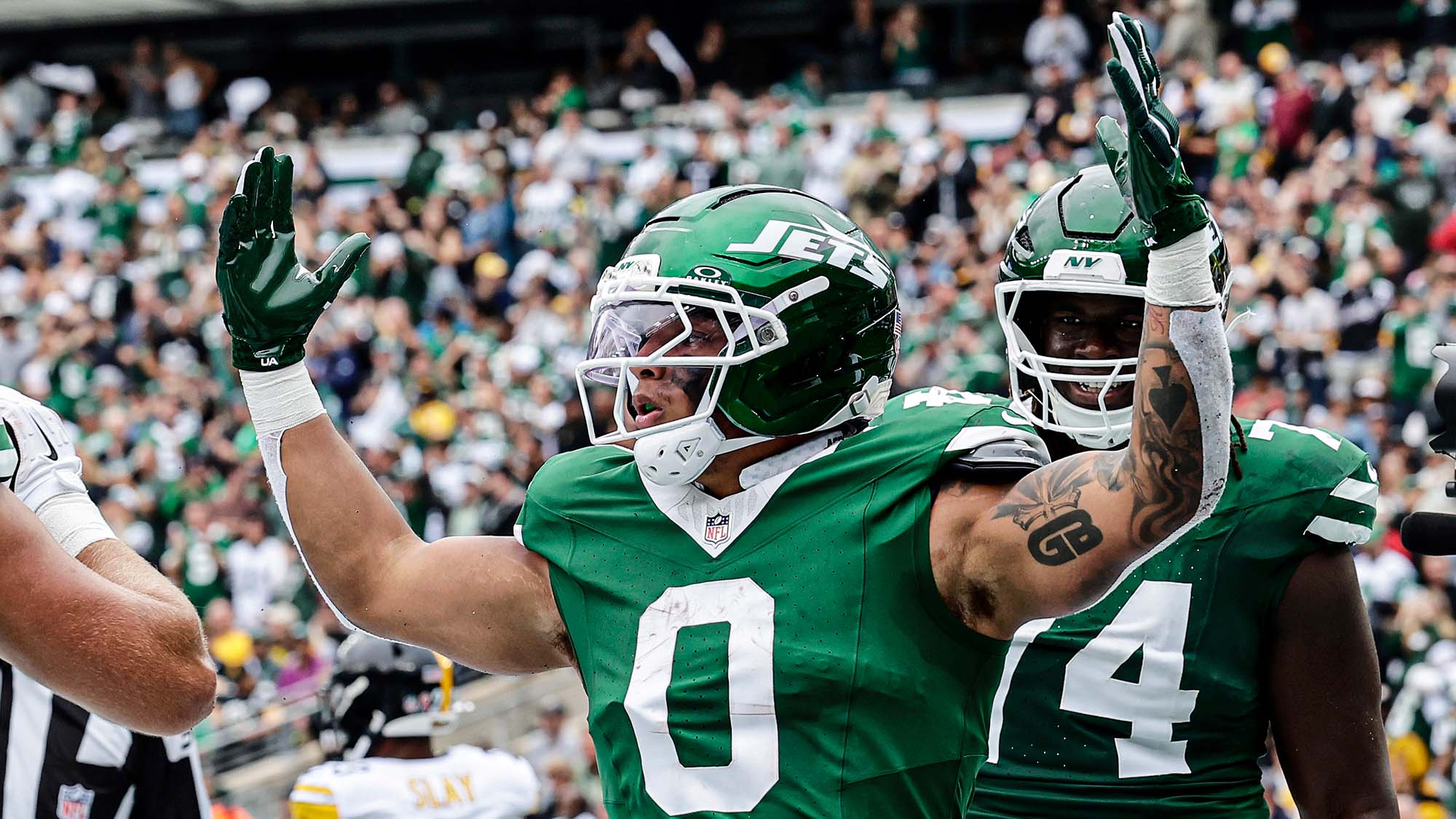
Reports are bound to come out regarding Breece Hall, Isaiah Davis, and Braelon Allen breaking off 50+ yard runs. But in a real game, many of those plays could have been stopped at the line of scrimmage if the defensive tackles and linebackers weren’t settling for light arm-tackle attempts to avoid hurting their teammate.
Running backs can still be evaluated on the practice field in other ways, whether it’s their hands, route-running, or pass-blocking. These things translate more closely to a real game.
But there is little to be gleaned about a running back darting through the line of scrimmage on a designed run play when the defense is instructed not to crush their own teammate.
It would even be a stretch to try to grade a running back’s vision in training camp, at least from the standpoint of someone who is not on the coaching staff. While the coaches of an NFL team can review practice film to properly evaluate a running back’s vision, media members are forced to watch each play once from a sideline angle.
Without the benefit of replay, it is impossible for media members to give an accurate evaluation of a running back’s vision based on a one-time glimpse of a run play from a poor vantage point that does not allow them to view the gaps from the running back’s perspective, as the coaches would on an end-zone-angle replay.
Fans should mostly ignore running back updates, unless it has to do with an isolated, independent event, such as drops, fumbles, routes, incredible catches, and pass-blocking. It would also be worthwhile to track how the coaching staff uses certain players or stacks them up on the depth chart.
2. Offensive consistency in team sessions
Fans will be quick to criticize the offense if reports describe consistent struggles from series to series in 11-on-11 team sessions.
It’s understandable: Jets fans are tired of having a poor offense, and they would rather see the offense outplay the defense for once. After all, most years, the Jets’ offensive struggles in camp are a sign of things to come.
However, if you look across the NFL, it is quite common to hear reports of offenses being outplayed, even for teams that have great offenses. There are multiple reasons for this.
For one, the training camp environment favors the defense in multiple ways. The limited physicality is arguably an advantage for the defensive line in trench play, as the offensive linemen cannot grapple with defensive linemen the way they would in a normal game, especially on days when there are no pads to grab. It becomes relatively easy for speedy edge rushers to win around the corner.
Secondly, most offenses are still installing their playbook. While the same goes for the defense, it is safe to say that the offensive playbook requires a bit more chemistry and understanding than the defensive playbook. Defensive schemes are generally more congruent across different teams than the offensive side, which can include entirely different language from team to team.
It is also important to remember that offenses are not trying to win on the practice field. It’s… practice. They’re practicing. This means they are working on everything in the playbook, with particular emphasis on things they struggle with. It’s not as if the offense is going out there and spamming the optimal plays to rack up touchdowns on the defense, as they would in a real game.
This can skew the results to the negative side, but teams do not care about results on the practice field. They care about working on things that must be worked on. Rabid fans on social media, though, pretend as if 11-on-11 drills in July are a direct reflection of how the offense plans to approach a divisional game in November.
3. Defensive consistency in 7-on-7 drills
Reports will fly around regarding the results of 7-on-7 drills. Fans and social media aggregators, though, will ignore the “7-on-7” part and spread the results of these drills as if they translate to real football.
7-on-7 drills are extremely favorable for the offense. The quarterback gets to face man coverage across the board with no pressure. It’s as pro-offense as it gets.
Like Jets X-Factor’s Robby Sabo said while watching 7-on-7 drills at Thursday’s practice, “The offense should rip apart the coverage.”
There is absolutely some value to 7-on-7 drills. It’s an opportunity to see receivers and corners go mano a mano, while the quarterback gets a chance to show off his clean-pocket accuracy, timing, touch, and anticipation.
Still, it isn’t fair to judge defenders too harshly for losing in 7-on-7s, and it is also wise to avoid giving offensive players too much credit for dominating in those situations. In-game snaps that feel remotely like a 7-on-7 drill are extremely rare. It would have to be a man-coverage rep in which the quarterback receives absolutely perfect pass protection. That happens only a handful of times in an average NFL game, and when it does, the offense usually wins.
Even then, the quarterback is still in a much more precarious position than he is in a 7-on-7 drill. He has to be aware of potential pressure, look over the offensive line, and survey the movements of 11 defenders rather than seven. In a 7-on-7, he doesn’t even have to think about the possibility of pressure, complex coverage looks, or the offensive line impeding the passing lane. Those factors allow the quarterback to feel immensely more comfortable, enabling him to throw accurate passes with a level of consistency he could never achieve in a real game. It’s tough for any DB to guard that.
7-on-7 drills aren’t meaningless, but it is important for fans to understand the context behind them. They are nowhere close to a one-to-one replication of your typical regular season rep. Rather, they are meant to evaluate very specific skills: the man-to-man route-running and coverage of the offensive weapons and the defenders. The quarterback should be almost completely excluded from evaluation during these drills, as he will never experience an in-game rep under the same circumstances.
