
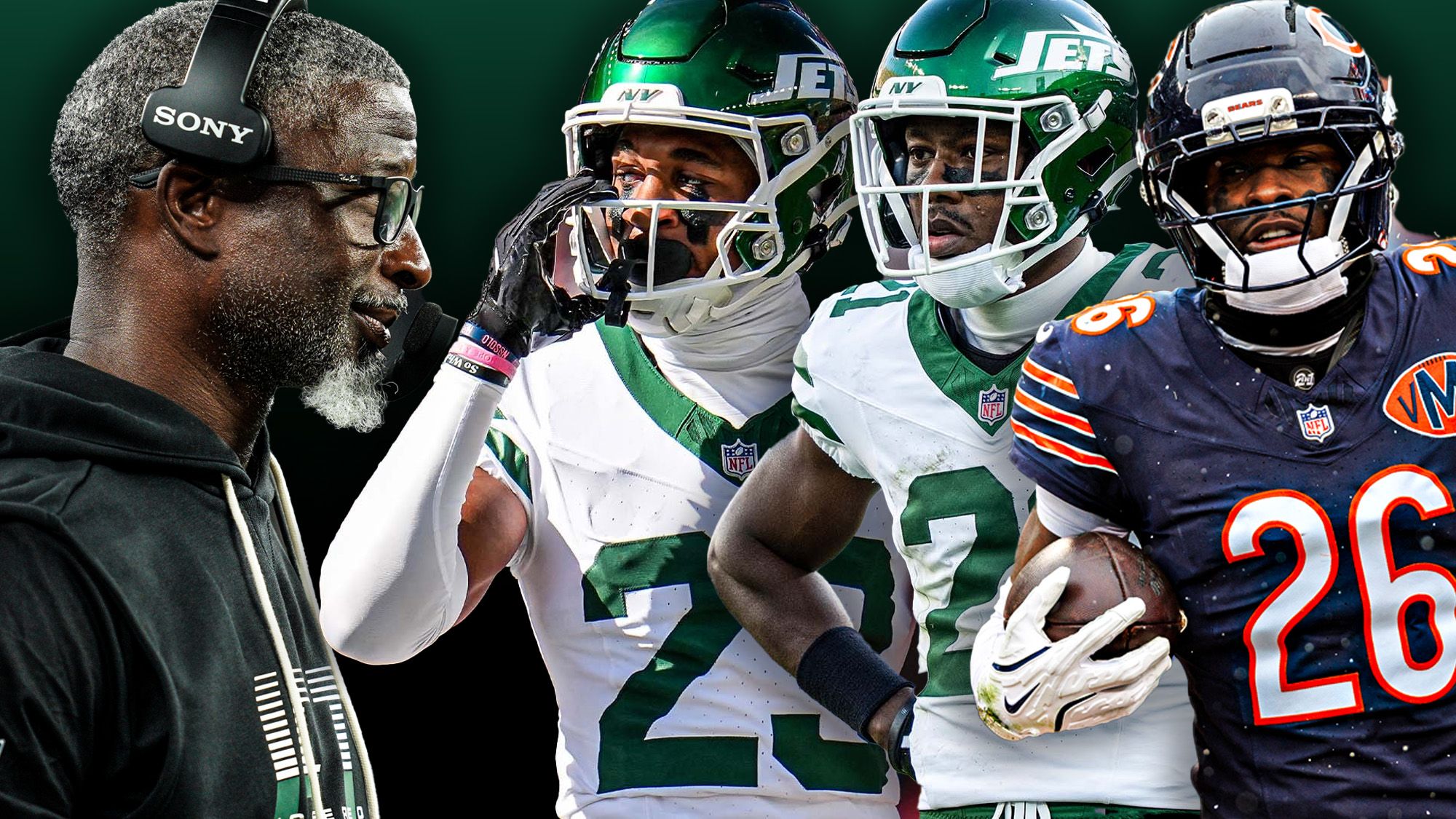
New York Jets head coach Aaron Glenn will be taking over the team’s defensive play-calling duties in 2026, and his schematic tendencies are well-documented.
During his time as the Detroit Lions’ defensive coordinator from 2021-24, Glenn established a reputation for utilizing man coverage at a very high rate. Throughout his final year in that role, Detroit’s 41.2% man coverage rate led the NFL.
Given Glenn’s history, it’s expected THAT the Jets will use man coverage heavily this season. Maybe they will not reach a 40+% clip, but it will certainly be a fair share if Glenn’s Detroit tendencies carry over to New York.
With that in mind, here is a look at how the Jets’ expected top three boundary cornerbacks, Azareye’h Thomas, Brandon Stephens, and Nahshon Wright, fared against man coverage last season.
- Azareye’h Thomas: 34.6% man coverage rate, 50% completion rate allowed, 131 yards allowed, 21.8 yards per reception, 0 pass breakups, 0 interceptions, 1 touchdown allowed
- Brandon Stephens: 33.1% man coverage rate, 59.4% completion rate allowed, 208 yards allowed, 10.9 yards per reception, 3 pass breakups, 0 interceptions, 6 touchdowns allowed
- Nahshon Wright: 27.8% man coverage rate, 73.3% completion rate allowed, 301 yards allowed, 13.7 yards per reception, 2 pass breakups, 1 interception, 3 touchdowns allowed
Now, here is a look at their numbers in zone coverage.
- Thomas: 53.5% zone coverage rate, 50% completion rate, 46 yards allowed, 7.7 yards per reception, 2 pass breakups, 0 interceptions, 0 touchdowns allowed
- Stephens: 59.5% zone coverage rate, 76.5% completion rate allowed, 274 yards allowed, 10.5 yards per reception, 3 pass breakups, 0 interceptions, 1 touchdown allowed
- Wright: 61.8% zone coverage rate, 60% completion rate allowed, 479 yards allowed, 11.5 yards per reception, 5 pass breakups, 2 interceptions, 5 touchdowns allowed
Second-round rookie D’Angelo Ponds, who is also expected to play a crucial role in the team’s CB room, had just a 7.6% man coverage rate at Indiana in 2025. It was the second-lowest mark among 134 qualified FBS CBs (minimum 350 coverage snaps), trailing just fellow Hoosier Jamari Sharpe at 7.5%.
How could this impact Glenn’s play-calling?
Thomas is the most interesting fit in a man-heavy system. While he allowed 21.8 yards per reception in man coverage last season, which is highly alarming, he stood out in that area during his final season at Florida State in 2024.
First off, he possesses a lengthy frame. His 6-foot-1½ height ranks in the 84th percentile among cornerbacks, while his 32⅜-inch arm length ranks in the 80th percentile.
At FSU in 2024, he thrived throughout 109 man-coverage snaps. He allowed just 7 of 14 throws in his direction to be completed for 60 yards, zero touchdowns, and an interception. Furthermore, his 31.8 passer rating finished 12th-best among qualified FBS corners (minimum 10 targets in man coverage).
Perhaps last year was an anomaly, having taken on a starting role down the stretch when the Jets’ secondary as a whole was at its worst, with Thomas being a 21-year-old rookie, to boot.
Thomas’ history, both production-wise and given his profile, suggests he can develop into a reliable corner in a man-heavy defense.
On the other hand, Stephens’ numbers from last year highlight an interesting conundrum.
The biggest red flag is the number of touchdowns he allowed in man coverage. He surrendered six touchdowns in man coverage compared to only one in zone coverage.
Interestingly, though, his completion rate allowed in man coverage (59.4%) was much better than his 76.5% rate allowed in zone coverage, and his yards per reception (10.9 vs. 10.5) were essentially identical.
This actually lines up with the main storyline of Stephens’ career. He has often been able to go stride for stride with pass catchers and put himself in position to make a play, but making plays on the ball has been his biggest issue.
That becomes even more important in Glenn’s defense. Playing more man coverage will subsequently put Stephens in more one-on-one situations, while he will need to be effective at the catch point, an area where he has historically struggled.
Overall, this helps explain why his coverage numbers often look great for stretches, but he eventually gives up too many plays for the final results to be ideal.
Wright’s numbers, meanwhile, are concerning for a man-heavy defense.
Despite playing man on only 27.8% of his coverage snaps last season, Wright allowed a 73.3% completion rate for 301 yards and three touchdowns. Beyond that, receivers averaged 13.7 yards per reception against him, while the former Chicago Bear logged just two pass breakups and an interception.
Altogether, though, he struggled in coverage last year. He was one of only two CBs to surrender 700+ yards and seven touchdowns in 2025.
His metrics in zone coverage weren’t much better. While his completion percentage allowed dropped to 60%, that could be attributed to a much larger sample size. The same holds true for his five pass breakups and two interceptions.
Five of his seven touchdowns were also allowed in zone coverage.
He holds great length at 6-foot-4 and 190 pounds, and as we broke down, perhaps the Jets can help develop the coverage element of his game.
While he is 27 years old, he has started just 19 NFL games, including 16 last season. Given that, he remains raw in certain ways.
D’Angelo Ponds is probably the most difficult player in this bunch to project into Glenn’s defense, simply because there isn’t much recent man-coverage tape to work with.
As I noted above, Ponds played coverage on just 7.6% of his coverage snaps at Indiana last season, the second-lowest rate among 134 qualified CBs.
That alone makes his transition into Glenn’s defense pretty interesting to monitor. It makes it possible that Ponds could go from one of the most zone-heavy teams in the country at Indiana to a man-heavy scheme in the pros.
That doesn’t take away from the fact that he thrived overall in coverage last season, earning an 89.6 coverage grade at Pro Football Focus. He also allowed just a 42.0 passer rating when targeted, one of the best marks in the nation.
This all makes Ponds such an interesting wild card. His overall coverage, particularly in zone, was excellent last season, but is he able to handle a sizeable shift in his rookie season?
Also, he doesn’t have measurables on his side. Standing at just 5-foot-8 and 182 pounds with 29 3/8-inch pounds, he is quite undersized for an NFL corner. Among CBs, his height and arm length both rank in just the 2nd percentile, while his weight ranks in the 11th percentile.
However, he has the athletic ability to make up for it. He reportedly ran a 4.38-second 40-yard dash at his pro day, which would have finished around the 89th percentile if official, while his 43.5-inch vertical at the NFL’s Scouting Combine was the fourth-best in history.
Ultimately, one of Glenn’s bigger challenges this year will be crafting a scheme to fit the corners that he has.
