

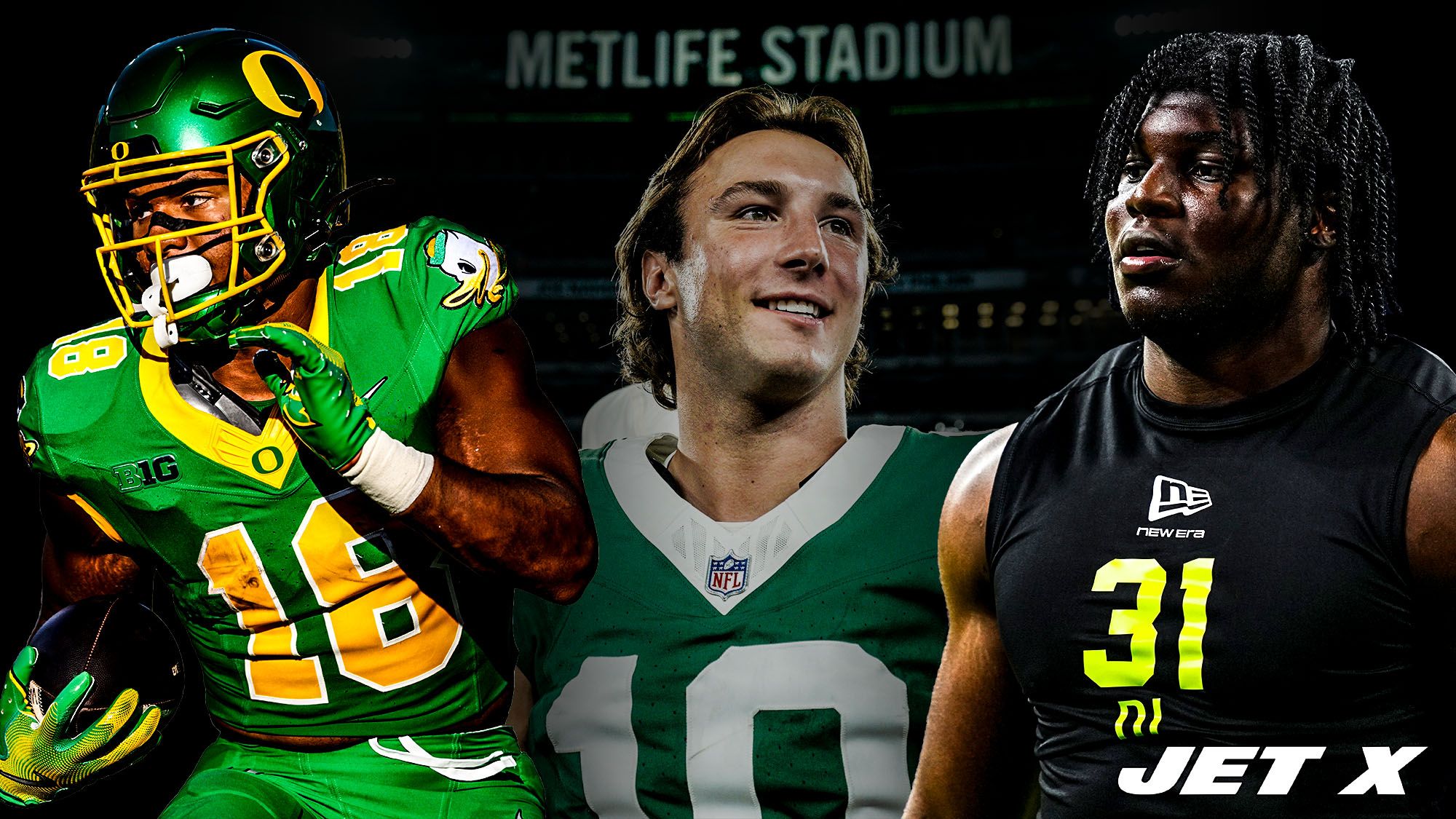
The NFL has a funny way of creating impossible expectations.
Each April, fans convince themselves that every first-round pick is destined to become an All-Pro, every Day 2 selection is a future starter, and every late-round sleeper is the next Tom Brady or Brock Purdy.
Reality, however, is much different.
Only about 30 percent of first-round draft picks eventually become Pro Bowl players, while fewer than half earn second contracts with the teams that drafted them. Mid-round selections face even steeper odds.
Success isn’t measured by immediate superstardom; it’s measured by development, consistency, and helping your football team win games.
That’s exactly why expectations for the New York Jets’ 2026 rookie class should be grounded in both optimism and perspective.
General manager Darren Mougey entered this past draft determined to reshape the roster around Aaron Glenn’s vision of explosive athletes, physical football, and relentless competition. By the end of draft weekend, nearly every major national outlet graded the Jets among the NFL’s clearest winners.
That doesn’t guarantee greatness, but what it does guarantee is opportunity.
David Bailey (ED): The franchise pass rusher
No player in this class carries more pressure than David Bailey.
The second overall pick immediately becomes the face of the Jets’ defensive rebuild, and his college resume suggests he deserves the responsibility.
After beginning his career at Stanford, Bailey transferred to Texas Tech and became one of college football’s most disruptive defenders. His senior season numbers are as follows:
- 52 tackles
- 14.5 sacks
- 19.5 tackles for loss
- 20.4% pressure rate (led the nation)
- Consensus All-American honors
- Big 12 Defensive Lineman of the Year
His 14.5 sacks tied for the FBS lead, while his elite pressure rate demonstrated that even when he didn’t finish plays with sacks, he consistently disrupted opposing quarterbacks.
NFL evaluators praised his explosiveness, bend around the edge, and rare closing speed. Simultaneously, an obvious case can be made that his overall game — particularly his run defense, technique at the point of attack, and balanced-down instincts — remains a work in progress.
What should Jets fans expect?
History provides a useful benchmark.
Recent elite rookie edge rushers, such as Will Anderson Jr., Jared Verse, and Aidan Hutchinson, flashed dominance as they adjusted to NFL strength and offensive schemes. Bailey won’t win every snap against veteran tackles, but his first-step explosiveness should immediately translate.
A realistic rookie stat line could be as follows:
- 50 tackles
- 8–10 sacks
- 12-15 tackles for loss
- 20+ quarterback hits
- Several game-changing strip sacks
If Bailey reaches those numbers, he should receive NFL Defensive Rookie of the Year consideration. To do so, Bailey will need to refine his pass rush plan to include more effective counter-rushes and show he can stay on the field on early (run) downs.
If he can show that growth in camp and throughout his rookie season, he’ll instantly become the centerpiece of Aaron Glenn’s defense.
Kenyon Sadiq (TE): The matchup nightmare
Modern NFL offenses revolve around creating mismatches.
That’s precisely why the Jets selected Oregon tight end Kenyon Sadiq with the 16th overall pick.
At Oregon, Sadiq developed into one of the nation’s most versatile offensive weapons. Despite sharing touches in a balanced Ducks offense, he became an explosive receiving threat capable of lining up at multiple spots:
- Inline TE
- Slot WR (Power Slot)
- H-Back
- Wider-Split WR
His athletic testing reinforced what coaches already saw on film:
- 4.39-second 40-yard dash
- 43.5-inch vertical leap
- 241 pounds
That combination of size and speed is extraordinarily rare. He has been described as essentially “a big receiver” because linebackers cannot cover him, and defensive backs struggle to match his size after the catch.
Expectations
Geno Smith has always favored dependable intermediate targets, and Sadiq should become exactly that for the 2026 Jets’ offense. Unfortunately, Sadiq hit a roadblock with core-muscle surgery he had in the offseason, coupled with a setback, which has kept him out of almost all of camp.
The prognosis for week one of the regular season is good, but the ramp-up may hinder how quickly he integrates into the game plan. Expect a slower start while Sadiq gets his NFL footing.
The collegiate tight end position poses a challenging learning curve when entering the professional ranks. Rather than expecting Travis Kelce-like production immediately, Jets fans should expect:
- 40-45 receptions
- 550 receiving yards
- 6 touchdowns
Even more importantly, Sadiq’s presence should create easier matchups for Garrett Wilson and Breece Hall. His potential impact forces defensive personnel to keep tabs on him; that may be worth more than his individual statistics.
Omar Cooper Jr. (WR): The missing RAC threat
The Jets didn’t simply draft Omar Cooper Jr.; they traded back into the first round to make sure they got him. That alone should explain how highly they value his skill set.
At Indiana, Cooper evolved into one of the Big Ten’s most dangerous receivers. NFL scouts praised a versatile skill set, including some of the following traits:
- Physicality
- Explosive acceleration
- Elite contact balance and ability to break tackles
- Versatility inside and outside
- Run-after-catch ability
Unlike many college receivers, Cooper consistently generated explosive plays after first contact instead of merely catching deep passes. NFL.com described him as an “ascending slot bully” capable of adding significant yards after the catch.
Rookie outlook
Garrett Wilson will command defensive attention. That leaves both AD Mitchell and Cooper facing favorable matchups throughout the year.
Pair that with Frank Reich’s infatuation with 11 personnel, and Cooper could get enough opportunities to be far more than just a blip on the roster in 2026.
Reasonable expectations:
- 40 catches
- 670 yards
- 4 touchdowns
- Several explosive plays of 40-plus yards
His greatest value may come from forcing defenses to cover more ground and being the catalyst for explosive plays, particularly in the RAC area.
D’Angelo Ponds (CB): The Day 2 gem
One of the most intriguing selections in the Jets’ 2026 draft class wasn’t made in the first round. It came in the second, when New York selected Indiana cornerback D’Angelo Ponds, a player many evaluators believed possessed first-round talent despite concerns about his size.
Standing 5-foot-8.625 and weighing 182 pounds, Ponds doesn’t fit the prototype of today’s NFL outside cornerback. What he lacks in height, however, he more than compensates for with instincts, competitiveness, ball skills, and elite coverage ability.
After beginning his career at James Madison, Ponds transferred to Indiana and immediately became one of the Big Ten’s premier defensive backs. Over his three collegiate seasons, he accumulated:
- 169 total tackles
- 7 interceptions
- 33 pass breakups
- 2 interceptions returned for touchdowns
- 10.5 tackles for loss
- 118 tackles, 5 interceptions, 20 pass breakups, and 2 touchdowns during his two seasons at Indiana
His final season was arguably his best. Ponds finished with 61 tackles (4.0 for loss), 2 interceptions, 11 pass breakups, a pick-six, and a forced fumble, consistently matching up against some of the nation’s top receivers as Indiana made a remarkable run to the College Football Playoff.
The advanced metrics are equally impressive.
According to Pro Football Focus, Ponds earned an 88.8 overall defensive grade, ranking eighth among all FBS cornerbacks. His 89.6 coverage grade ranked seventh nationally, and quarterbacks managed just a 42.0 passer rating when targeting him.
He allowed only 18 receptions all season despite playing more than 560 defensive snaps.
Fitting Aaron Glenn’s defense
Aaron Glenn made his reputation coaching aggressive, instinctive defensive backs who thrive in both man and zone coverage, and Ponds checks every one of those boxes.
His willingness to tackle, anticipation in off coverage, and ability to mirror receivers make him an ideal fit as a nickel defender who can also play outside against certain matchups. His football intelligence allows him to recognize route concepts quickly, while his short-area burst helps him close throwing windows before quarterbacks can capitalize.
Although larger NFL receivers may occasionally create matchup challenges in contested-catch situations, Ponds’ competitiveness and timing consistently helped him overcome that disadvantage in college.
Rookie expectations
Unlike many second-round corners who are eased into rotational roles, Ponds has a legitimate opportunity to compete for meaningful defensive snaps immediately. A calf injury has caused the Jets to slow-play Ponds throughout the preseason, so we still haven’t seen him practice and play with the 1s.
Notwithstanding, Ponds’ inside/outside versatility should allow him to push newcomer Nahshon Wright and incumbent Jarvis Brownlee for defensive snaps with the 1s early and often if his calf proves not to be a hinderance.
A realistic rookie season could look something like this:
- Starting nickel corner by midseason
- 40-50 total tackles
- 2-3 interceptions
- 8-10 pass breakups
Those numbers would represent an outstanding rookie campaign and could establish him as one of the steals of the 2026 NFL draft.
The Long-Term Outlook
Every draft class has a player who quietly exceeds expectations.
D’Angelo Ponds has all the ingredients to become that player for the Jets.
He may never possess elite size, but his production tells a compelling story. Across stops at James Madison and Indiana, Ponds consistently found the football, disrupted passing lanes, and elevated his level of play against increasingly tougher competition. His instincts, toughness, and polished coverage skills give him one of the highest floors among the Jets’ rookie class.
If David Bailey becomes the headliner and Kenyon Sadiq becomes the offensive star, don’t be surprised if, two or three years from now, Jets fans look back and say Ponds was one of the biggest values of the entire 2026 draft.
Cade Klubnik (QB): The luxury of patience
No rookie benefits more from the Jets’ current roster than Cade Klubnik. Unlike first-round quarterbacks expected to rescue struggling franchises, Klubnik enters the NFL behind veteran Geno Smith.
That’s ideal.
At Clemson, Klubnik enjoyed an accomplished collegiate career, throwing for more than 10,000 passing yards, producing 90-plus total touchdowns, winning multiple conference championships, and demonstrating athletic ability as both a passer and runner.
While his final season had inconsistencies, evaluators still believed his mobility, anticipation, and competitiveness made him a worthwhile developmental investment.
Immediate experience is not the goal
The biggest mistake fans make is assuming every rookie quarterback must play immediately. There were good things to build on in Klub’s first preseason game versus Tampa Bay, but more development is needed.
Let’s be honest: This is Geno’s team, and the best-case scenario for the Jets is that Klubnik finishes the 2026 season as a redshirt quarterback.
For Klubnik, success means the following:
- Winning the backup job
- Mastering the offense
- Improving footwork
- Learning NFL coverages
- Excelling during preseason opportunities
If he spends the entire season holding a clipboard behind Geno Smith, that isn’t failure; it’s smart quarterback development on the part of the New York Jets.
Darrell Jackson Jr. (ID): Quietly Important
Championship defenses require more than stars. They need depth.
That’s where Darrell Jackson Jr. enters the picture.
Standing over 6-foot-5 and weighing well over 330 pounds, Jackson possesses the size that coaches cannot teach.
At Florida State, he consistently occupied blockers while flashing disruptive pass-rush ability. Evaluators believe improved technique could unlock considerably more production at the professional level.
Expectations
Jackson should rotate early while learning behind veteran DL like David Onyemata and Harrison Phillips, both of whom are in their walk years.
A successful rookie season includes:
- 15-20 tackles
- 2 sacks
- Consistent rotational snaps
- Strong run defense in short-yardage situations
Granted, there’s nothing flashy here, but it’s still incredibly valuable from a depth perspective.
VJ Payne (S): The Seventh-Round Steal Candidate
Every successful draft class has one late-round surprise. Could VJ Payne become that player?
Kansas State developed Payne into a dependable defensive back known for physical tackling, football intelligence, and special teams excellence. Those qualities often determine whether seventh-round picks survive final roster cuts.
Payne, currently on the shelf with a bone bruise in his knee that will likely keep him out for the start of the regular season, faces an uphill battle to make the final 53. Don’t be surprised if the Jets place him on IR to start the year — with a designation to return, of course.
Success looks different
Jets fans shouldn’t expect Payne to start.
Once he is deemed healthy, his goals should look something like the following:
- Become a core special teams contributor
- Dress every Sunday
- Earn rotational defensive snaps late in the season
If he accomplishes those goals, he’ll exceed expectations.
Anez Cooper (IL): The importance of OL depth
Fans rarely celebrate sixth-round offensive linemen — until injuries happen, that is.
Anez Cooper may prove to be one of the draft’s most underrated selections.
The Miami guard started against elite ACC competition while displaying tremendous size, strength, and positional flexibility. NFL evaluators believe his best football is still ahead of him because of his natural power and ability to neutralize defenders in confined spaces.
Immediate goal
Cooper’s first-year goal is pretty simple at this point (even with his impressive preseason debut in the books): make the 53-man roster.
Everything else becomes a bonus.
If Cooper develops into the Jets’ top interior reserve while occasionally appearing in heavy packages, he’ll have enjoyed a successful rookie campaign.
Patience is key
The temptation to judge the New York Jets 2026 NFL draft class immediately, or even halfway through the season, will undoubtedly be there.
No matter what happens this season, don’t do that.
NFL history consistently shows that rookie development is rarely linear. Many elite players don’t truly emerge until their second or third seasons, once they’ve adjusted to NFL speed, strength, and complexity. Even highly graded draft classes often need time before their full value becomes evident.
The Jets’ coaching staff understands this.
Aaron Glenn inherited a roster that needed foundational pieces, not quick fixes. Darren Mougey responded by selecting players with high ceilings and strong athletic profiles rather than chasing immediate headlines.
What realistic success looks like
Forget unrealistic expectations like seven starters, multiple Pro Bowlers, or a Rookie of the Year winner.
Instead, imagine this:
- David Bailey records 9 sacks and becomes one of the league’s most exciting young edge rushers.
- Kenyon Sadiq gets healthy, stays healthy, and develops into Geno Smith’s most reliable red-zone target with 6 touchdowns.
- Omar Cooper Jr. surpasses 650 receiving yards while stretching opposing defenses.
- D’Angelo Ponds snags 3 interceptions and is a plus from a perimeter run-fit perspective.
- Cade Klubnik spends the year developing without being forced onto the field.
- Darrell Jackson Jr. becomes a trusted member of the defensive line rotation.
- VJ Payne earns a permanent role on special teams.
- Anez Cooper proves he can be trusted when injuries inevitably strike.
If those things happen, the Jets won’t simply have enjoyed a good rookie class — they’ll have established the foundation of a sustainable winner.
Championship organizations aren’t built on a singular magical draft pick; they’re built by stacking productive draft classes year after year, developing young talent, and allowing players to grow into larger roles. The 2026 NFL draft class has all the ingredients to become the first major building block of Aaron Glenn’s vision.
New York Jets fans have every reason to be excited.
Just ensure the excitement is paired with the rookies’ realistic expectations. The value of reality is critical in every way to avoid overshooting and setting unattainable goals.
