
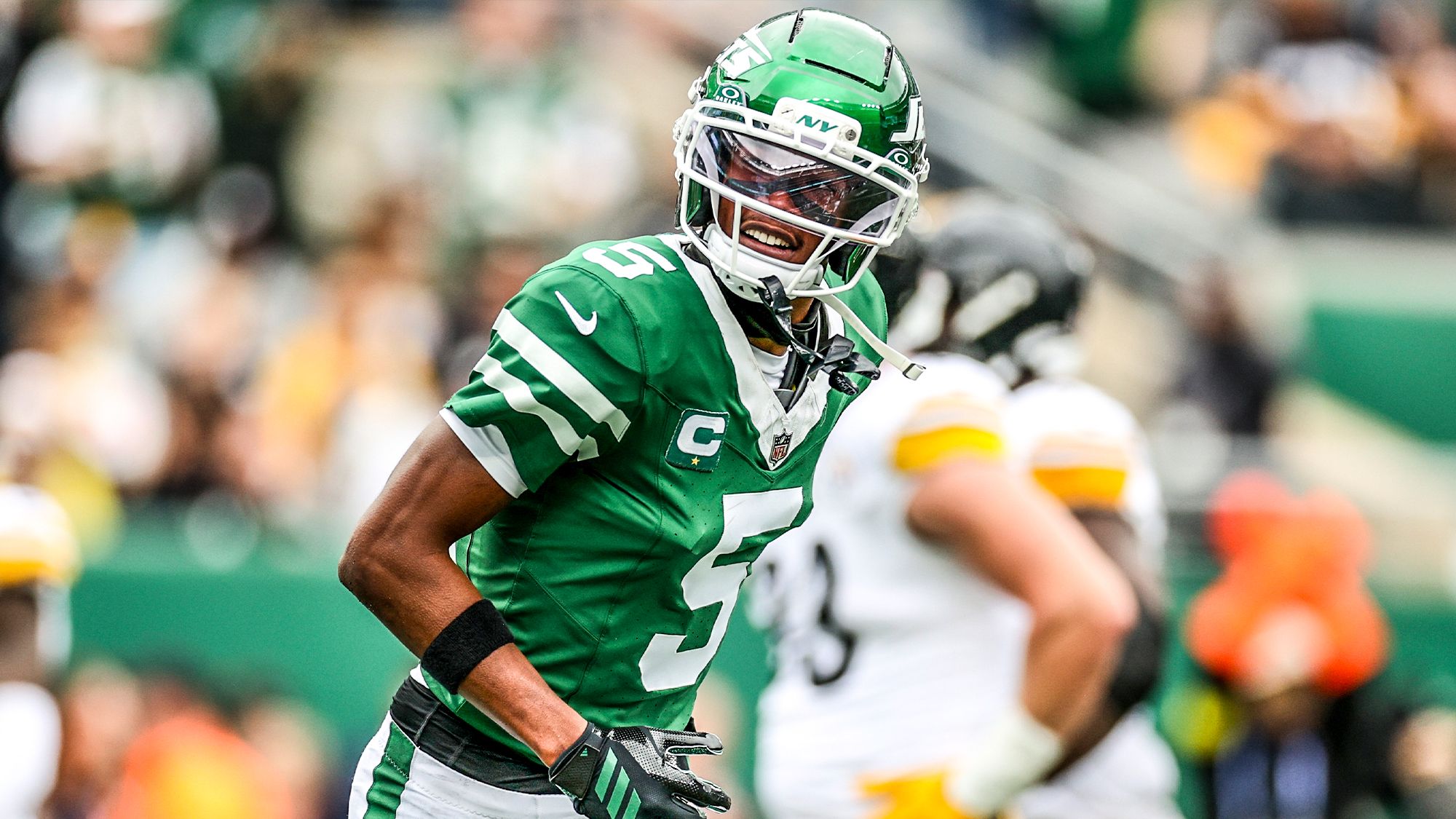
New York Jets fans are patiently waiting for the day when Garrett Wilson’s stats and league-wide reputation match up with the brilliance of his abilities.
Wilson’s highlight reels and route-running film both portray a gifted wideout who should be considered one of the most talented playmakers in the NFL. His numbers, though, show a player with just 18 receiving touchdowns in four seasons, tied for 37th in the NFL.
There is optimism in Florham Park that 2026 will finally be the year that Wilson’s surroundings allow him to put up numbers that match his talent. With a veteran pocket passer in Geno Smith, an experienced offensive coordinator in Frank Reich, a high-upside offensive line, and a promising WR2 in Adonai Mitchell, things are lining up nicely for Wilson.
A new role will also be part of Wilson’s quest for a career year.
Speaking with former Jets wide receiver Keyshawn Johnson, Wilson described the new role that he will play under Reich: lining up outside nearly full-time.
“If I had to choose to be stationary, I would say just probably the slot, just because you can eat in there. If it’s man coverage, you got a lot of space. I truly, like this year, I’m getting back to playing outside, which—and we were kind of talking about on the field—all of a sudden, the routes you do catch are a little more contested, but deeper down the field, more rewarding. So there’s aspects to it. I like being able to do a little bit of everything and, playing outside for me this year has been something I ain’t done in a while, and I missed it.”
According to Pro Football Focus, Wilson has lined up in the slot on 29.5% of his career offensive snaps. In 2025, under offensive coordinator Tanner Engstrand, that number jumped to a career-high 34.4%. His career low was 23.4% in 2024, meaning he lined up outside on a career-high 76.6% of his snaps that season.
Under Reich, there is a good chance that Wilson will surpass that 76.6% mark.
Historically, Reich has asked his top receiver to line up outside on a very high percentage of their snaps. This is evident in his tenure as the Indianapolis Colts’ head coach.
Back in 2021 (Reich’s last full season as an NFL coach), the Colts’ No. 1 wide receiver, Michael Pittman Jr., lined up outside on 83.7% of his snaps. In 2020, T.Y. Hilton had an 85.6% mark as Indy’s top receiver.
This trend holds up dating back to Reich’s days as a championship-winning offensive coordinator with the Philadelphia Eagles. In 2017, Philly’s top receiver, Alshon Jeffery, lined up outside on 86.2% of his snaps.
Based on Wilson’s comments, it seems clear that Reich is preparing to place Wilson in the Pittman/Hilton/Jeffery role as a strict X receiver. As Wilson stated, that means his targets are bound to be “deeper” and “more rewarding”.
Across 19 regular season and playoff games under Reich, Jeffery averaged 14.6 yards per reception. Hilton averaged 14.3 yards per reception in four seasons under Reich, while Pittman averaged 12.4 yards per reception in two full seasons.
For perspective, Wilson’s career average in yards per reception is just 11.6. He has not surpassed the 11.0 mark since peaking at 13.3 in his rookie year.
Look for Wilson to see a spike in explosiveness this season. It’s great news for both him and Jets fans, and it’s precisely what he’s been missing in his game.
There is a misconception about Wilson that his underwhelming production is due to a lack of targets, and that he needs a QB/OC combo that will feature him more heavily. That’s incorrect. Wilson’s problem has never been a lack of opportunities.
From 2022 to 2024 (when he played all 51 games), Wilson ranked third in the league with 469 targets (9.2 per game), a byproduct of both his elite separation ability and the fact that the Jets have, indeed, tried their best to pepper him with throws.
The problem is not the volume of Wilson’s targets, but their efficiency.
Wilson has caught just 59.7% of his career targets, which doesn’t match up with the film for a player whose hands are as good as his, so that one can be largely pinned on inaccuracy at quarterback. This is backed up by the fact that his career drop rate, per PFF, is just 5.1%, so it stands to reason that most of those incompletions were on the quarterback.
To boot, many of Wilson’s targets have come on shorter throws, as the Jets have tried to force the ball to him on shallow throws after long stretches when their quarterbacks could not get him involved downfield. That explains why he is averaging a mediocre 11.6 yards per reception when he does catch the ball.
This is the perfect mixture for a ghastly bowl of inefficiency stew. When a wide receiver catches less than 60% of his targets and averages under 12 yards on those catches, you get Wilson’s paltry career average of just 6.9 yards per target, ranking 67th among the 73 wide receivers with at least 200 targets since 2022. He also converts a very low percentage of his targets into touchdowns, with his 3.4% touchdown rate placing 62nd out of 73.
So, the Jets don’t need a coach who will force more throws to Wilson. He’s gotten plenty of forced throws in his career.
They need a coach who will help Wilson get higher-quality targets.
Reich might be the right coach to pull that off.
For a player with as many eye-popping downfield highlights as he has, it is startling to realize that Wilson has only caught 22 deep passes (20+ air yards) in his four-year career. He has never caught more than seven deep passes in a full season.
This is where Reich can make a difference. With Wilson bound to play upwards of 85% of his snaps on the outside, he will receive more opportunities to beat defenses vertically than ever before. Many of those empty targets from his first four seasons will be converted to high-upside deep chances, with greater yardage potential and a higher probability of touchdowns.
These types of targets are precisely what Wilson needs to generate the yards-per-reception and touchdown-per-target efficiency that he’s been lacking. At last, the Jets might actually get valuable results out of the many targets that they pepper on their best receiver.
In fact, as a result of this role, Wilson’s target volume may actually go down compared to his first four seasons.
But that’s okay. Hypothetically, let’s say that the Jets eliminate 20 of Wilson’s force-fed short throws and turn them into 10 deep shots against one-on-one coverage. Wilson would likely rack up significantly more yards and touchdowns on those 10 plays than he would have on the 20 manufactured short plays, even if the stat sheet says he is getting targeted less frequently.
This also helps the efficiency of the entire offense. The Jets can redistribute those freed-up 10 targets in a more efficient fashion.
With Wilson establishing himself as a threatening deep weapon, there will be more room underneath for the rest of the offense to work. Using the space created by Wilson to spread those 10 short throws around to various other weapons, like Breece Hall, Kenyon Sadiq, or Mason Taylor, would be a more efficient usage of those throws than spamming 10 throws to Wilson with the defense draped all over him.
Expect to see a more vertical and explosive version of Garrett Wilson in 2026. If the offensive line holds up and Geno Smith can return to his peaks as a deep passer, it could lead to the most productive season of Wilson’s career, and, as a result, the most efficient Jets passing attack in over a decade.
