
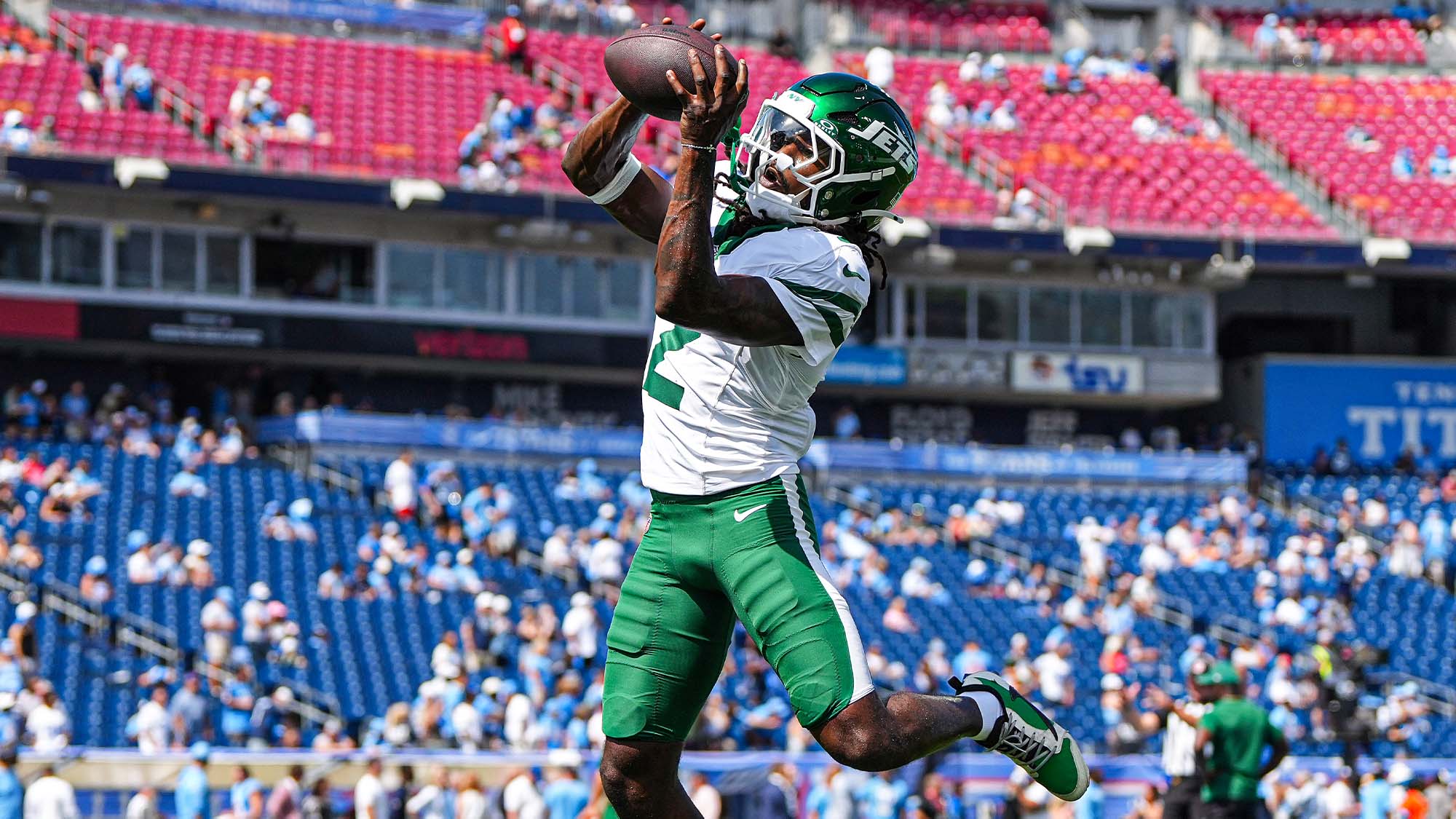
It’s easy to forget now, but the New York Jets were underdogs going into their eventual 23-10 win over the Tennessee Titans, which wasn’t as close as the final score indicates.
On paper, the Titans had some legitimate advantages over the Jets. This was poised to be a competitive game between two re-tooling teams, unless one side figured out how to negate its disadvantages.
The Jets turned out to be that team. Not only did they maximize their on-paper advantages, but they even won the battle in areas where the Titans seemingly had the edge, turning this into a blowout in their favor.
Perhaps the Jets’ biggest on-paper disadvantage was their unproven cornerback unit against what figures to be a solid Titans wide receiver unit. In particular, the Jets were poised to have a rough time against slot receiver Wan’Dale Robinson, a $70 million free agent pickup this offseason.
Robinson led the NFL with 675 slot receiving yards for the New York Giants last season. He figures to be a reliable safety blanket for young quarterback Cam Ward, especially early in the season, as he acclimates to a new offensive coordinator, Brian Daboll, whom Robinson is familiar with from their time together in New York.
Across from Robinson would be the Jets’ backup slot corner, Jarvis Brownlee Jr., who got the start due to second-round rookie D’Angelo Ponds missing the game with a calf injury.
It seemed like a matchup that could allow the Titans’ offense to wipe out the main advantage held by New York’s defense: Aaron Glenn’s blitz packages against a young quarterback in Ward.
Brownlee struggled mightily in coverage last season, committing nine penalties and allowing a 108.9 passer rating on throws in his direction. If he couldn’t contain Robinson on quick-hitting routes, Ward would be able to consistently hit Robinson on short throws before Glenn’s blitzes had time to get home.
That did not turn out to be an issue whatsoever.
Brownlee enjoyed a lockdown afternoon in coverage. Across 28 snaps in coverage, Brownlee was targeted just four times, with Ward completing two of those passes for eight yards and zero first downs.
When matched up against Robinson, Brownlee was targeted once, with that pass falling incomplete.
Overall, the entire Jets secondary did an excellent job containing Robinson, who finished with five catches for 38 yards. Before the Titans went down by three scores in the second half, Robinson had two catches for 14 yards.
Glenn blitzed Ward heavily in this one, as expected coming into the game. Ward was blitzed on a whopping 46.2% of his dropbacks. Those blitzes were effective, as Ward completed 9 of 14 passes for a measly 57 yards (4.1 yards per attempt) when blitzed, while also taking a sack and scrambling twice.
A blitz-heavy defense cannot be effective without quality coverage behind it. The more pass rushers that are sent into backfield, the less reinforcements there are in coverage, which makes every coverage defender’s job that much harder.
Brownlee had a lot in this plate in his game. He had to man up against one of the league’s top slot receivers in a blitz-heavy defense that would be asking him to work with little help, all against a young quarterback who likely expected to be blitzed and would be eager to rely on his $70 million safety blanket.
Yet, Brownlee escaped the game completely unscathed from a coverage standpoint. It’s an outcome that, on paper, seemed almost impossible before Sunday.
Brownlee pulled it off, and he deserves all the credit in the world for his role in New York’s season-opening win.
