
Much scrutiny has been directed at the Green Bay Packers’ offensive line after their Week 1 loss to the Minnesota Vikings.
After the New York Jets’ defensive front dominated the Tennessee Titans in the season opener, Green Bay’s offensive line is an appealing mismatch waiting to be exploited.
But the Jets also have an appealing matchup in the trenches against Green Bay’s defensive line.
With their 39-22 loss in Minnesota, the Packers fell to 0-6 since perennial All-Pro edge rusher Micah Parsons went down with a torn ACL last December. Over that span, Green Bay is allowing 30.5 points per game.
In Week 1, Green Bay coughed up five touchdowns to an offense led by backup quarterback Carson Wentz, who was thrown into action after an early injury to starter Kyler Murray. Four of those five scores were part of a 29-0 run to close the game.
To be fair, three of the five touchdown drives were set up inside of Green Bay’s 30-yard line, including one at the 1-yard line. Still, the Packers allowed the Wentz-led Vikings offense to convert 8-of-15 third downs while scoring touchdowns on all four of their red zone trips, symbolizing how much they have struggled to get stops since Parsons went down.
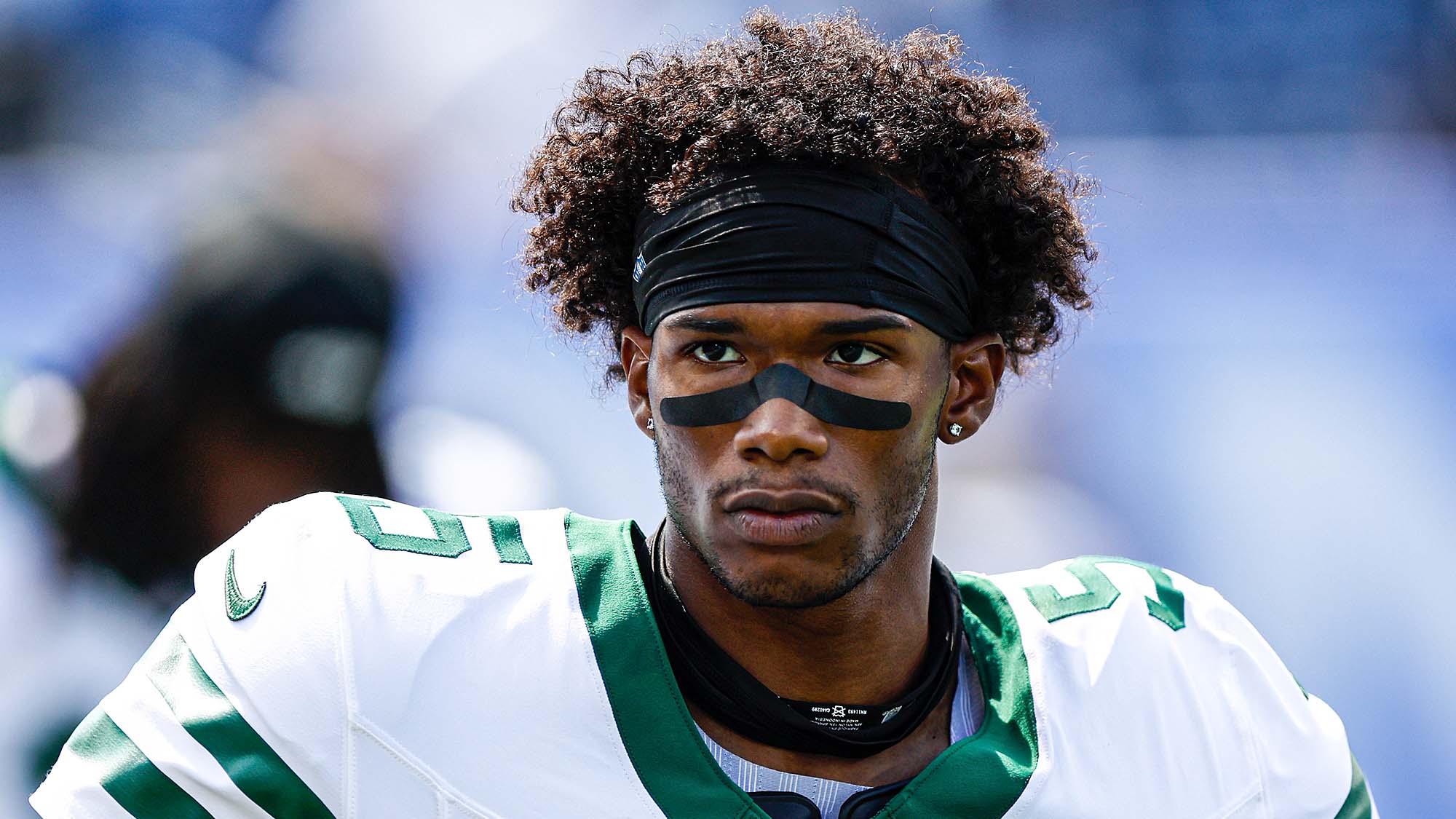
The Jets should rely on one specific method of exploiting Green Bay’s defense, which would be particularly beneficial for wide receiver Garrett Wilson.
How the Jets can exploit a Parsons-less pass rush
Over their three full regular season games without Parsons in 2025, the Packers racked up just three sacks. They ranked 31st in the NFL with a 3.2% sack rate from Weeks 16-18.
During the same span, they also ranked 24th in the NFL with an average time-to-pressure of 2.91 seconds, signifying that, even when their pass rush did get home, it typically took them a while.
The Packers showed signs of improvement in Week 1 against Minnesota, picking up three sacks while averaging 2.29 seconds to pressure, which ranked eighth in the league.
This was thanks to Green Bay’s blitz packages. Two of Wentz’s three sacks came against the blitz, as well as half of his pressured dropbacks.
But if the Packers did not blitz, they struggled to get home. Across 15 non-blitzed dropbacks, Wentz was pressured just four times, a lowly pressure rate of 26.7%, while taking one sack.
The message to Jets offensive coordinator Frank Reich is clear: Tee up downfield shots when you anticipate a four-man rush.
Packers defensive coordinator Jonathan Gannon showed in Week 1 that he can scheme up pressure, but when Gannon counted on the defensive line to generate pressure without the blitz, it was clear that Green Bay simply does not have the reinforcements to do so without Parsons.
Reich can exploit the Packers’ weak pass rush by calling longer-developing, downfield passing concepts against the four-man rush. There is a high likelihood that the Jets’ offensive line, which dominated in pass protection on the road against a Jeffery Simmons-led unit in Week 1, will be able to keep Geno Smith clean at a very high rate whenever the Packers’ depleted pass rush sends four.
Gannon has displayed some noticeable tendencies regarding when he likes to blitz, which should allow Reich to anticipate the best spots to call shot plays.
In Week 1, the Packers ranked second in the NFL with a whopping 62.5% blitz rate on first down. That number plummeted to 20% on second down (21st) and 25% on third down (19th).
These numbers line up with Gannon’s 2025 trends as the head coach of the Arizona Cardinals. In 2025, the Cardinals had the league’s eighth-highest blitz rate on first down (33.2%) but dropped to 15th on second down (25.9%) and 29th on third down (21.1%).
Gannon has a clear preference for blitzing on first down, while he tends to dial it back on second and third down. That means Reich should anticipate Green Bay sending four rushers on the vast majority of second and third down plays.
That’s when the Jets should be aggressive.
The Jets have little reason to believe that their offensive line cannot hold up for three-plus seconds against this four-man rush. Gannon’s blitzes will cause some problems on first down; Reich can scheme around that with some screen passes or outside run calls.
On second and third down, though, when the Jets can expect Gannon to frequently sit back and play conservative coverage instead of bringing the house, the Jets must punish his strategy. Force the Packers’ back end to cover the Jets’ receivers on downfield routes for an extended period of time due to the pass rush’s inability to get home without a blitz.
One man, in particular, should benefit from this approach: Garrett Wilson.
Wilson entered the 2026 season with a shockingly paltry total of 22 deep receptions (20+ air yards) in four seasons. In Sunday’s season opener, he recorded his 23rd, snatching his only deep target from Geno Smith for a 22-yard gain.
The matchup between the Packers’ four-man rush and the Jets’ pass protection should tee up ample opportunities for Smith to locate Wilson on at least one, if not multiple deep shots, including ones for much more than 22 yards.
Wentz only attempted one deep pass in Week 1, but it was against a four-man rush in which Green Bay didn’t even sniff him, and the veteran connected with Justin Jefferson in the back of the end zone for a 39-yard touchdown bomb.
Down the stretch in 2025, Chicago Bears quarterback Caleb Williams peppered the Packers with deep passes across two Parsons-less matchups, completing 8 of 15 deep attempts for 216 yards, two touchdowns, and one interception.
The Packers didn’t allow any deep receptions in Parsons-less matchups against Tyler Huntley and J.J. McCarthy, but those quarterbacks couldn’t hit the broad side of a barn, anyway. Geno Smith will be capable of matching the success that Wentz and Williams had against a Green Bay defensive line that cannot get home fast enough without the blitz to prevent vertical routes from developing.
Wilson, along with fellow boundary receiver Adonai Mitchell, are poised to benefit. They will match up against a Green Bay cornerback room that is highly vulnerable.
Second-round rookie Brandon Cisse got the start at right corner in Week 1, and he was beat by Jefferson for the 39-yard touchdown seen above. Since the Packers keep their corners tethered to one side of the field for the entire game, the Jets can isolate Wilson on Cisse whenever they please.
Starting on the left side is 29-year-old veteran Keisean Nixon, a former All-Pro returner who has developed into a starting corner late in his career. Nixon strangely earned Pro Bowl honors in 2025, a misleading distinction for a player who allowed a 7-to-1 touchdown-to-interception ratio and committed a position-leading 13 penalties.
To Nixon’s credit, he can play the ball well (17 passes defended in 2025) and is an excellent tackler (4 missed tackles in 17 starts). He also had an interception off of Kyler Murray in Week 1, part of a strong season-opening performance.
But when a starting corner has racked up a combined 20 penalties and touchdowns allowed over his last 18 regular-season starts, he is an appealing target to go after, especially when his four-man rush will force him to cover for a long time.
Look for Frank Reich to dial up second and third-down shots to Garrett Wilson and Adonai Mitchell, putting trust in his offensive line to dominate in pass protection against a depleted four-man rush, one that Gannon has made relatively easy to predict.
