
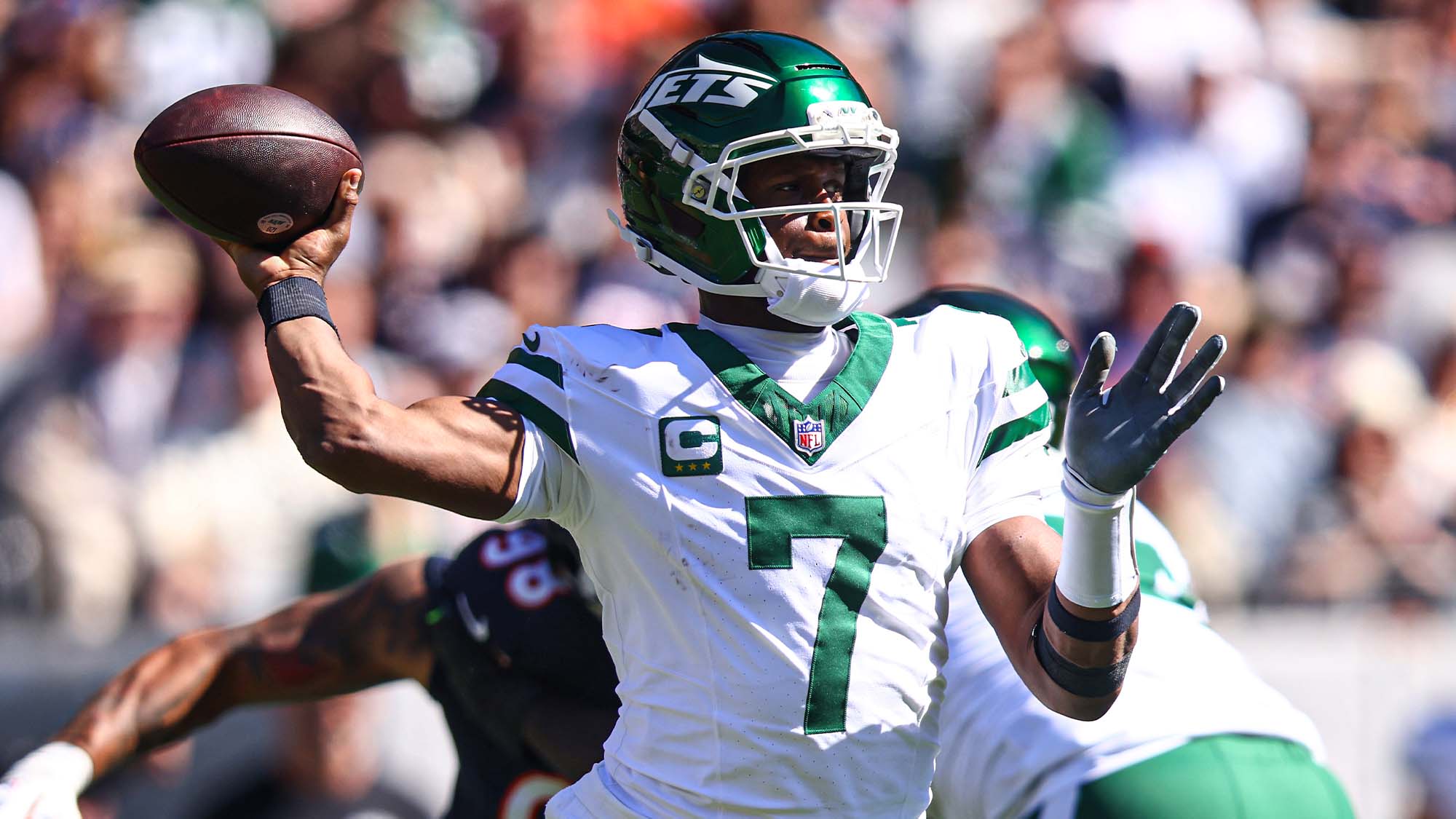
The New York Jets are 1-3 and free-falling quickly, losing three straight games with each loss looking less competitive than the last.
Aaron Glenn is now 4-17 as the New York’s head coach. The former Pro Bowl cornerback is scrambling for answers as the Jets find themselves on the brink of a second consecutive season in which their playoff hopes are dashed before Halloween.
A plethora of issues arose from the Jets’ Week 4 loss in Chicago, which saw the team suffer its worst total first down margin in franchise history (-27). Five plays, in particular, can sum up the majority of what plagues the Jets right now.
1. A lack of explosiveness out of the backfield
One of the most controversial storylines from New York’s Week 4 defeat was the team’s running back usage in its first game Breece Hall sidelined. Braelon Allen was given 94% of the snaps and 100% of the touches, while Isaiah Davis played two snaps and did not see the football.
It was a baffling decision based on the wide disparity between Allen and Davis’ career track records, with Davis standing out as a more efficient player in most aspects. That includes explosiveness, where Davis has proven himself as a much greater home-run threat than Allen.
The Week 4 film displayed multiple instances in which Allen’s lack of explosiveness cost the Jets yards in spots where the average running back would have had the potential to break loose for a larger gain. At 250 pounds (per himself) with an upright running style, Allen does not have the burst or top-end speed that most other NFL running backs do, and he isn’t getting enough extra yardage out of his power and size to make up for it.
This 2nd & 4 run in the second quarter is a prime example. On paper, it’s a 6-yard gain for a first down, which looks nice, but the eye test shows the hidden yards being left on the field.
As the Jets search for ways to produce more explosive plays, giving some of Allen’s touches to Davis would be a smart move.
2. Mental mistakes in run-blocking
New York’s run-game woes were certainly not all Allen’s fault, though. Sometimes, it is baffling how out of sorts the Jets’ run-blocking looks.
Even basic assignments are being botched, including this befuddling miscue by left tackle Olu Fashanu. Allen also gets away with a fumble.
There is plenty of talent and physical ability within the Jets’ offensive line, but it will never matter if the unit cannot get on the same page. A cohesive offensive line beats a physically gifted offensive line every day of the week.
It is purely speculative to try and deduce whether the Jets offensive line’s frequent mental mistakes are more due to lapses of concentration by the players or poor coaching. No matter the blend, it has to cease if the Jets want to eliminate the accumulating examples of unblocked defenders killing their drives in high-leverage spots.
3. Missing shot opportunities through poor feel for offensive play-calling
In addition to Allen’s plodding performance on the ground, another issue that cost the Jets big plays was the conservative play-calling of offensive coordinator Frank Reich.
Coming out of halftime, the Jets called four straight run plays, which were all successful, yielding a combined 26 yards. It set up a perfect opportunity for a play action shot, but Reich ran a fifth straight time, and the Bears were ready for it, leading to a drive-killing 5-yard loss, which may as well be a sack.
Reich is the man calling the plays, but Aaron Glenn is not off the hook for these situations. As the head coach, his overall football philosophy trickles down to the offensive philosophy. If Glenn is preaching things like “control the clock”, “protect the ball”, and “win behind the defense”, it will affect the aggressiveness of the offensive play-calling, even if Reich ultimately calls the shots.
New York does not have enough talent to generate explosive plays through sheer willpower. The coaches have to set up the players for success, and they are failing to do that when they miss opportunities like this one.
4. Non-existent pass rush
The Jets’ defense let the Bears hold the ball for nearly 43 minutes, and it was largely because they could not get after backup quarterback Tyson Bagent.
Bagent was pressured on just 27.8% of his dropbacks, per Pro Football Focus, the third-lowest rate of Week 4. He also took just one sack while attempting 34 passes.
New York’s quiet pass rush can be blamed on a combination of questionable play designs and poor individual execution, which can both be seen on this allowed third-down conversion.
5. The pass rush finally wins, and a youthful penalty negates it
The Jets had so many problems in Chicago that even when they got something right, it was usually cancelled out by something else.
On a third-down stop in the second quarter, David Bailey finally stepped up with an impactful pass-rush win, but it was wiped out by a combination of two overlapping issues that New York is battling through: youth and penalties.
In his first extended NFL appearance, rookie cornerback D’Angelo Ponds committed two penalties on 18 snaps, one of those seen here, which was much more egregious than simply a “rookie mistake”.
The Jets are fifth in the league with 37 penalties through Week 4. Of the 30 that were called on individual players, 22 were committed by a player aged 25 or younger.
A laundry list of things to figure out
Boiling the Jets’ issues down to one coach, player, or unit would be naive. This team has lost three of its four games for a reason: there are a lot more than one or two problems.
The offense is lacking explosiveness with Breece Hall, Adonai Mitchell, and Omar Cooper Jr. sidelined. The Jets need those players back; without them, defenses can hone in on Garrett Wilson and Kenyon Sadiq.
In the meantime, the Jets can help themselves out in the explosiveness department by redistributing a large chunk of Braelon Allen’s touches to Isaiah Davis. The fact that Allen has so heavily out-snapped Davis points to a player-optimization issue from the coaching staff, which is just one of many coaching-related issues right now.
Reich and Glenn need to come together and put a greater emphasis on hunting for explosive plays offensively. Glenn needs to find more ways to scheme up a pass rush on defense. Offensive line coach Steve Heiden needs his unit to clean up the communication and assignment issues. The penalties also need to come down, although it is debatable whether penalties are a coaching issue or a player-execution issue.
New York’s pass rushers simply need to start making more noise, particularly the two edge rushers who are supposed to be anchoring the pass rush, David Bailey and Will McDonald.
The road ahead does not get easier for the Jets, who are currently 0-3 against .500 or better teams, with their lone win coming against a winless team. Five of their next six games are against .500 or better teams.
Can Glenn solve all of those aforementioned problems overnight and lead the Jets to a season-saving run over this difficult six-game stretch?
His 4-17 career record makes it challenging to buy into that possibility, but hey, as his stock circles the drain, there would be no better way to rescue his reputation than to shock the world by racking up quality wins over the next month-and-a-half.
He sure has a lot of cramming to do for the test, though.
