

Every NFL coaching staff wants to build the same thing: a winner.
Where each staff differs, though, is in precisely how they want to build that winner.
Some teams are offense-first. Other teams are defense-first.
That’s only the tip of the iceberg. When you dive into schemes and philosophies, teams’ identities become even more distinct from one another.
Some teams want to win with speed and athleticism, while others want to win with power and grit. Some teams want to score off methodical drives, and others thrive off explosives. Some defenses like to sit back and rush four, while others prefer to be relentless.
You have your zone run schemes and your man/gap run schemes. Then you have your zone defenses and your man defenses.
The endless array of possibilities to deploy the troops on the football field is what makes it one of the world’s most fascinating sports from a strategic standpoint. It’s also why coaching is arguably more important in this sport than any other.
The New York Jets and their fans know this quite well. Since Weeb Ewbank led the team to a championship in 1968, the Jets have cycled through 19 different head coaches (including interim coaches) looking for the next man to accomplish that feat. Not only have none of them pulled it off, but only two managed to win over half of their games, including just one who lasted multiple seasons: Bill Parcells.
One of Parcells’ former star players with the Jets, cornerback Aaron Glenn, is the 19th man to don New York’s headset since Ewbank.
When the Jets hired Glenn in 2025, the former Pro Bowl ball-hawk revealed that Parcells “still coaches him to this day.” It was music to the ears of Jets fans who are eager for their favorite team, which has not made the playoffs since 2010, to finally craft a distinct identity—something it has not had since that aforementioned 2010 season, when Rex Ryan had the Jets playing some of the most brash and physical football in the league.
After all, Parcells had established himself as one of the best culture-setters in league history. Wherever Parcells went in the NFL, a new identity was instantly born. Parcells-led teams were tough, disciplined, and no-nonsense. The hope was that Glenn, who reached an AFC championship game with the Jets under Parcells’ leadership, would bring that same culture to the Jets.
While Glenn has occasionally shown flashes of building a Parcellsian culture off the field, the on-field results have not been there. New York is now 5-18 under Glenn after their latest loss, a 26-19 defeat in Foxborough that felt attainable for much of the afternoon.
A big reason for the Jets’ 5-18 record under Glenn? They still don’t seem to know who they want to be.
Off the field, the Jets seem more professional and focused than in years past. That’s all well and good, but until the Jets know who they are on the field, no amount of off-field cultural touting will affect the win column.
One play, in particular, showed the Jets’ struggles to understand their own identity.
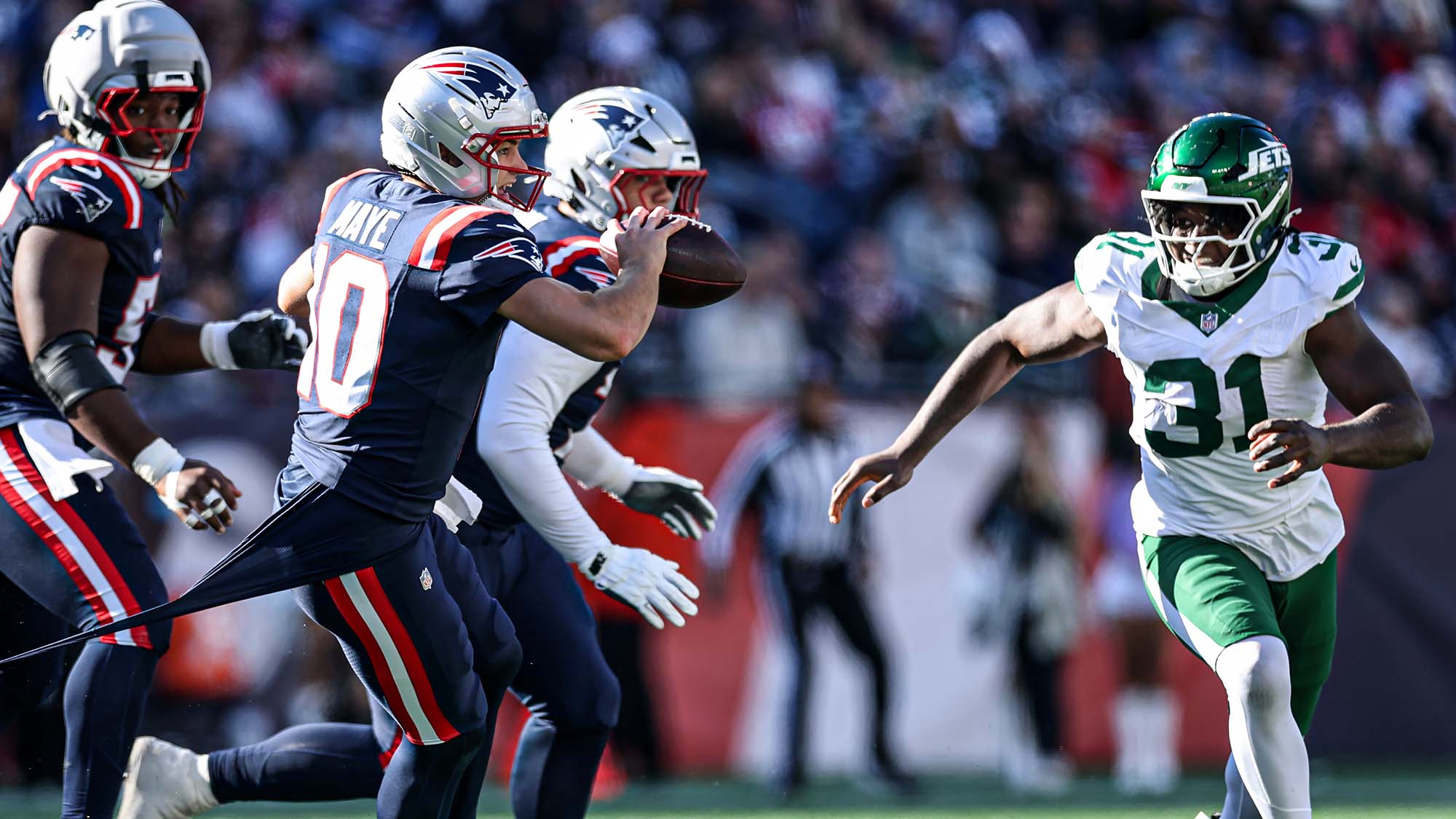
On a second-and-10 play for the Patriots offense late in the first quarter, with the Jets holding a 3-0 lead, Glenn, who calls the Jets’ defensive plays, sent three rushers after quarterback Drake Maye. The 2025 MVP runner-up stood in the pocket for an eternity without an inkling of pressure and proceeded to launch a 42-yard touchdown bomb to Romeo Doubs, giving New England a lead they would never relinquish.
It was a play that highlighted the Jets’ identity crisis in many ways. One week earlier, the Jets racked up eight sacks, the NFL’s league-high this season and the engine behind New York’s gritty 17-12 win over a quality Cleveland Browns team. Those eight sacks were driven by a blitz-heavy game plan from Glenn, who is known for his aggressiveness.
In New England, though, Glenn significantly dialed back his blitzes. That made sense in a vacuum, as Maye has struggled when not blitzed this year, throwing six of his seven interceptions against fewer than five pass rushers.
However, Glenn’s execution of that approach fell short. When he did not blitz, Glenn often got overly “cute” with his shows and drops up front. New York often showed a blitz, but dropped out unexpected defenders, often the edge rushers. The hope was to confuse Maye, but the plan usually backfired, as the Jets ended up conceding clean pockets because they were sending lackluster pass rushers after Maye.
The first-quarter Doubs touchdown bomb summed it up perfectly. While Maye stood around in a pocket as large as the Patriots’ midfield logo, the Jets’ reigning Defensive Player of the Week, David Bailey, was standing around in coverage, covering nobody. Meanwhile, Harrison Phillips, a 307-pound, 30-year-old run-stuffer, was trying to rush off the edge on Maye’s blindside.
It was one of nine coverage snaps for Bailey, who dropped into coverage on more than a quarter of his pass-game snaps in this contest. That’s hard for the Jets’ coaches to defend as an integral part of the scheme when the team ends up with zero sacks.
Why even draft Bailey with the second overall pick if the plan was not to fully unleash the skill that got him drafted that high: his pass rushing? The incongruency between Bailey’s usage and his skill set is a red flag of potential organizational cohesion. There shouldn’t be any mystery about how the No. 2 pick in the NFL draft will be used.
The Jets have generally looked competitive this year, but they continuously come up small in the biggest moments, and those high-leverage blunders can often be chalked up to their lack of identity. Whether it’s not knowing the best plays or players to count on when they need one yard offensively, or out-thinking themselves into ending up with Drake Maye throwing touchdown bombs against a Harrison Phillips-led three-man rush, the Jets don’t know what their bread-and-butter is on either side of the ball.
The Doubs touchdown sums up not the Jets’ pass-rush struggles in the loss to New England, but also New York’s inability to understand who they want to be as a defense—and as a team.
