
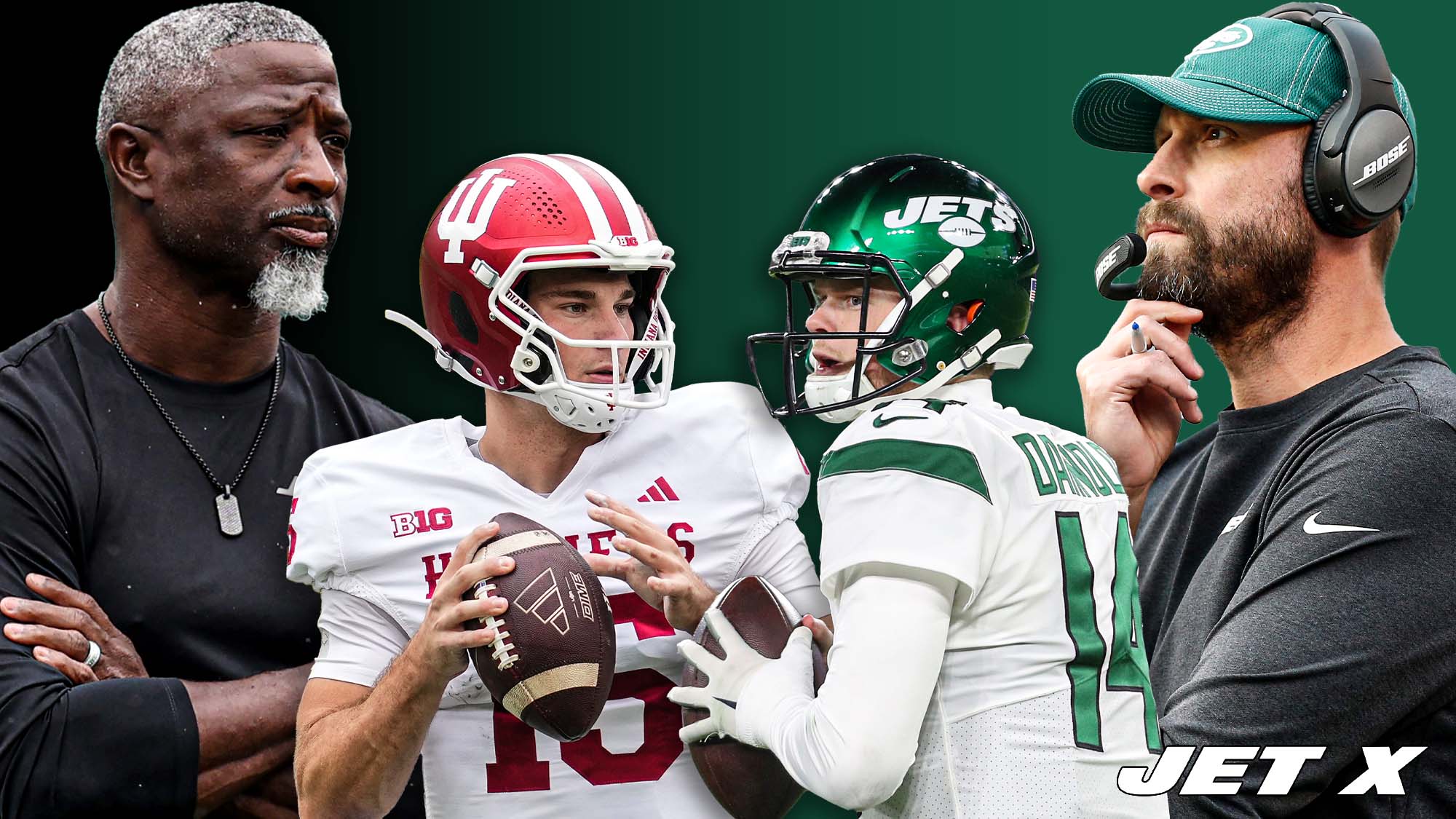
Here’s the reality: Aaron Glenn’s odds of panning out with the New York Jets are not good. That is, at least not until he starts showing drastic improvement.
Before Glenn, there were 17 NFL head coaches who started 0-6 with a new team since 1980. Only four of them (26%) went on to make the playoffs with that team.
Those are the odds we are working with here: 26%.
We can pull up comparisons to Dan Campbell and the 2021 Detroit Lions all we want, but he is an outlier. For every Campbell, there are three coaches who started similarly and never improved. Just because Glenn was a part of Campbell’s turnaround, it doesn’t make him any more likely to replicate Campbell’s fate than he is to replicate the fate of coaches like Hue Jackson, Frank Reich, or Gus Bradley.
But as bad as Glenn has looked so far, here’s the other reality, which might frustrate the large percentage of Jets fans who are leaning toward wanting Glenn gone in 2026: He probably isn’t going anywhere.
It is difficult to imagine Jets owner Woody Johnson canning Glenn after one year, not after what Johnson pulled in 2024. Johnson built a poor reputation in the public eye for his in-season firings of head coach Robert Saleh and general manager Joe Douglas, along with his overall meddling. In 2025, Johnson committed to handing the keys over to Glenn and seeing through a long-term rebuild.
Johnson is the type of owner who always knows what the public is saying about him and makes decisions to control that perception. After the fiasco that was the 2024 season, Johnson is unlikely to add to his perception as a meddling, impatient owner. Johnson has stayed out of the spotlight since hiring Glenn.
Perhaps Johnson’s hand would be forced if Glenn sets a single-season NFL record for losses with an embarrassing 0-17 season (which is still on the table), but if Glenn wins even a single game, Johnson seems unlikely to make a change after just one season.
That leaves Jets fans facing an uncomfortable truth: They have to figure out how to envision a successful future with Glenn despite the low odds he has given himself with his abysmal start.
Is there a way for Jets fans to envision the team succeeding long-term if Glenn is retained?
Picturing a positive future with Glenn is a daunting task for fans, because unless Glenn improves significantly over the next 10 games (which he can still do!), retaining him in 2026 would leave the Jets vulnerable to continuing the cyclical dysfunction that has held the franchise back in the past.
The Tennessee Titans’ recent firing of second-year head coach Brian Callahan highlights the risk of retaining Glenn.
The Titans have left their prized rookie quarterback, No. 1 pick Cam Ward, dealing with a coaching change just six games into his rookie year, and he’ll have to adapt to a new system in his second season. Considering it took just six games for them to fire Callahan, Tennessee’s ownership clearly wasn’t high on him entering the year, so they would have been better off going one-and-done with him and hiring a new coach who would be given time to grow with Ward.
Now, Ward’s early-career development track has been thrown off the rails. It’s a similar catastrophe to what the Jets put Sam Darnold through after selecting him third overall in 2018.
The Jets fired head coach Todd Bowles after Darnold’s rookie year, forcing Darnold to learn a second new system at 22 years old. They also fired their general manager in Darnold’s second offseason, but only after they let him run free agency and the draft for a head coach with whom he was in an arranged marriage. Darnold failed to progress beneath all the dysfunction, causing the Jets to give up on a quarterback who went on to become a solid starter.
As the 2025 Jets careen toward a high draft pick that will almost assuredly be used on their next hopeful franchise quarterback, they would be setting themselves up for a high chance of repeating the Ward and Darnold scenarios if they do not go one-and-done with Glenn (again, unless he uses the next 10 games to drastically improve his stock).
On his current pace, Glenn will enter the 2026 season as a lame duck after earning a second season solely on the basis of unearned “patience” rather than his actual performance in 2025. With the free-pass year out of the way, Johnson would enter the season with a short rope for Glenn. He might feel pressured to make a move after the team inevitably starts poorly with a rookie quarterback and a defensive head coach who has looked in over his head so far.
Unless the Jets have a surprisingly excellent season with a young quarterback led by a coach who hasn’t shown he should be trusted with one, Glenn would be at risk of getting fired during or after the season, leaving another young Jets quarterback ruined by dysfunction.
And so the Jets’ never-ending cycle of dysfunction continues.
That’s a frightening scenario to think about. It could set the franchise back for years. Unfortunately, it’s the scenario Glenn and the Jets are trending toward on their current trajectory.
Today, we’re here to talk about how the Jets can avoid such a fate.
How can the Jets avoid the rookie-QB-ruining fate Glenn is trending toward?
In essence, there are three scenarios New York could find itself in at the conclusion of the 2025 season:
- Best-case scenario: Glenn improves mightily over the Jets’ final 10 games, proving that he deserves to stick around. He inspires legitimate optimism about his prospects as the leader of the franchise.
- Reset: Glenn’s next 10 games look no different from his first seven. Johnson hits the reset button after one year, giving the Jets a clean slate for their incoming rookie quarterback. The potential for a franchise-crippling Ward/Darnold-esque scenario is eliminated.
- Purgatory: Glenn doesn’t improve enough to justify a return and inspire legitimate optimism. Johnson keeps him around anyway.
No. 1 cannot be ruled out, as there is plenty of time for Glenn to facilitate improvement with this Jets team, but as we discussed earlier, No. 2 is probably off the table. Johnson doesn’t seem likely to fire Glenn unless the Jets go winless.
That leaves No. 3 as the likeliest scenario.
The Jets are 0-7, but they’re not the type of 0-7 in which 0-17 feels likely, yet they are also not the type of 0-7 in which an awe-inspiring turnaround feels likely. It means that the best bet is New York slumping into the 2026 offseason led by a lame-duck Glenn after a poor debut season.
For the Jets’ sake, let’s hope that doesn’t happen, meaning Glenn uses the next 10 games to build a roaring finish that leaves New York in scenario No. 1. The purpose of today’s article, though, is to tackle the most daunting scenario of the three.
Let’s put our optimistic goggles on and try to map out a future in which the Jets achieve long-term success despite entering the 2026 offseason in scenario No. 3.
If the Jets nail these goals, they can still be successful with Glenn over the long haul, even if he looks hopeless at the conclusion of 2025.
1. Accountability at the coordinator spots
In a scenario where Glenn enters the 2026 offseason without having inspired legitimate optimism from Weeks 8-18, it means the Jets probably won somewhere from two to four games, with those wins coming in mostly unimpressive fashion. For a team with an over-under of 6.5 entering the season, that isn’t nearly good enough relative to the talent level on the roster, not after starting 0-7.
After such an underwhelming season, the coaching staff around Glenn would require significant upgrades for him to have any chance of working out as a head coach.
The Lions finished relatively strong in 2021, going 3-5-1 after an 0-8 start. Those wins were against solid teams, and the losses were typically competitive. For an extremely limited roster that entered the season with an over-under of 4.5, it displayed meaningful progress for Campbell and the organization.
Still, Campbell didn’t use the improved finish or the low expectations as excuses to pretend no changes were necessary after a three-win season. Detroit had the NFL’s second-worst record in 2021, and Campbell responded accordingly instead of blindly trusting the process.
Campbell fired veteran offensive coordinator Anthony Lynn, promoting tight ends coach Ben Johnson to the role. Under Johnson, the Lions improved to a top-five scoring team in 2022. Johnson established himself as an elite offensive coordinator over his three-year run in the role, and he is now the head coach of the Chicago Bears.
If Glenn is lucky enough to stick around despite the team inspiring little optimism over the next 10 games, he cannot sit idly by and expect improvement without at least one major change to the coaching staff. That means one of Steve Wilks or Tanner Engstrand has to go.
Early on, Wilks was the stronger candidate to be fired, but Wilks’ defense has improved significantly over the last two weeks. Meanwhile, Engstrand’s offense has imploded since a promising opener, going six straight games without a first-half touchdown (and two straight games without any touchdowns).
Engstrand is in his first year as an OC, but that doesn’t mean he should be excused for this level of ineptitude. If the Jets continue on this trajectory, Engstrand must be the one to go, especially considering that a rookie quarterback is coming.
With Glenn being a defensive-minded head coach, his offensive coordinator has the most hands-on role in developing a young quarterback. So, if Engstrand continues to lead a dismal offense over the next 10 games, causing the Jets to lose plenty of games and fail to progress as an overall team, Glenn has to cut ties and find someone more reliable to be entrusted with the Jets’ incoming franchise quarterback.
There’s also a scenario where the offense improves mightily with Tyrod Taylor at the helm, while Wilks regresses to what we saw over the first five games and throughout his recent stops as a defensive coordinator. In that case, Wilks should go.
Either way, if Glenn returns in 2026 without the Jets playing much-improved football, one coordinator must go. If the Jets nail the replacement hiring, Glenn might be able to find success long-term as New York builds out its roster. Nailing the Lynn-for-Johnson swap is the critical move that ignited Campbell’s turnaround.
2. Add veteran help to the coaching staff, particularly on offense
Beyond looking for an upgrade at one of the coordinator spots, Glenn must also seek out additional veteran help on the coaching staff, particularly offensively. It would give him a stronger backbone to lean on as he seeks to take a second-year leap in the head coaching role.
Firing Lynn and promoting Johnson was not the only significant change that Campbell made to Detroit’s offensive coaching staff. Campbell also hired 53-year-old John Morton as a senior offensive assistant.
Morton had offensive coordinator experience from his time with the Jets in 2017, which stands out as one of the best OC performances in recent Jets history. He came up under Jon Gruden with the Oakland Raiders and also spent time coaching wide receivers under Jim Harbaugh and Sean Payton. His OC experience and impressive connections made him an attractive choice to accompany the 36-year-old Johnson as he debuted in the OC role.
The Jets’ current offensive staff sorely lacks someone like Morton. They have Scott Turner as their senior assistant and pass game coordinator, who has been an offensive coordinator in the past (2020-22 with Washington and 2024 with Las Vegas on an interim basis), but Turner’s offenses were poor. He is also the same age as Engstrand and has been a part of fewer above-.500 teams in the NFL (Engstrand 3, Turner 1).
Turner isn’t exactly the best resource for Engstrand to lean on, which is troubling because the rest of their offensive staff is extremely inexperienced. Their offensive line coach (Steve Heiden), tight ends coach (Jeff Blasko), and running backs coach (Nic McKissic-Luke) are all handling their respective roles for the first time in the NFL.
With a rookie quarterback coming in, Glenn would be foolish to make no additions to this green staff. A veteran offensive coach, particularly specializing in the passing game or quarterbacks, would become necessary.
Alongside adding a new respected veteran to the staff, Glenn should strongly consider seeking an upgrade at quarterbacks coach. His initial hire, Charles London, was questionable from the get-go.
London, 50, is a former running back who solely coached running backs in college and the NFL through 2020. He got his first job as a quarterbacks coach with the Falcons in 2021 and has stayed in that role since then.
However, his results with Atlanta (2021-22), Tennessee (2023), and Seattle (2024) were hardly inspiring. Suffice to say, that’s continued with the Jets’ quarterbacks in 2025, as Justin Fields and Tyrod Taylor are performing even worse than their already mediocre standards.
If Glenn messes up the Jets’ incoming young quarterback, he will be gone in due time, and the Jets’ foreseeable future will be ruined. That’s why it is imperative that Glenn doesn’t screw around with his offensive coaching staff.
Whether or not Engstrand should go depends on what we see over the next 10 games. Regardless of Engstrand’s fate, Glenn should make two moves: hire a respected veteran assistant like Morton and dump London for a more inspiring quarterbacks coach.
3. Pursue self-improvement with game management, or entrust game management decisions to an analytics assistant
Glenn has looked completely lost as a game manager. While his mistakes have leaned conservative, he has made blunders on both sides of the spectrum, whether it’s going for it when he should kick a field goal or punting when he should go for it.
As-is, Glenn’s game management is untenable for an NFL head coach. He is actively hurting the Jets’ chances of victory each week.
This simply cannot continue. If he still has the job in the 2026 offseason, Glenn must look inward and figure out how to curb this problem. He must seek out advice, whether it’s from the resources in Florham Park or other experienced head coaches he respects. Heck, that guy he worked for in Detroit is the best there is in this department.
If outside advice isn’t enough to help Glenn make better decisions under the rapid pressure of a gameday environment, there’s no shame in Glenn delegating his game management decisions to assistants who can help him quickly process all of the variables at play during a game. As much as football coaches hate numbers and the little nerds who come up with them, those nerds would give the Jets a better chance to win games than Glenn right now.
For Jets fans to rekindle any faith in Glenn as the guy responsible for critical game-day decisions, he must show them that action has been taken to address the problem. Whether that’s a full offseason of dedicated information-gathering or simply entrusting his decisions to a nerd with an analytical model, Jets fans need to see tangible changes in this area.
Empty promises won’t do it; we just saw Glenn fail to learn from a mistake he had a chance to correct one week after he said he would do something differently in the same spot. Actions must be taken.
Many aspects of a head coach’s success are due to factors that are either out of his control or not completely in his control. Game management, though, is the one thing that falls entirely on him.
Glenn must improve in this area to make himself a game-day asset for the Jets, especially since he doesn’t call offensive or defensive plays. He could have an overarching positive effect on the team through the culture he establishes and his game-planning, but if he doesn’t get better at managing the game, his presence on the sidelines will only make the Jets a worse team.
4. Look inward and reevaluate philosophy
From his time observing Dan Campbell and Ben Johnson, Glenn should know what wins in today’s NFL: aggressiveness, deception, and strategy.
He’s shown none of that in his seven games with the Jets.
From his “play not to lose” mentality (revealed through his pre-game comments against Denver and ensuing game management decisions), to the Jets’ predictable offensive and defensive schemes (opponents know they will run on first and second down offensively, and blitz on third down defensively), to the Jets’ game plans routinely being ineffective (as evidenced by the team’s terrible performance in first halves)… Glenn’s brand of football is the opposite of Detroit Lions football.
This isn’t to say that Glenn should be copying and pasting the habits of his old home; every coach should put his own personal spin on things. But Glenn should definitely be taking quite a bit of what the Lions do, because they are arguably the top innovators of the current era of NFL football (2022-present).
Instead, Glenn has the Jets playing football in reverse.
If Glenn gets a second chance to coach the Jets in 2026, he must use the offseason to dig deep and think back to what helped the Lions turn things around from their 0-10-1 start in 2021 to a 15-2 finish in 2024. It sure wasn’t Glenn’s defense, which allowed the most yards of any NFL team from 2021-24 (362.6). It was the Lions’ innovative, aggressive offense, which ranked third in total yards over that same span (376.7).
Glenn cannot come back to New York with the same outdated philosophies in 2026 and expect things to magically turn around.
5. Nail the quarterback and you’re golden
As hard as it is to see the Jets being successful with Glenn right now, the truth is that an elite quarterback can hide a lot of issues in today’s NFL.
If the Jets nail their upcoming quarterback selection, they might be just fine with Glenn at the helm.
The thing is, though, recent NFL history has shown us that the days of the guaranteed superstar at quarterback might be over. John Elway, Peyton Manning, and Andrew Luck aren’t walking up to that podium again. Trevor Lawrence showed us as much. As valuable as the quarterback is in today’s league, he can only go as far as the supporting cast allows him to.
That’s why if the Jets decide to stick with Glenn instead of cleaning the slate, Glenn had better do everything in his power to make sure the quarterback position works out.
It highlights the importance of our first two goals for Glenn. He can’t be complacent with the members of an offensive coaching staff that oversaw the worst passing performance in Jets franchise history, as well as a six-game streak of no first-half touchdowns. As currently constructed, this Jets staff is almost guaranteed to ruin whichever quarterback’s heart drops when he finds out he is destined to walk through the gates of green hell next April.
But if Glenn makes the necessary changes to New York’s coaching staff, and the Jets are lucky enough to select a quarterback with the goods to carry a franchise, that marriage alone might be enough for the Jets to find success with any head coach.
As embarrassing as the Jets have looked under Glenn in 2025, it is easy to picture them having three or possibly even four wins through Week 7 if they enjoyed league-average quarterback play in each game. A good quarterback changes everything.
It’s all doom and gloom right now, and it’s always been doom and gloom with the Jets, but that’s because they still haven’t had a good quarterback since Joe Willie. I mean, look at the numbers; it’s staggering how far ahead Namath remains of every other quarterback in Jets history when it comes to era-adjusted efficiency.
It’s not even remotely close. And until the Jets get another quarterback like that, it will be hard to truly judge any other aspect of the team.
Get the quarterback right, and Glenn might be just fine. Getting it right, though, depends on whether Glenn looks inward and makes necessary changes within his coaching staff and as an individual.
