
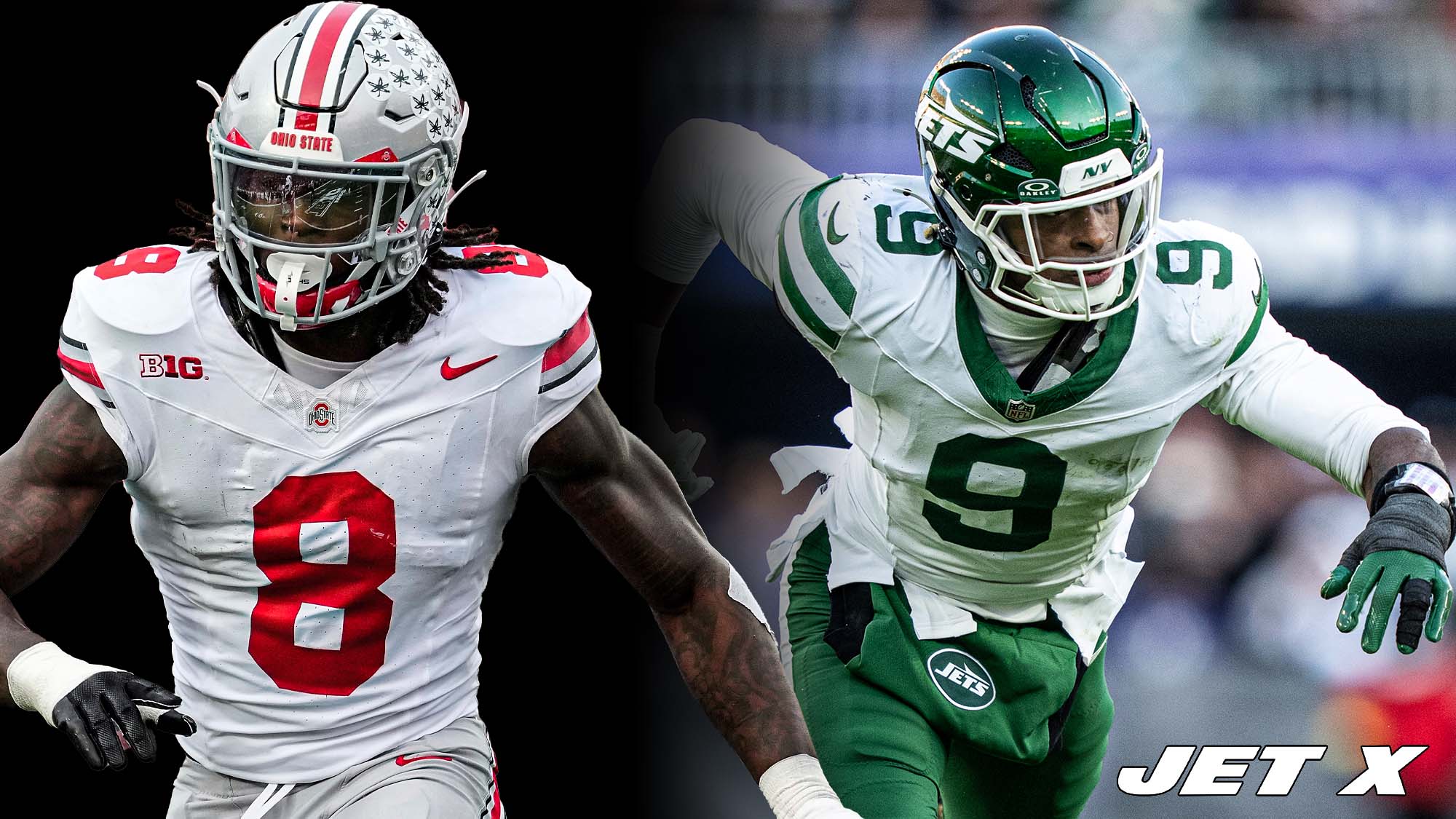
When a first-round draft pick walks through the doors of his new NFL facility, he immediately becomes one of the most important people in the building.
Therefore, his arrival facilitates a domino effect across his new team’s depth chart.
With the New York Jets widely expected to select Ohio State’s Arvell Reese with the second overall pick in this year’s NFL draft, here is how the potential selection would alter the makeup of New York’s defense.
Arvell Reese would create numerous options for Aaron Glenn
Arvell Reese’s versatility makes him arguably the highest-ceiling player in the draft. It also makes him one of the most difficult players to project.
Would the Jets immediately deploy Reese as a full-time edge defender, looking to accelerate his transition into the role? Perhaps they would start him out as a primary off-ball linebacker, while only gradually acclimating him to the edge?
The answer likely lies in the middle. New York can maximize Reese’s versatility to ensure he stays on the field at all times while always being a plus-impact player.
With their base package on the field (≤4 defensive backs), Reese could play outside linebacker in either a 3-4 or a 4-3. In either look, he would be deployed as the “JACK” (weak-side) linebacker, where his versatility would allow the Jets to shift between a multitude of looks. Playing weak-side outside linebacker would also allow his pass-rushing skills to be unleashed, even in a role that would be labeled as “linebacker.”
In situations where the Jets use a nickel or dime package (≥5 defensive backs), meaning they take a front-seven player off the field to replace him with a defensive back, Reese can drop down and play defensive end to stay on the field. His absurd pound-for-pound strength allows him to be utilized as a trusty edge defender in a 4-down front, even at 241 pounds.
So, let’s say the Jets were just in a nickel package, and now, they want to switch to a base package. Instead of having to sub in the LB3 on their depth chart (a backup-caliber player), they can trust Reese to stand up and be the third linebacker, while subbing in one of their top four defensive linemen instead.
With Reese in the fold, here are a few packages we could see:
- 3-4 base: DT Jowon Briggs, NT T’Vondre Sweat, DT Harrison Phillips, OLB (SAM) Joseph Ossai, ILB Demario Davis (MIKE), ILB Jamien Sherwood (WILL), OLB Arvell Reese (JACK)
- 4-3 base: DE Joseph Ossai (Strong), DT Jowon Briggs, DT Harrison Phillips, DE Will McDonald (Weak), LB Jamien Sherwood (SAM), LB Demario Davis (MIKE), LB Arvell Reese (WILL)
- 4-2 nickel: DE Arvell Reese (Strong), DT Jowon Briggs, DT David Onyemata, DE Will McDonald (Weak), LB Demario Davis (MIKE), LB Jamien Sherwood (WILL)
As currently constructed, when the Jets switch from a nickel package to a base package, Reese’s versatility could allow New York to sub in a solid defensive end like Joseph Ossai or Will McDonald instead of an unproven backup linebacker like Francisco Mauigoa. That raises the collective talent level of the defense.
If the Jets want to go from base to nickel, they can sub out a defensive end like Ossai instead of a linebacker, thanks to Reese’s ability to drop down. And because Reese is such a strong and fundamentally sound edge-setter, they wouldn’t lose much in terms of run defense, while the collective speed of the defense would rise, which is precisely what you want when using a nickel package to match the offense’s switch to a lighter personnel group.
The options would be endless with a player like Reese in the fold. New York would not enjoy the same benefits with Texas Tech’s David Bailey, whose role would be far more rigid.
This may be the main reason why Reese is the Jets’ most appealing choice at No. 2 overall. New York’s pivotal decision with the second overall pick is not just about who is the better player—it’s about deciding which player would make the most substantial impact on the team as a whole.
That player is Reese.
