
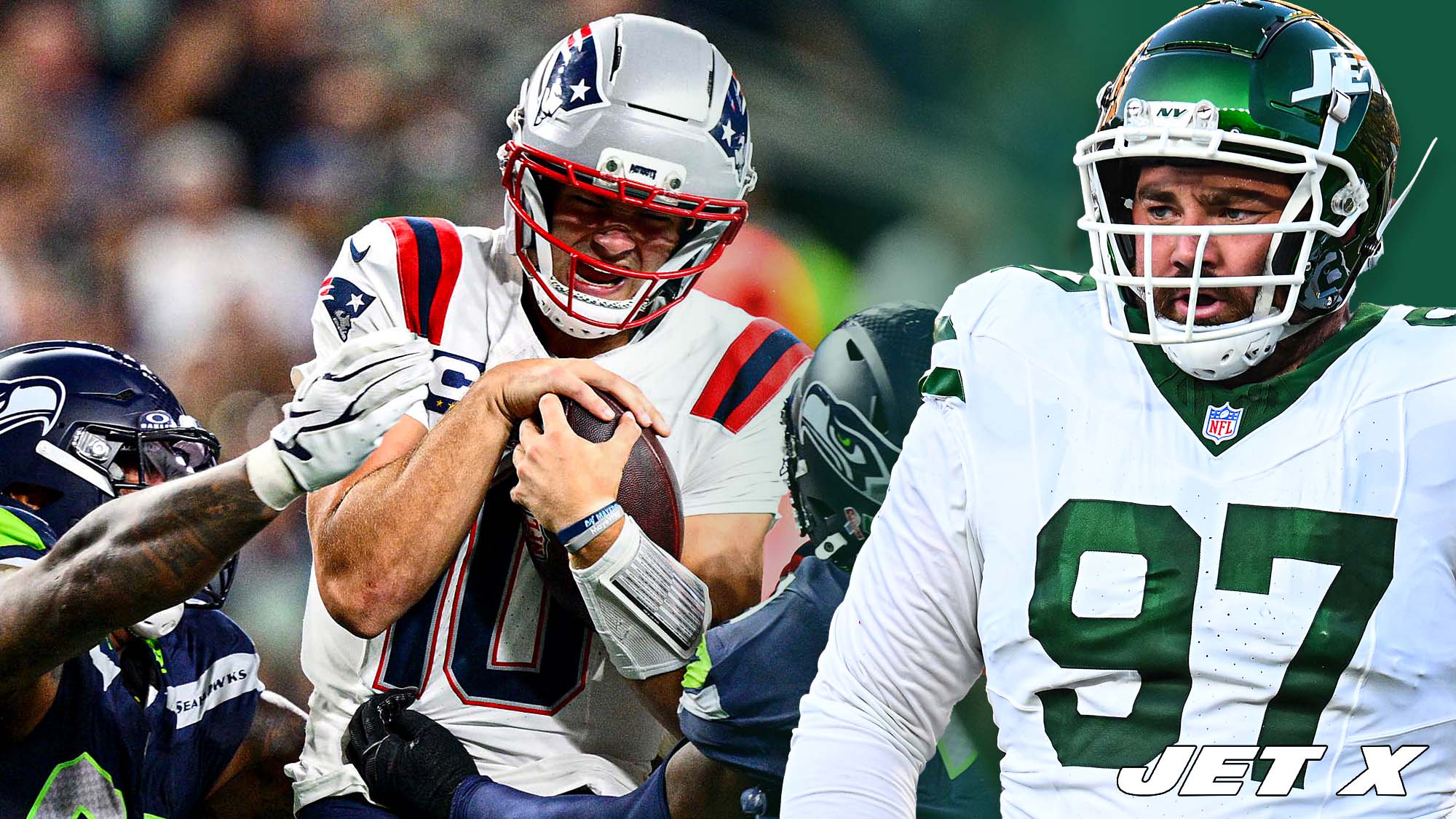
The Seattle Seahawks just revealed a blueprint for the New York Jets in their 13-10 season-opening victory over the New England Patriots.
No, no—that isn’t to say that New York has a chance to be nearly as good in 2026 as the current iteration of the Seahawks, who have now won 11 straight games dating back to last November.
Nor does it even guarantee that the Jets can match up as well with the Patriots as the Seahawks do.
What Seattle did accomplish, however, is showing the world why one of the Jets’ potential secret weapons still carries a lot more value in today’s NFL than many fans realize: run defense.
The Seahawks keep winning on the strength of their run defense
The headliner from Seattle’s 13-10 victory over New England was the three fourth-quarter interceptions thrown by Patriots quarterback Drake Maye. They helped the Seahawks ice a comeback from a 10-0 deficit after starter Sam Darnold left the game in the first quarter.
The trio of interceptions represented a dominant performance by the same Seattle defense that just cruised to a Super Bowl title in February. It wasn’t the interceptions themselves, though, that anchored Seattle’s defensive excellence on Wednesday night (I had to double-take, but, yes, I have the day correct; that will take some getting used to).
Rather, it was the outstanding run defense. The interceptions wouldn’t happen without it.
After watching Maye get destroyed by Seattle’s defensive front in February (six sacks), the Patriots tried extremely hard to protect Maye by building an offensive game plan around the run game and quick passing. At times, it worked decently, but in the end, the Seahawks’ elite run defense forced the Patriots to take more chances than they wanted to, resulting in the turnovers.
Removing Maye’s seven carries for 47 yards on scrambles, New England rushed for just 62 yards on 24 carries, a paltry 2.6 yards per carry. As a result, the Patriots were buried in a lot of second and third-and-longs, forcing them to deviate from their conservative game plan.
In fact, all three of Maye’s interceptions were downfield passes in high-likelihood passing situations on second and third down, two of them following run stops from Seattle. They came on second-and-9 (after a run for 1 yard), third-and-14 (two plays after a run for -4 yards on first down), and third-and-5 (after a sack and a short pass).
The interceptions themselves will get the well-deserved attention, but Seattle’s run defense was a necessary cog to set those interceptions up. That’s often the role that run defense plays in a team’s success. Fans won’t think back on the run defense itself very often, as few run-stopping plays are particularly memorable, but they set the table for the big sacks and interceptions that ultimately turn the tide.
Without the Seahawks’ stingy run defense, the Patriots would have happily ran the ball over 30 times on their way to a gritty victory. Based on their play-calling sequences from the start of the game, they were more than willing to ride the run game in this one. Seattle didn’t let it happen.
That’s why the value of excellent run defense often goes unnoticed until a team doesn’t have it. When you can’t stop the run, your opponent will seldom be placed in high-pressure situations that lead to mistakes. They can cruise along through favorable down-and-distance situations. Eventually, too, once the defense over-commits to stop the bleeding, the passing matchups become favorable.
Seattle’s run-stopping success on Wednesday was a continuation of the 2025 season, when their run defense was the crux of their championship success. The Seahawks allowed a league-low 3.7 yards per rush attempt in the regular season, out-ranking their yards-per-play performance in any of the other three main facets (pass offense, rush offense, pass defense).
So, what does any of this have to do with the New York Jets, anyway?
The Jets can ride their run defense in 2026
The Jets had a poor run defense in 2025, allowing the fourth-most rushing yards per game (139.5).
That number was influenced by how often they were trailing, but even if you filter for garbage time by removing plays where the Jets’ win probability was below 5%, they still ranked 25th in EPA per rush attempt allowed.
But in 2026, the Jets could undergo a night-and-day turnaround against the run.
It does not get enough attention how drastically the Jets have upgraded their run defense. Across all three levels, New York added veteran players who are among the best run stoppers at their positions.
Up front, the Jets added two of Pro Football Focus’ eight highest-graded run defenders among defensive tackles in 2025: T’Vondre Sweat and David Onyemata. They join forces with another member of last year’s top eight in PFF’s run defense grade, Harrison Phillips.
At linebacker, in comes Demario Davis, who tied for third at his position with 39 run stops last season, while placing sixth with an 89.3 run defense grade.
Then, at safety, the Jets added a reliable last line of defense in Minkah Fitzpatrick, whose 79.6 run defense grade placed 13th among 71 qualified safeties last season.
Fitzpatrick had the deepest average depth of tackle among safeties at 13.7 yards, showing that his high-level run defense grade is an indicator of his ability to make open-field stops in the back end. That will help the Jets prevent some of the home-run plays they were prone to coughing up in 2025.
Finally, the Jets shored up their edge-setting by adding Joseph Ossai and Kingsley Enagbare, two sturdy presences on the outside.
All things considered, the Jets have the pieces to field a top-10 run defense in 2026. It could be the team’s strongest facet between their offense and defense.
While it is extremely unlikely that New York’s run defense will be as good as Seattle’s elite unit, or that the Jets could be as strong a team overall, the Seahawks’ season-opening win was still noteworthy for Jets fans, as it reminded the football world why run defense matters immensely despite its lack of fanfare. That was an exciting sight for Jets fans as their team prepares for a season in which run defense could be its calling card.
