
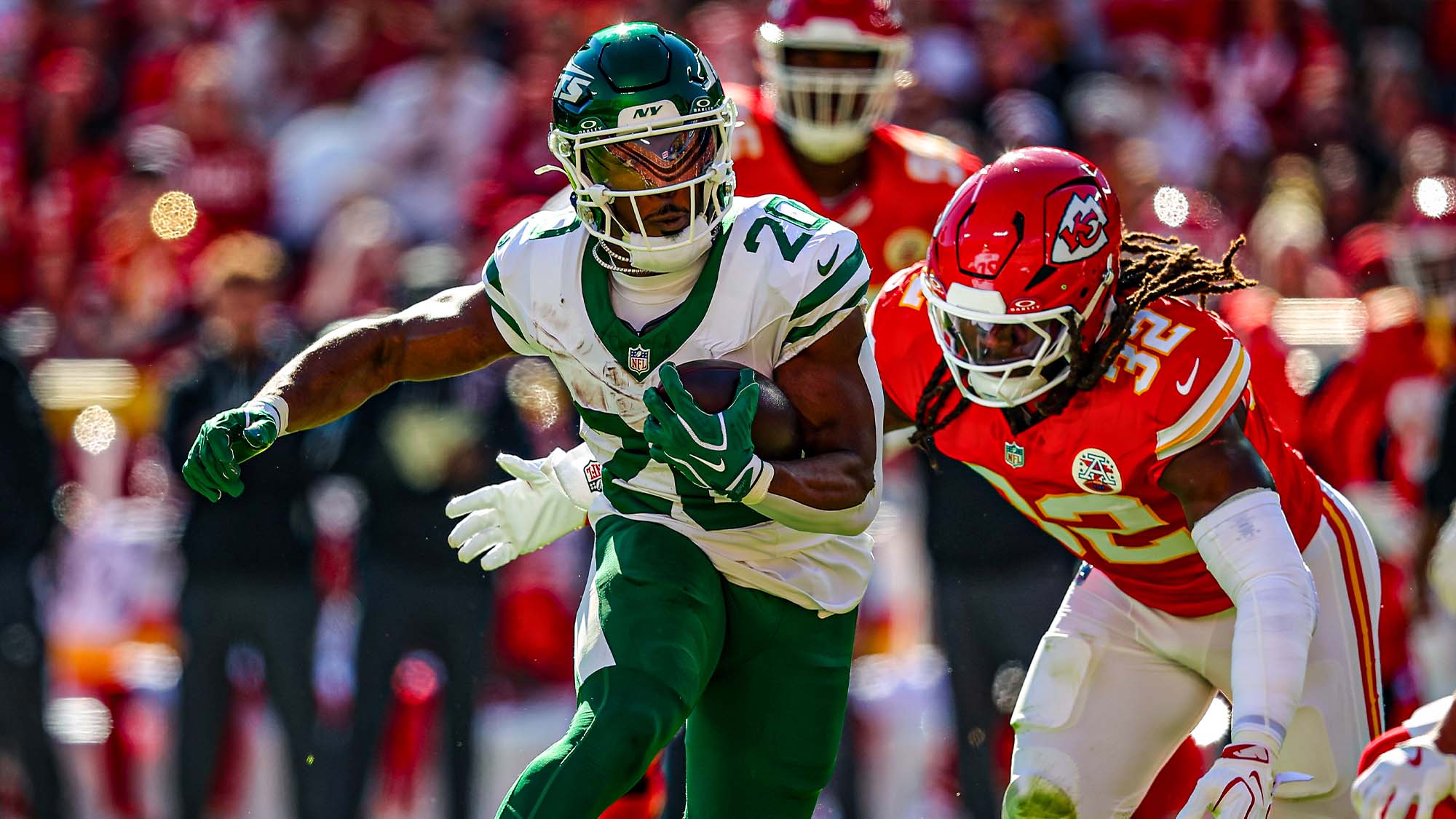
Entering the 2026 season, the New York Jets set a clear hierarchy at the running back position:
- Breece Hall
- Braelon Allen
- Isaiah Davis
Fresh off a three-year, $43.5 million contract extension, Breece Hall had been handed the keys as the team’s workhorse. Braelon Allen was a distant No. 2, only to be used to spell Hall for brief stretches; the 2024 fourth-round pick had not proven much in two NFL seasons (3.7 yards per carry). Isaiah Davis did not factor into the offensive game plan; he has yet to play an offensive snap this season across five games with Hall available.
Over the first two weeks of the season, with Hall fully available, Hall received 45 combined carries and targets, compared to Allen’s 17 and Davis’ zero. That gave Hall a 73% share of the backfield’s playmaking opportunities, with Allen far behind at 27%.
Then, everything changed when Allen attacked defenses during Hall’s five-week absence. A breakout stretch from Allen, featuring 100.8 rushing yards per game on 5.4 yards per carry, made it clear that the Jets would have to shake things up after Hall returned.
Hall has been back for two games, and while things have shifted in Allen’s direction, it hasn’t been as drastic as you’d think. From Weeks 9-10, Hall received 34 combined targets and carries to Allen’s 19, a 64%/36% split in Hall’s favor. That isn’t too different from their 73%/27% from Weeks 1-2.
In terms of snaps, the two players have been nearly even over the last two weeks, with Hall playing 68 snaps to Allen’s 71. That’s a more noticeable change from the first two weeks, when Hall had an 87 to 50 advantage.
When it comes to playmaking opportunities, though, Hall is still the Jets’ preferred option. That is still the case when we solely look at carries, removing targets from the equation; over the last two weeks, Hall has 26 carries to Allen’s 16 (62%/38%).
Should this really be the case, though?
This is the question that the Jets must grapple with, both over the next seven games and heading into 2027 (whoever may be in charge of the decision at that point).
How good is Breece Hall nowadays?
Through five games and 94 combined carries and targets in 2026, Hall has displayed some concerning signs.
As a rusher, it’s been a rough go for Hall. He is averaging a career-low 3.4 yards per carry, and we can’t pin that on the offensive line or the general offensive situation, as Allen is averaging 5.0 yards per carry in the same offense.
When you break it down to metrics that are designed to isolate the rusher from his surroundings, Hall pales in comparison to not only Allen, but most backs across the league.
Among the 33 running backs with at least 70 carries, Hall ranks last with 2.03 yards after contact per carry, per Pro Football Focus. It’s by a wide margin, too; the gap between him and 32nd-ranked Jeremiyah Love (2.41) is larger than the gap between Love and the 22nd-ranked Emmanuel Wilson (2.75).
Meanwhile, Allen ranks fifth with 3.65 yards after contact per carry.
Hall fares better when it comes to missed tackles forced per carry, ranking 17th out of 33 qualifiers at 0.169 (13 on 77), but Allen ranks seven spots higher, placing 10th with a 0.219 mark (28 on 128).
NFL Pro’s rushing yards over expected (RYOE) metric is particularly low on Hall. He is averaging -0.4 RYOE per carry, placing 31st out of 33 qualifiers. Allen is fourth at 0.9.
No matter how you slice it, Hall has been a poor rusher this year, while Allen has been elite. While it’s only been five games for Hall, he’s carried the ball 77 times, so it’s not a meaningless sample size, especially when his results are essentially the polar opposite of his running mate in the backfield.
Hall has been much more effective in the passing game, though. He’s caught 17 of his 18 targets (94.4%) with zero drops, racking up 195 receiving yards and eight first downs.
Impressively, Hall is averaging a career-best 10.8 yards per target, while his receiving success rate (percentage of targets yielding a positive result for the offense) is an absurd 88.9%, which leads all players with at least as many targets. Granted, this is all on just 18 targets, but he deserves credit for making the absolute most of his opportunities as a receiver.
Allen has not been nearly as dynamic in the passing game. He’s caught 20 of 25 targets (80.0%) for just 108 yards and six first downs. His 4.3 yards per target are well below average for a running back and less than half of Hall’s current mark, while his 48% receiving success rate is nothing to write home about, either.
Pass-catching is where Hall will always have an edge over Allen, making it worthwhile to keep both around despite Hall’s rushing struggles. Simply put, Hall can do things in the passing game that Allen cannot. Hall has clear-cut advantages across the board: hands, route-running, and YAC.
However, the opposite is starting to be true in the running game: Allen is bringing things to the table that Hall cannot. If things don’t change over the next seven games, the Jets might be wise to go into 2027 viewing Allen as their workhorse on the ground, while Hall, if he sticks around, would be better deployed as a third-down back.
