
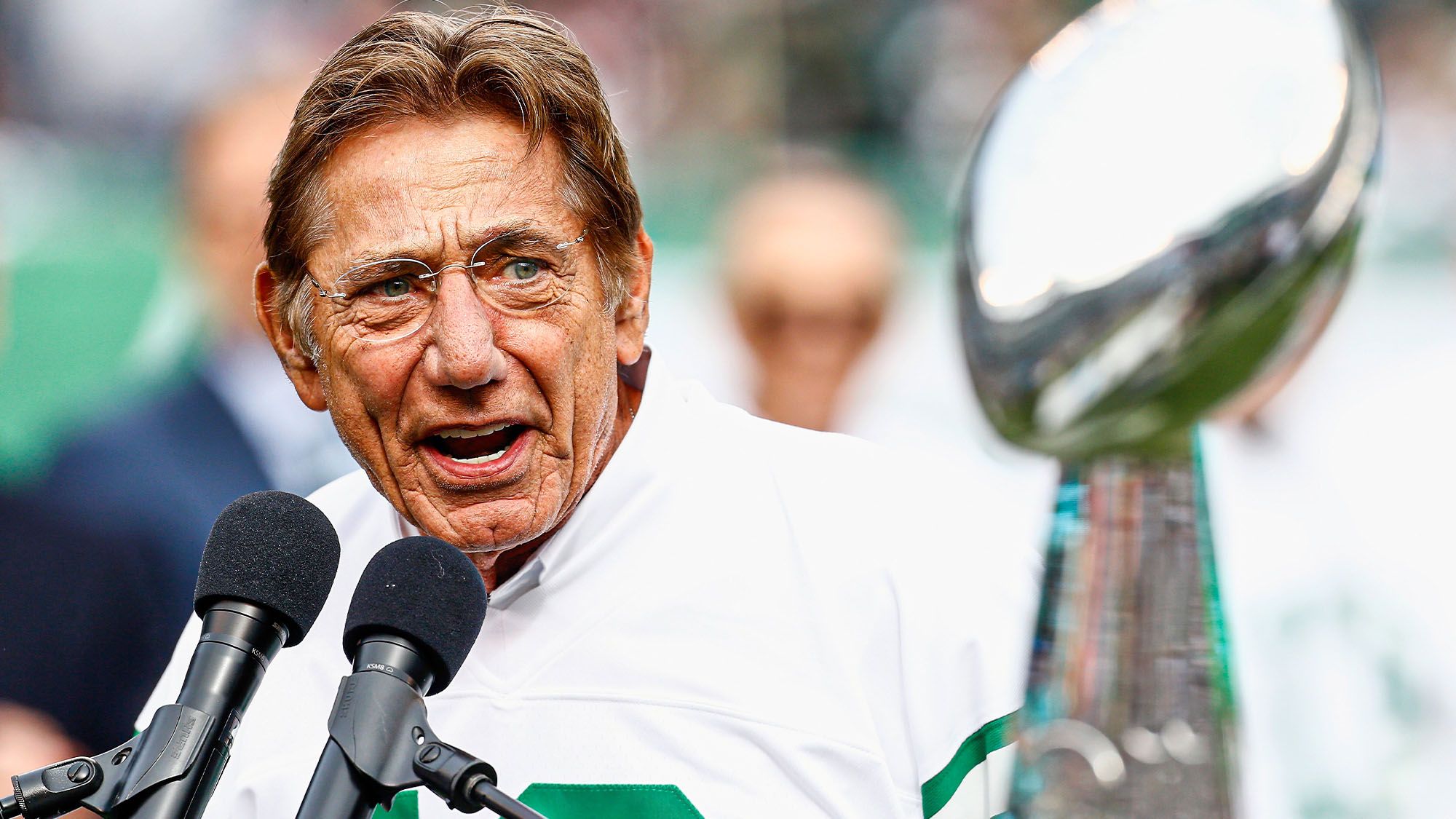
Calling New York Jets legend Joe Namath an overrated quarterback is downright silly
Joe Willie Namath. The face of New York Jets football.
It’s been 46 years since Broadway Joe donned a green-and-white helmet, but the kid from Beaver Falls, Pennsylvania remains the most iconic figure in the 63-year history of the Jets franchise.
Namath holds a dazzling reputation. He is a five-time Pro Bowler, a two-time AFL MVP, a Super Bowl MVP, and a Hall of Famer. Those who were around to watch him play will forever sing the praises of his revolutionary playstyle.
However, in recent years, some critics have emerged from the woodworks with accusations that Namath is an overrated quarterback, pointing to his career statistics as evidence. They claim that his reputation is based largely on his lone championship run and his beloved off-field persona rather than his actual dominance as a player.
If you’re one of those critics – stop it. That claim is beyond ridiculous.
Let’s put an end to this silly notion that Namath is an overrated quarterback.
The primary argument for Namath being overrated
***Any all-time rankings referenced in this article refer to the all-time list of combined NFL/AFL statistics dating back to 1920; even prior to the 1966 merger.
First of all, let’s take a look at the most commonly cited reason that Namath is overrated. Listening to both sides of the argument is critical in any debate.
Namath’s interception total is easily the number one reason that some people think he wasn’t as good as his legacy suggests. Namath threw 220 interceptions in his career compared to 173 touchdowns. He led the league in interceptions four times.
This is certainly a blemish on Namath’s resume. Even relative to the league averages of his era, Namath threw a lot of picks.
Namath threw an interception on 5.8% of his career pass attempts. That rate ranked 38th out of 43 qualified quarterbacks (min. 1,000 passes) over the 13-season span from 1965 to 1977. His total of 220 picks ranked as the second-most over that span (trailing John Hadl’s 223).
Why the interception total doesn’t take away from Namath’s excellence
Namath’s ball security was inarguably a weakness in his game. However, there have been plenty of dominant quarterbacks throughout pro football history who threw a lot of interceptions. It’s possible for a quarterback to struggle in this area and still be great.
Brett Favre led the NFL in interceptions three times. Johnny Unitas and Ben Roethlisberger led the league in picks twice apiece.
Seven of the top 10 quarterbacks on the all-time interception list are in the Hall of Fame. Thirteen of the top 20 quarterbacks on the list are in the Hall of Fame, including Namath, who currently ranks 20th.
Yes, Namath’s ball security was an issue. But he was so remarkable in other areas that he was still fantastic overall.
Namath was a trailblazer in his era
When comparing quarterbacks across different eras, a lot of fans forget to account for the league averages at the time of the players’ careers. The stat-line of a good quarterback in 2021 looks much different from the stat-line of a good quarterback in 1971.
Some of Namath’s stats look pedestrian compared to the passing numbers that we see today, but during his career, Namath was doing things that the league had never seen before he came around. At a period in football history where most teams were still extremely run-heavy, Namath’s ability to carry an offense with his arm was mostly unprecedented.
Namath led the league in passing yards three times, including in both his second and third seasons (1966 and 1967). His 3,379-yard performance in 1966 was the fourth-best single-season mark in history at the time. Namath soared past that number with a 4,007-yard output in 1967, which was a new all-time record at the time and stood for 12 years until Dan Fouts beat it in 1979.
Few quarterbacks put up bigger numbers than Namath during his 13 years in the league. From 1965 to 1977, Namath ranked third in passing yards (27,663) and fourth in passing touchdowns (173). This is despite battling various injuries that caused him to miss 42 games.
When Namath retired following the 1977 season, he was ranked first all-time in passing yards per game (197.6). He was 10th in total passing yards and 15th in total passing touchdowns.

As for Namath’s apparently ghastly touchdown-to-interception ratio, it’s not as ugly as it seems when you account for the standards of his era. Throwing more interceptions than touchdowns was a very normal occurrence at the time. From 1965-77, the league average touchdown-to-interception ratio was approximately 0.85-to-1.
Namath actually threw enough touchdowns in his prime years to surpass that average despite his massive interception numbers. Over his first 10 seasons (1965 to 1974), Namath’s touchdown-to-interception ratio was 0.88-to-1 (151 to 171). His total of 151 touchdown passes ranked sixth-best in the league over that span.
What about Namath’s completion percentage?
Another common criticism of Namath’s resume is his completion percentage. Namath only completed 50.1% of his career pass attempts, which was below-average even in that era. Throughout Namath’s career, the league-average completion rate ranged from 50.9% to 52.5%.
While Namath’s completion percentage was low, the passes that he did complete were so stupendously effective that his per-play passing performance was still excellent.
Throughout his first 10 seasons (1965 to 1974), Namath only ranked 24th out of 34 qualified quarterbacks (min. 1,000 passes) in completion percentage at 50.5%. Yet, he still ranked sixth-best in yards per pass attempt at 7.6. That’s because he ranked third with an outstanding average of 15.1 yards per completion.
Namath is one of the most explosive passers in league history. He led the league in yards per completion three times and is currently ranked 11th on the league’s all-time list with 14.7 yards per completion.
Thanks to his explosive passing, Namath led the league in yards per pass attempt on two occasions despite having a completion percentage no better than 52.5% in either of those seasons.
Namath’s elusiveness in the pocket adds to his per-play greatness
An underrated aspect of Namath’s game is his ability to avoid sacks. It adds to how effective he was on a per-play basis.
Sack totals for quarterbacks were first tracked in 1969. Namath consistently ranked as one of the least-sacked quarterbacks in the league once the stat began being tracked.
From 1969 to 1977, Namath had a sack rate of 4.98%, ranking fifth-lowest out of 33 qualified quarterbacks (min. 1,000 pass attempts) over that span.
Among quarterbacks in league history with at least 1,000 pass attempts since 1969, Namath’s 4.98% sack rate currently ranks 29th-best out of 314 qualifiers (91st percentile).
Sacks are a quarterback stat, not an offensive line stat. The offensive line’s job is to prevent pressure – whether the quarterback gets sacked or not is up to him. Namath was elite at staying on his feet, making him even more impressive on a per-play basis than his standard yards per attempt average shows.
From 1969 to 1974, Namath averaged 7.0 net yards per pass attempt (passing yards-minus-sack yards ÷ pass attempts-plus-sacks), which ranked first out of 30 qualified quarterbacks over that span (min. 700 pass attempts). In other words, he was the league’s best producer of passing yardage on a per-dropback basis throughout that six-season stretch.
Great quarterbacks win and perform in the clutch; Namath did just that
Over his first 10 seasons, Namath ranked sixth among quarterbacks with 56 wins as a starter while also tying for second with 15 fourth-quarter comebacks.
Football fans love quarterbacks who win games and make big plays in big moments. Namath did those things.
Let’s stop calling Joe Namath overrated
Yeah, Joe Namath threw a lot of interceptions. He wasn’t perfect.
Despite all of his flaws, Namath’s strengths made him a superstar in his time. It’s harder to grasp for people like myself who weren’t around to watch him play, but a contextualized dive into his production gives us an idea of how revolutionary he truly was even if his game had some holes.
