
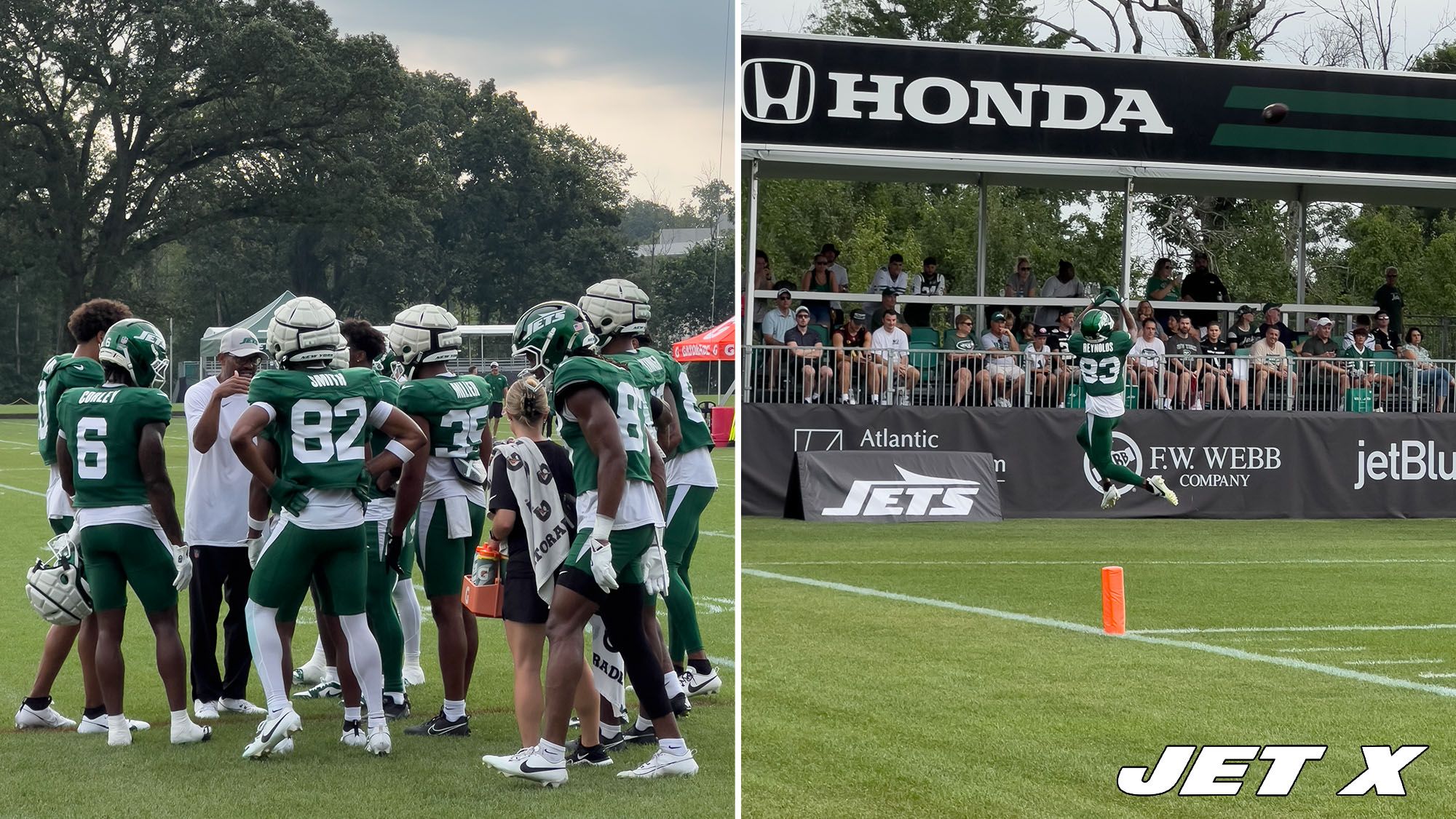
Gone are the days of multiple New York Jets wide receivers running in the same area. At least that’s been one of the consistent features of OTAs and training camp in Florham Park, NJ, this offseason.
Fans know all too well what I’m referencing. Whether it happened in the infamous Adam Gase era with Sam Darnold, the Robert Saleh era with Zach Wilson, or even while Aaron Rodgers led the way, Jets fans couldn’t help noticing that receivers would sometimes clump together like some mystifying science experiment.
Under rookie offensive coordinator Tanner Engstrand, such a scene has been impossible to spot. This can be attributed to proper spacing and timing, with Garrett Wilson playing a key role.
“Garrett’s a feel player at times, and (Amon-Ra) St. Brown, he had the feel, but he was a very specific—no wasted motion—type of player,” Engstrand said after Thursday’s session, when asked about the differences between his WR1 and Amon-Ra St. Brown. “Garrett, at times, will have a little bit of, I don’t know, call it, ‘Sauce,’ to the routes at times. We try to keep that under control where it’s beneficial to us.”
Garrett Wilson, 25, signed a four-year, $90 million guaranteed extension in mid-July, but that doesn’t mean everything has gone swimmingly. Rumors consistently swirled around his unhappiness within the Rodgers-led offense last season, and a lot of the issues were rumored to be created by Wilson’s “freelancing” via route-running.
On one hand, Wilson’s ability to exploit the cover player’s blind spots is a tremendous advantage. On the other hand, playing off-script too often can potentially destroy the scheme’s integrity.
The underlying reality of Garrett Wilson's 2024 seasonEngstrand made it clear on Thursday that he’s working with Wilson in this area, considering timing is a key element of this scheme.
While the Rodgers-led offense featured passing concept sloppiness akin to regimes that came before him, it was born out of a totally different reason. Whereas the Gase and Mike LaFleur offenses were simply not clean and buttoned up, Rodgers’s offense demanded the weapons to read coverages in real time.
Therefore, a lot was asked of the wideouts. They were forced to be on the same page as the quarterback—as far as reading leverage was concerned.
This Justin Fields-specific offense takes a 180-degree turn from that idea.
Instead of the receivers having multiple options on specific routes (extremely run-and-shoot-like), the Engstrand offense is built to scheme players open. It’s all about space and timing, which keeps it as simple as possible for the quarterback in the passing game.
It’ll be the all-encompassing area where Fields must make on-the-fly decisions (RPO, zone read, etc.).
When discussing his quarterback, Engstrand again turned to the “timing” element of his offense.
“He just has to play fast because of the defensive speed and the pass rush getting there and the tight coverage by the defenders,” Engstrand said in response to the idea that the Jets defense is a nice challenge for his offense. “(We have) to play on time, and that’s, again, been good for Justin (and) the rest of the quarterbacks.”
A red zone big-boy battle
Aaron Glenn placed a red zone emphasis on Thursday morning’s camp session. Fortunately for the fans on hand (the team’s third open practice this summer), the big boys started the party …
Garrett Wilson vs. Sauce Gardner.
The first matchup resulted in a Wilson touchdown. If the story had ended there, a significant injustice would have unfolded—because analyzing this game is never that simple.
Despite the touchdown, everything about the rep was perfect—on the quicker-type route that targeted the left-front pylon. Wilson ran a tremendous route, Justin Fields threw the perfect pass (with the correct timing), and Sauce’s coverage was nearly as good as it gets.
Only a perfect throw could get it done, and a perfect throw is what occurred.
The next matchup went in Sauce’s favor. The coverage was great, and the throw was horrendous. Wilson and Fields just weren’t on the same page.
A not-so-great QB day
Fields and the Jets offense slightly rebounded from their worst performance of the summer (Tuesday). And perhaps describing it that way is a bit too liberal.
The rushing attack looked much better, but the passing game still struggled.
Team sessions began a bit rocky. After a nice Fields-to-Josh Reynolds connection on the first play of teams, Tony Adams intercepted the Jets quarterback and returned it for a solid chunk down the left sideline.
Although Tyler Johnson created some separation in the middle of the field, Fields sailed it well over his head, leading to an easy Adams theft.
Later in practice, Fields sailed another one, this time while targeting his WR1 on a corner-type concept down the vertical left sideline. The anticipation-type throw featured great timing, but the placement was well over Wilson’s radius.
Brandon Stephens dropped the easy interception. However, seeing the ball travel right into his breadbasket was shocking from his perspective.
Later in team sessions, near the end of practice, another near-INT rep unfolded when Fields missed Wilson over the middle. Stephens or Andre Cisco would have come up with the interception if not for a collision.
It wasn’t all bad for the Jets quarterback, however. One of his more impressive QB decisions resulted in a red zone touchdown to Breece Hall out of the backfield.
Fields read the pressure pre-snap and appropriately hit the hot option on time.
News and notes
Braelon Allen missed his second straight practice due to knee soreness, despite the original thought that he would return for Thursday morning’s session.
Quinnen Williams left practice early due to a calf issue.
Defensive end Eric Watts bodied Breece Hall on a rush concept (second team) on one play in teams. He seemingly beat his man with no problem to pick up the impressive tackle for loss against No. 20.
The New York Jets return to the practice Field on Friday morning.
