
Ladies and gentlemen, welcome to the main event.
Sure, kickoff for Sunday’s highly anticipated matchup is slated for 1:00 p.m. ET—as opposed to the more predictable primetime slot. If the NFL had its druthers, the world would be forced to tune in on Sunday or Monday evening.
That’s just not the way the 2025 cookie crumbled. For whatever reason, Mr. Aaron Rodgers took his sweet time to make his Pittsburgh Steelers union official, and thus, the CBS broadcast team of Ian Eagle and J.J. Watt will be on the call from MetLife Stadium.
Hey, let’s not pretend New York Jets fans are upset. This is a welcomed departure from the Rodgers-led primetime dominance the ritualistic Jets fans—who cannot get enough of their tailgating—are accustomed to.
However, the strategic mindset remains the same no matter the time of Week 1’s clash. Aaron Glenn understands what his team must accomplish to start the brand new season 1-0, and it should resemble our first game plan film session this season.
Game plan bullet points
The heart of each game plan deals with high-level bullet points, both from a connected general perspective and unit individualization.
Connected
- Conservative tempo.
- Control the clock.
- Aggressive mindset at select moments.
- Do not overextend any of the three units; instead, ensure each complements the next.
Offense
- Establish one’s own identity, first and foremost.
- Stretch the opponent’s EDGE players east-west, particularly on early/rush-pass downs.
- Play the chain game, limiting third-and-long situations (pass-rushing situations).
- Don’t pass the ball to open up the rushing game, but rather threaten the EDGE defenders to open up the between-the-tackles rushing game.
- Chip the EDGE defenders with running backs and tight ends when necessary (third-and-passing situations).
Defense
- Stop the early-down rush.
- Always understand the situation; read-and-react on balanced downs rather than relentlessly attacking gaps.
- Run-fit responsibility on all rush-pass/balanced downs.
- Interior pressure to force Rodgers to move laterally (left or right).
- Less pressure than usual, but timely pressure in the right situations.
- Elaborate upfront gaming on third-and-passing situations (for a pass rush).
Special Teams
- Discipline.
Offensive Game Plan: Threaten the EDGES East-West
Let’s get one thing out of the way from the jump: Week 1 is a different animal. This league is a random beast in a general sense, yet Week 1 pumps that randomness with MLB’s Summer of 1998-esque steroids.
Additionally, the 2025 New York Jets are as specific as it gets at this level. They know who they are and who they want to be: a smashmouth, in-your-face, rack-up-the-rushing-yards squad.
Much of this offensive game plan involves establishing an internal identity. While Cam Heyward, T.J. Watt, and others need to be accounted for, expect Tanner Engstrand’s offense to emerge with its own identity at the forefront.
It just so happens that the Jets’ rushing identity is a perfect game-plan fit against this Pittsburgh front.
Justin Fields’s elite rushing traits must be used early and often, and jet motion can also be used early and often. Both of these concepts should be utilized to give T.J. Watt and Alex Highsmith plenty to think about early.
It’s simple: force Watt and Highsmith to stay home so that one fewer rush defender is out of the mix. That’s the entire name of the QB-rushing game.
Remember, the Steelers are a 3-4 base team. This means that while nonetheless rewarding, keeping Watt and Highsmith home still differs from the 4-3 look (more upfront bodies when running north-south).
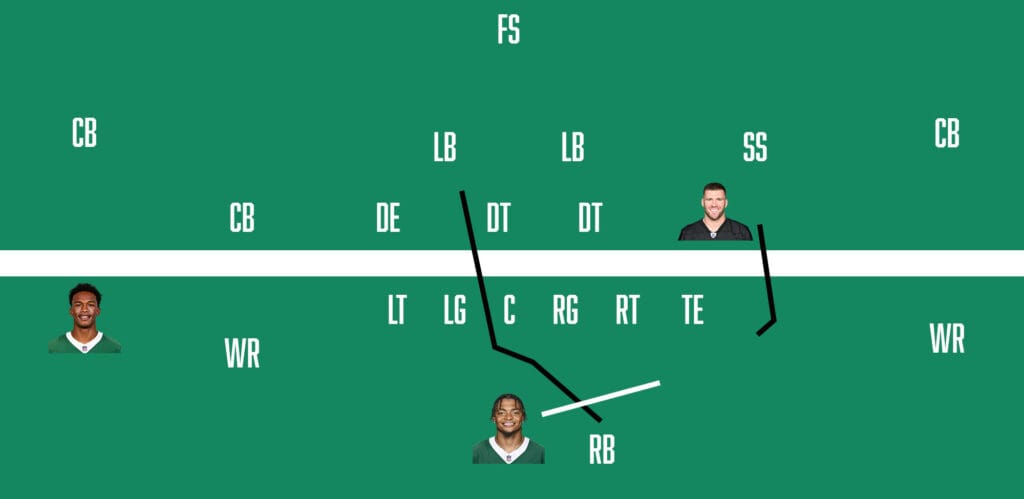
Like most teams, Pittsburgh plays a four-man front routinely thanks to the domination of 11 personnel (and nickel).
Offensively, it’s simple: threaten the edges, establish the rushing attack, and tell Fields to scamper with the ball every chance he gets.
Defensive Game Plan: Stop the Run and Move Rodgers
Defensively, it’s all about stopping the run on early downs. Expect defensive coordinator Steve Wilks to mix in a bunch of early run blitzes.
Above all else, the Jets’ front must remain disciplined to the run fits. Period.
Newcomer Harrison Phillips should be tested early, reading and reacting to early-down rushes, while tempted to travel too far downhill against some of Arthur Smith’s rushing concepts. He has to resist that urge.
Stay home, provide pushback against double teams, and allow Quinnen Williams and the linebackers behind him more freedom to make plays.
Because Aaron Rodgers isn’t fleet of foot, the Jets will have the ability to game some pass-rushing concepts up front on passing downs. But that opportunity can only come if they first stop the run to an effective degree.
This idea is totally flipped on the other side of the ball, whereas Mike Tomlin’s defense will have to maintain its rushing lanes against Justin Fields in passing situations.
For the Jets, after stopping the run, it’ll be about interior pressure. They can send Michael Carter II off the edge, replacing one of the defensive ends who crashes down the line.

Or, they can send Jamien Sherwood or Quincy Williams up the gut.
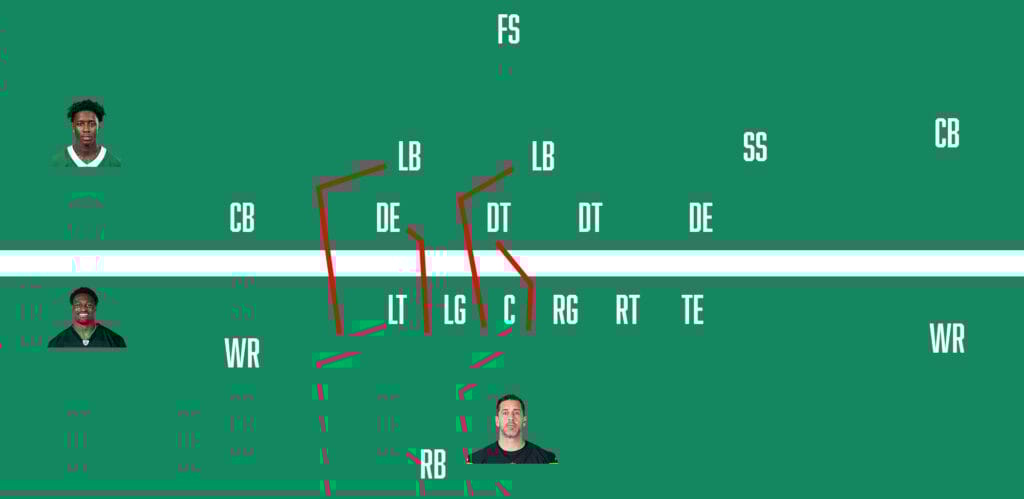
This way, instead of allowing Rodgers to step up in the pocket (via EDGE pressures), the interior pressure forces the older man to move laterally.
I’d also allow Sauce Gardner to travel from boundary to boundary in his matchup against DK Metcalf. I’d only allow the matchup to disappear when Metcalf lines up in the slot.
Carter II should remain in the slot, thanks to his prowess. Besides, leaving MCII in a press-slot position with Sauce and Brandon Stephens in an off, bail-tech, outer-third situation, should be the most common look against the Steelers offense.
