


According to New York Jets owner Woody Johnson, winning games with Justin Fields is an impossible task for any NFL head coach.
“If you look at any head coach with a quarterback like that, you’re going to see similar results,” said Johnson during Tuesday afternoon’s quasi-diss track against Fields.
Apparently, Johnson wiped the 2024 NFL season from his mind, when Pittsburgh Steelers head coach Mike Tomlin achieved a 4-2 record with that very same quarterback.
It’s hard to blame Johnson for erasing his memory of that season, though, because the Jets went 5-12 with a quarterback who is now 4-2 with Tomlin in 2025 after being dumped by the Jets.
From Fields, to Aaron Rodgers, to Sam Darnold, to Geno Smith, it is sure starting to seem like every signal-caller plays their worst football with Johnson’s franchise, and when they join a quality coaching staff like the one in Pittsburgh, everything clicks.
Johnson’s anti-Fields tirade was designed to distract from that ugly truth. The 78-year-old owner tried to get the public to buy into the notion that Fields is solely to blame for the franchise’s struggles.
Nobody is falling for it, though, because the facts are right in front of us.
What Johnson and others are missing about Justin Fields’ 2025 season
Fields has undoubtedly performed poorly in 2025, costing the Jets wins and playing himself into a deserved benching. But something is going overlooked in the discourse surrounding him: He has never looked this bad.
While Fields was underwhelming over his first four NFL seasons, he wasn’t unplayable. He came to New York viewed as a competent, top-25 starting quarterback capable of leading the Jets to the competitive season they craved. He led the Steelers to a 4-2 record across six starts in 2024, and even in the 2023 season, with a poor Chicago Bears roster, Fields achieved a 5-8 record under head coach Matt Eberflus.
Over his last 17 starts before joining the Jets, Fields led his teams to the equivalent of a wild card-caliber season: 9 wins, 8 losses.
Aaron Glenn’s Jets are 0-6 with that same quarterback.
Not only that, but Glenn’s staff has Fields playing his worst ball in the NFL.
Fields is averaging a career-low 4.3 net yards per pass attempt, almost a full yard worse than his previous career-low (5.1 in 2022). His 31.8 QBR is his worst since his rookie year, barely beating his mark from that season (31.4). It is nearly 16 points shy of his 47.4 QBR in Pittsburgh last season.
Before joining the Jets, Fields was trending up in one of his worst areas, sack-proneness, but the Jets have him moving backwards in that area (figuratively and literally). His 14% sack rate is a 5% increase from the career-best 9% mark that he achieved with Pittsburgh last year, and it is barely better than the career-worst mark he set in 2022 (14.8%).
Perhaps the greatest indictment of the Jets’ coaching staff is how indecisive and scared they have made Fields look. These have always been problems for him, but they have festered in New York’s scheme.
Fields’ ADOT (average depth of target) is a career-low 7.4, the seventh-lowest mark among 32 qualified quarterbacks. This is despite him averaging 3.13 seconds to throw, which is third-highest. His ADOT is down from last season (7.8) despite his time to throw being up (3.08), meaning the Jets have him holding the ball longer to challenge the defense less.
No other NFL quarterback is holding the ball this long to throw it this shallow. Fields is the only QB ranked bottom-10 in ADOT who is also averaging 3.0+ seconds to throw.
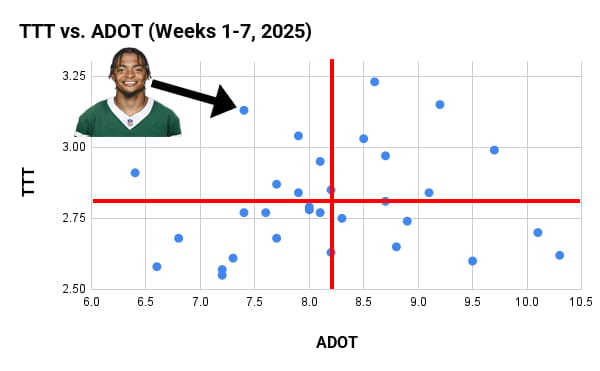
It highlights the flawed logic of Jets head coach Aaron Glenn, who defended Fields’ TTT by comparing him to Lamar Jackson and Josh Allen, two quarterbacks who also tend to put up high marks in that category.
Seemingly unbeknownst to Glenn, it’s because Jackson and Allen actually use that extra time to attack downfield. Jackson (9.6) and Allen (8.5) each have an ADOT over a full yard higher than Fields this season; their career averages are 9.3 and 9.4, respectively, about two yards above Fields’ Jets average.
Glenn’s inability to understand Fields’ strengths and weaknesses indicates how lost the Jets’ staff is when it comes to maximizing their starting quarterback, the same one they targeted in free agency and wanted to build their scheme around.
This lack of understanding extends to offensive coordinator Tanner Engstrand, who hasn’t bothered to maximize Fields’ best ability, his legs. Fields is averaging just 4.2 designed rush attempts per game with the Jets, way down from his 6.2 per game as a starter in Pittsburgh.
The Jets’ coaching staff is responsible for Fields’ big-time regression and its ensuing consequences on the team as a whole.
Fields himself isn’t the main problem
Johnson’s comments imply that Fields is a liability the coaching staff was saddled with. That isn’t the case at all.
This Jets regime wanted Fields. They wanted him on their team, they wanted him to be their starter with no competition, and they wanted to build the entire offense around him.
Thus, any damage Fields has done to the Jets organization should be pinned on the staff that targeted him and failed to get the most out of him, not Fields himself.
In free agency, the Jets went out and signed Fields to a two-year, $40 million with $30 million guaranteed. They already had Tyrod Taylor on the roster, who has performed at a similar level to Fields in recent seasons, which gave New York a great opportunity to facilitate a quarterback competition.
Instead of initiating a competition, the Jets handed Fields the job from the get-go. They believed they had a schematic vision that would allow Fields to reach a new ceiling.
The result of that vision? Fields reaching a new floor.
Let’s be clear: Yes, Fields is a mediocre quarterback, and there is no denying that he has performed shockingly poorly this season. But Johnson’s comments ignore that:
- Fields was a competent starter in the recent past; he had a winning record over a full season’s body of work
- Johnson’s team specifically targeted him
- The staff hired by Johnson has Fields playing worse than ever
Johnson is certainly aware of these facts. He just buried them when speaking to the media on Tuesday because they wouldn’t serve his narrative of deflecting blame away from the coaching staff that created this mess.
New York will draft a rookie quarterback within the top 10 picks of next year’s draft, potentially first overall if the Jets continue on their current trajectory. Johnson must be certain that he has the right leaders in place to help that young quarterback become the best version of himself.
Based on how the Jets’ new regime has handled the quarterback position so far… should they really be trusted with a young quarterback prospect in 2026?
Probably not, but Johnson appears dead set on letting them try, which is why he did his best to deflect blame for the team’s woes onto Fields and away from the incompetent staff that wanted to build around him in the first place—the same staff that Johnson appointed this past offseason as the product of his widespread search with The 33rd Team.
