
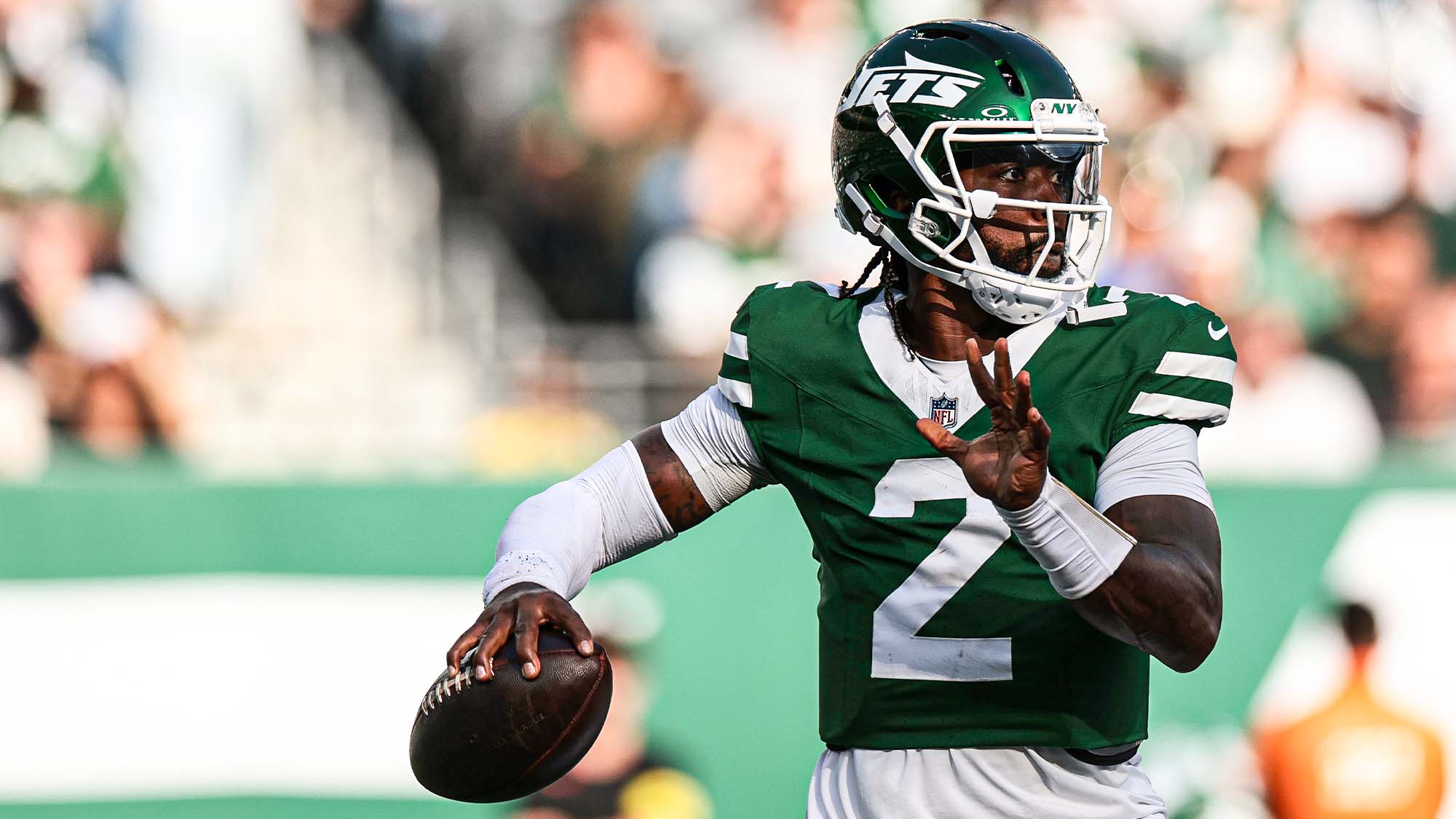
There is well beyond just a single reason that the New York Jets should bench Justin Fields in favor of Tyrod Taylor for tonight’s battle with the New England Patriots.
The fact that Fields has thrown for only 1,143 yards this season, the fewest by an opening-week starter through eight starts since JaMarcus Russell in 2009, should be enough on its own.
However, the decision goes beyond just Fields’ struggles. To bench your starting quarterback, you have to be able to trust your backup—particularly against the team you’re facing that week.
Taylor matches up far better against the Patriots than Fields.
One stat should be all the Jets need to know that Taylor is their best bet tonight.
Tyrod Taylor gives New York the best shot
The 8-2 Patriots have thrived in many areas on the defensive side of the ball, as they rank sixth-best with 19.2 points per game allowed.
One of the Patriots’ few weaknesses is their susceptibility to explosive passing plays.
According to FTN Fantasy, New England has allowed 1.074 EPA (expected points added) per attempt against “go” routes this season, which ranks fourth-worst in the NFL.
That stat is all the Jets should need to hear to give Taylor the ball.
Fields’ biggest issue this season has been his unwillingness to push the ball downfield. His ADOT (average depth of target) is just 7.0, ranked 36th out of 42 qualified quarterbacks. He is averse to throwing deep passes, hurling just 14 of them in eight starts. Only 7.9% of Fields’ passes went deep, ranking 39th.
Taylor, on the other hand, has played aggressively during his brief time on the field this season. The veteran’s ADOT is 9.1, placed ninth out of 42, and he’s attempted 10 deep passes in limited time. Taylor has thrown deep on 14.5% of his attempts, nearly double Fields’ rate and good enough for seventh-highest.
Specifically focusing on the go route, Fields has tossed just eight of them across eight starts and 228 dropbacks; that’s 1.0 per game and once every 28.5 dropbacks. Taylor has already launched five go balls across seven quarters and 91 dropbacks, a rate of 2.9 per game and one every 18.2 dropbacks.
Jets must take risks to even the playing field
As 12.5-point underdogs in New England, the Jets should be focused on playing a high-risk, high-reward style of football that gives them the highest possible ceiling. That’s the best path to victory as an overmatched team in the NFL, not trying to “protect the ball,” “control the clock,” or whatever other 1970s adage you want to throw out there as a facade for your true mindset: fear.
Getting into a blow-for-blow rock-fight with a team that’s better than you is a path to nowhere except earning pats on the back for losing by less than expected. If winning is the goal, the underdog must take as many risks as possible and just pray that a good chunk of them work out.
The Jets have a better chance of scoring touchdowns by giving themselves opportunities to score seven points on one or two plays, rather than trying to out-execute the Patriots time and time again for 12+ plays down the field. New England has the fourth-best run defense in the NFL based on yards per carry (3.8).
New York is in the lucky position of facing a heavily favored team with a gaping hole in a specific area that yields favorable opportunities for high-reward plays. If the Jets don’t do everything in their power to exploit that hole, it would mean their coaching staff is not doing the best possible job of maximizing the team’s odds of victory—a concerning sign about Aaron Glenn as we evaluate his coaching chops.
Starting Taylor does not guarantee the Jets will win the game or succeed offensively. While Taylor has been aggressive this season, he hasn’t been successful on those throws; in fact, he is 0-for-5 on his go balls this season, and 1-for-10 on deep passes overall.
However, the deep ball has always been one of Taylor’s strengths, and the Jets should expect his accuracy on those passes to even out with more opportunities. Back in 2023, when he started five games for the Giants, Taylor ranked 10th-best out of 41 qualified quarterbacks with a 47.4% adjusted completion percentage on go routes.
In the Jets’ Week 7 loss to Carolina, Taylor took over for Fields in the second half, and he went bombs-away during his two quarters of action, posting an astronomical ADOT of 16.8. Taylor tossed deep shot after deep shot, and the windows for touchdowns were open—he just kept missing them.
The opportunities were there, though. It was apparent that inserting Taylor at quarterback opened up a plethora of deep chances that did not exist with Fields.
With more chances to attempt these passes, Taylor’s accuracy should regress to the mean, allowing the Jets to convert the explosive plays they need to pull off road upsets against teams like New England and Baltimore.
Nothing is guaranteed in the NFL. Starting Taylor in Foxborough might lead to a plethora of big plays, or it might not.
What we do know is that Taylor yields a substantially higher probability of producing big plays than Fields.
Will Aaron Glenn correctly analyze this matchup and choose the option that gives his team the best chance to win?
