

I’d like to apologize…
Sixty-four days ago, the New York Jets fell to 0-4 with a 27-21 loss to the Miami Dolphins on Monday Night Football. It was considered an inexcusable loss for New York at the time.
While the Dolphins now have a semi-respectable 5-7 record, Miami entered the Week 4 contest with an 0-3 record and a ghastly -42 point differential (compared to the Jets’ much less egregious -24). It was a winnable game for New York that only became more attainable after it got underway; midway through, the Dolphins lost their best player, wide receiver Tyreek Hill.
Yet, the Jets came up short, setting the tone for the season that was to come. There were many reasons for the defeat, but one man’s mistakes were so baffling that he drew the majority of the ire: returner Isaiah Williams.
In his third game as a Jet after being tabbed to replace the fumble-prone Xavier Gipson, Williams had a disastrous outing. He fumbled away the opening kickoff of the second half, and in the fourth quarter, he inexplicably fair caught a punt at the three-yard line when the Jets desperately needed to score, teeing up a Jets punt that basically ended the game.
Given that Williams was essentially added to the roster for the sole reason of not fumbling the ball, it seemed like a performance that did not warrant a second chance. Throw in his ill-advised fair catch on top of the fumble (along with a second near-fumble where Williams put the ball in harm’s way), and the 24-year-old seemed flat-out lost on the field.
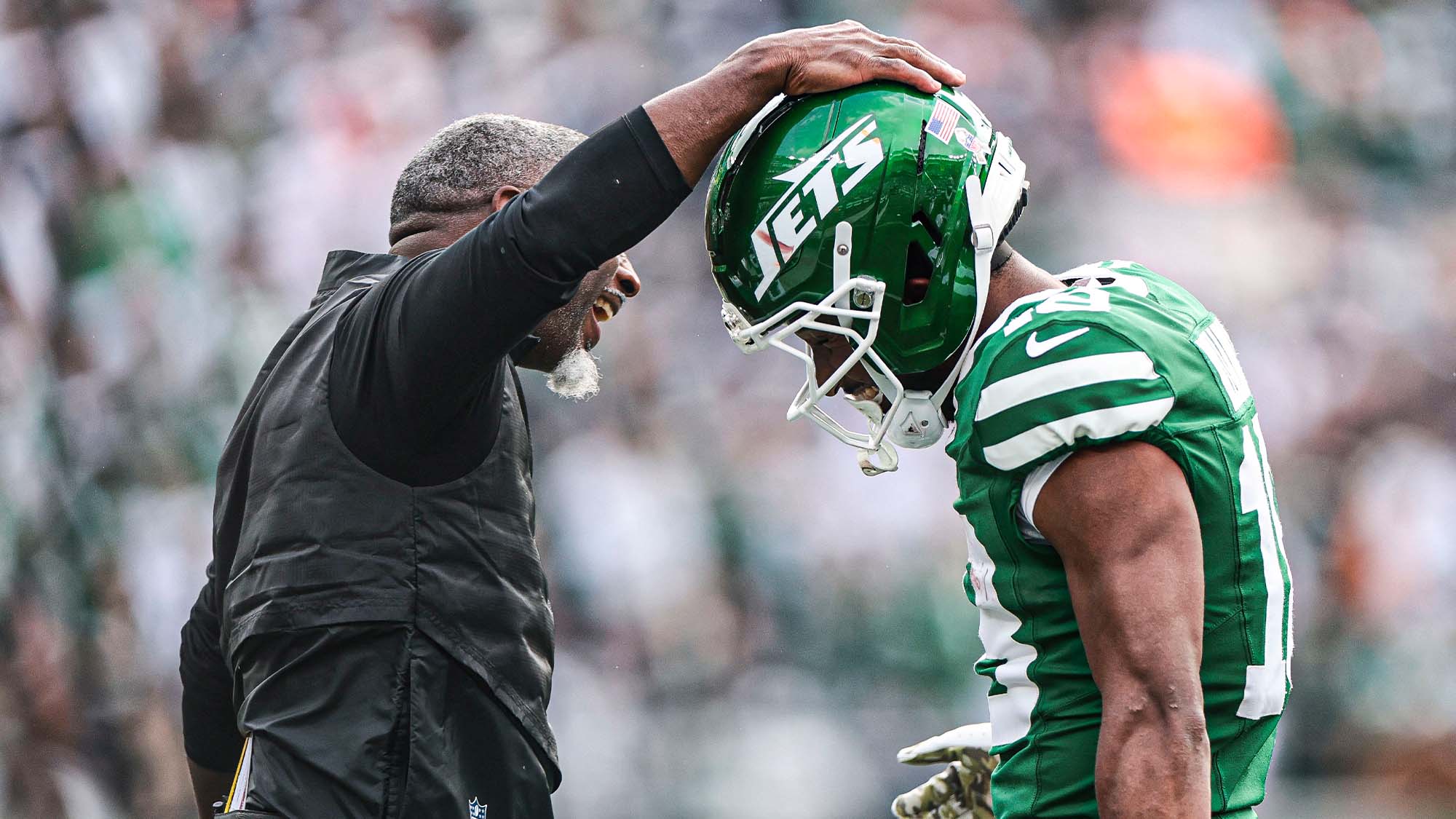
Clearly, this was a situation where Jets head coach Aaron Glenn needed to show accountability by immediately kicking Williams to the curb. After all, he did it with Gipson, affirming that “you will not be on the field with this team if you are going to cause us to lose games” before releasing Gipson soon thereafter.
The Jets did release Williams a few days after his Miami debacle, but to the surprise of many, they re-signed him to the practice squad. Just two weeks after the Miami game, he was called back up to re-assume primary kick and punt return duties.
I chastised the Jets for the decision. I thought it indicated multiple negative things on the part of Glenn and the Jets’ new regime, from a lack of accountability to poor scouting in the special teams department.
Williams was a second-year UDFA with no track record of quality production in the NFL. He cost the Jets a game the last time he was on the field, and it was by way of elementary mistakes that an NFL player shouldn’t make. It seemed to be as easy a “cut” decision as the Jets could ask for. How could they possibly allow this player to get a second chance?
Sixty-four days later, we understand loud and clear why the Jets stuck with Williams. That’s why I’m here to admit I was dead wrong.
The Jets’ faith in Williams has been rewarded
Since getting his second chance in New York, Williams has been one of the best returners in the NFL.
Over his last seven games, Williams is averaging 30.2 yards per kick return (17 attempts) and 12.7 yards per punt return (21 attempts), including a critical punt return touchdown in the Jets’ Week 10 win over Cleveland. Williams also won AFC Special Teams of the Week honors for his quality returns in the Jets’ Week 8 comeback victory over Cincinnati.
In fact, Williams is directly responsible for producing multiple Jets victories. They don’t win their Week 10 game against Cleveland (27-20) without Williams’ 74-yard punt return touchdown, nor do they win their Week 13 game against Atlanta (27-24) without Williams’ 83-yard kick return to set up a field goal. His big plays represented the difference in the final scores of those contests.
Perhaps they wouldn’t have defeated Cincinnati, either, as Williams had three solid returns in the second half that directly preceded Jets touchdowns. In a one-point win, every yard counted.
For a player who was blamed for single-handedly costing the Jets a win just a few weeks earlier, it’s quite the redemption story.
It’s a testament to Williams for his fortitude. At a moment when he easily could have given up, he took his second chance and ran with it—and he didn’t fumble it this time. (That was just intended to be some clever wordplay, but it’s true; Williams’ fumble in Miami remains the only ball he has allowed to touch the ground this year.)
Glenn, special teams coordinator Chris Banjo, and the Jets’ entire coaching staff deserve immense credit for their belief in Williams. At a time when I advised them to send him packing, they stuck by him, and seven games later, it isn’t unfeasible to say that they might be winless if they listened to me.
It speaks to the human element of player evaluation in sports, something that only those in the building can fully understand.
There’s more to player evaluation than just on-field production
As outsiders, we can only evaluate what we see on gamedays. We see brutal production from a player like Williams, and we want him gone—simple as that. With no on-field evidence to suggest we should believe in his ability to turn things around, the pragmatic conclusion is to let him go and find someone with a better track record of production.
On-field production alone can never tell the whole story, though. It’s also critical to evaluate the human—and we can’t do that from the outside.
The Jets were well aware of Williams’ struggles. They were surely frustrated; that’s why they released him.
But after working with him every day for multiple weeks, they were familiar with not just Isaiah Williams the player, but also Isaiah Williams the man. Clearly, the Jets’ coaches saw a young man with the resolve and work ethic to learn from his struggles and move forward stronger than he was before; otherwise, they would not have bothered keeping him on the practice squad.
They wouldn’t give that second chance to just anyone, though. Alongside their recognition of Williams’ mental capacity to learn and grow from his mistakes, they saw a player whose physical skills lent him a lofty ceiling, one tantalizing enough to justify gambling on him despite the low floor he had already displayed.
Although he struggled in Miami with ball security and decision-making, Williams’ quickness with the ball in his hands was evident across his first three games in New York. The Jets had a chance to toss him aside for his mistakes, but instead, they chose to see him as who he could be, not who he was.
With Williams proving himself to the Jets’ coaches as a person, he earned the right to a second chance. They wouldn’t give a bonus opportunity to just any athletic player if the mental fortitude wasn’t there (hence their valuation of Malachi Corley, for instance). Williams had it, though—that much is obvious by now.
This hidden element of player evaluation could likely explain many of the decisions made by NFL teams that baffle us lowly pigskin peasants.
From the outside, our player evaluations are nearly one hundred percent based upon the film and stats generated in-game. Perhaps we will take off-field factors into account if there is a major negative storyline surrounding a player, but for the vast majority of players, nothing comes into play besides the on-field product.
This is especially true for players with positive off-field traits. Sometimes, in the draft cycle, we try to identify tangible things like being a team captain (something Joe Douglas valued), but it’s absurd to pretend as if anyone who isn’t a team captain isn’t worthy of being labeled as a high-character individual, or even that a team captain is guaranteed to be a high-character individual.
It’s why teams invest so much effort into scouting a prospect’s character just as deeply as they scout his game. These evaluations go on to play a major role in how players are valued (even once they get to the NFL), but from the outside, we know very little about players’ reputations in these areas (barring extremely positive or negative characters), thus creating the disconnect between NFL teams’ valuation of players and outsiders’ evaluations.
That all brings us back to Isaiah Williams and the Jets.
The Jets’ staff has shown its belief in potential
If this were Madden, cutting Williams would have been a no-brainer after the Miami game. Judging solely on his on-field performance, there was no way to predict the improvement he ended up achieving. Only the Jets’ coaches could have seen the potential he possessed, and they deserve credit for investing in it, even if it was a risky gamble given what Williams had shown on the field.
The reality is, from the outside, we are often guilty of playing Madden with these real-life human beings. It’s a difficult thing to account for, though, because at the end of the day, none of us can know Isaiah Williams personally. All we have are the film and numbers presented to the public each Sunday.
Still, we must remember that there is so much more to evaluating these men than solely the tangible results. So, if a decision is made that shocks us, there is likely a good reason for it, even if it’s something we can’t see on the field.
Williams is not the only example of this type of faith shown by the Jets under their new regime. Led by Glenn, the Jets’ new regime has already built a long list of moves that are built around their faith in a player’s potential.
Look no further than former Ravens cornerback Brandon Stephens, whom the Jets signed to a three-year, $36 million deal after he allowed the second-most yards among cornerbacks in the 2024 season. It’s another move that I lambasted based on the lack of production to justify the investment.
Just like with their decision to keep Williams, the Jets saw Stephens for who he could be, not who he was. They believed that their scheme and staff could help Stephens reach new heights in their environment. To help justify that faith, they likely had intel from Baltimore (or dating back to the 2021 draft cycle) that gave them confidence in Stephens’ work ethic. If you’re going to bet on a player’s improvement in Year 5, you had better be confident in his mental makeup.
So far, the Jets’ faith has paid off. Stephens has allowed just 27.6 yards per game in coverage this season, about half of what he gave up last year between the regular season and playoffs (54.4).
Beyond Stephens, another great example is former Colts wide receiver Adonai Mitchell, whom the Jets acquired in the Sauce Gardner trade.
A 2024 second-round pick, Mitchell produced lowly numbers across two seasons with the Colts, but his film and numbers showed immense potential. Through two games with the Jets, things weren’t going any differently, but Jets offensive coordinator Tanner Engstrand kept the faith.
Speaking to the media after Mitchell’s drop-filled debut, Engstrand acknowledged the mistakes, but focused primarily on Mitchell’s potential.
“If you want to watch his performance last week, I [get] it. The drops, that happens occasionally. But what I see there is separation. I see separation, and to me, that gets me fired up. That gets me excited about that player and where he’s going to go. We haven’t even seen it. We haven’t even scratched the surface with that guy, and we’re excited about where he’s going to go.”
Like Williams, the Jets’ faith went beyond solely the physical traits. It was also based upon their belief in the person.
“I’ll just first start as AD, Adonai as the person, he’s awesome,” Engstrand said. “He’s been phenomenal so far. Just like being around him. He’s got great energy, he’s got a great attitude. To me, that’s where it starts. When I see him, I think he’s one of us.”
After two rough games to begin his Jets career (three catches on 13 targets), the Jets could have buried Mitchell in their offense. Instead, they relied on him more, throwing him a career-high 12 passes in his third game. He rewarded their faith with a career-best day, securing eight receptions for 102 yards and a touchdown.
This is the same 23-year-old who was benched by the Colts earlier this year after a silly goal-line fumble as he celebrated prematurely, even though Mitchell made an incredible play to reach the goal line in the first place. Rather than invest in the potential Mitchell showed on the play, believing that he wouldn’t make the same silly mistake again, they put him in the doghouse and sent him away as a trade throw-in.
Where Indy saw a lost cause due to a lack of results, the Jets saw potential.
The Jets’ cultural reset under Aaron Glenn and Darren Mougey is intended to be built around many things, but this might be the single defining trait that the two men have established in their first year at the helm. From Williams, to Stephens, to Mitchell, and many moves in between, this regime has consistently chosen to see upside in people whom others might see as merely unproductive.
This approach is a bet on the talent identification and talent development skills of their front office and coaching staff, respectively. If the Jets excel in those two areas, their high-risk gambles will ultimately pay immense dividends. If not, the Jets will crash and burn, paying the price for betting on players with lackluster track records instead of making safer investments in proven players.
The time for the safe route has long passed the Jets by, though. After 15 years of no playoffs, the organization has elected to swing for the fences. They’ve waited this long; the goal now is not just to make the playoffs, but to build a culture that can sustain yearly Super Bowl contention for a decade-plus.
You don’t get there by playing it safe. You get there by taking risks.
When it comes to taking risks in the NFL, it’s not just about talent. It’s also about taking risks on people.
As Isaiah Williams shows, the Jets’ young regime understands that. They are willing to invest not just in talented players, but gifted humans.
If the early rewards of their gambles are any indication, their feel for the human element of football could take them further than this grounded franchise has ever flown before.
