
As per usual, the New York Jets are a bad football team, but not bad enough to bottom all the way out and lay a clear path into the future for their fanbase to embrace. They are eternally cursed to struggle in a fashion that leaves them with no easy way out.
Despite their grotesque 3-10 record, the Jets are only projected to land the seventh overall pick in the 2026 draft. It leaves their fanbase split between two popular opinions on how the organization should handle its pursuit of a franchise quarterback in the upcoming offseason.
Some Jets fans want to see the team trade up for a quarterback. Armed with a boatload of picks, these fans are willing to pay whatever price it takes to get Fernando Mendoza or another top-tier prospect instead of sitting on their hands at No. 7.
Some fans would rather see the Jets punt their quarterback pursuit to 2027. They don’t want to see the team’s assets wasted on one prospect who might not pan out as hoped.
But what if the best option lies in between?
I would argue that the Jets’ best option is to hang tight at their first-round draft slot and take the BQBA (best quarterback available)—within reason, of course.
Let’s break down why it might be the Jets’ best course of action at their current draft slot (No. 7 overall).
What reason is there to punt again?
The Jets already used one year to “punt” on a quarterback. After electing to part ways with Aaron Rodgers, they took the half-measure route by committing to a relatively cheap, low-percentage gamble on Justin Fields instead of pursuing a more proven veteran or drafting a quarterback in the first round (or any round, for that matter).
If you don’t have an above-average quarterback in the NFL, you’re wasting your precious time on Planet Earth. While it is an exaggeration that you cannot win a Super Bowl without an MVP-caliber quarterback (as evidenced by winners like Eli Manning, Eli Manning a second time, Joe Flacco, a decrepit version of Peyton Manning, Nick Foles, and Jalen Hurts), you absolutely need at least a competent signal-caller to have a realistic chance.
The Jets didn’t give themselves that chance in 2025, and if they punt on the quarterback position in 2026, they will do it again, making it two straight seasons that were deliberately wasted by choosing not to make a serious push at the quarterback position. Rebuild timelines be damned; it shouldn’t take long to get back into contention in the parity-driven NFL.
Whether it was the Washington Commanders’ 2024 run to the NFC championship or the Cincinnati Bengals’ 2021 run to the Super Bowl, teams can and often do make overnight turnarounds from zeroes to heroes. Examples like these spit in the face of the popular narratives that claim NFL rebuilds must always require three-plus years of steady progression.
The only thing that is absolutely necessary to forge an overnight turnaround like Cincinnati’s or Washington’s? A quarterback.
The longer the Jets wait to take an aggressive stab at a franchise quarterback, the longer their playoff drought will drag on. Plain and simple. They can accumulate as much talent as they want across the rest of the roster, but as long as they’re led by a bridge quarterback, their ceiling will be firmly capped beneath the AFC’s seventh seed.
So, what motivation is there for the Jets to keep wasting their time? None, really.
The Jets need to get a quarterback now, not wait until an idealistic savior descends from the football heavens to deliver them from Tankathon hell.
The dilemma, then, is how to get him without a top draft pick. That’s where legitimate concerns arise about the Jets’ ability to pursue a potential franchise quarterback in 2026. However, there are strong reasons why the Jets should ignore those concerns and still make a real push to find their guy.
Why fans argue to trade up (and why it isn’t the best move for New York)
The Jets are situated in the No. 7 slot as of today. It’s a dubious position for a QB-needy team.
The 2026 quarterback class is projected to have three top-tier options: Fernando Mendoza (No. 3 overall prospect on the consensus big board), Dante Moore (No. 4), and Ty Simpson (No. 6). After the top three, there is a large jump to LaNorris Sellers (No. 29), the fourth-ranked quarterback.
With three quarterback-needy teams ahead of the Jets—Las Vegas (No. 2), Cleveland (No. 4), and New Orleans (No. 5)—it is unlikely that any of the “big three” slips to the Jets at No. 7 (at least, that’s how things look on Dec. 9, which, as we know, is a long way out from draft day).
That explains why the “trade-up” talk is currently dominating the Jets’ landscape. Many fans do, in fact, agree with the logic I laid out in the previous section (not wanting to punt on the quarterback position), but since it doesn’t look like one of the top prospects will fall into the Jets’ laps at No. 7, those fans’ desperation for a quarterback is leading them to advocate the idea of trading up for one.
However, trading up would undermine the ultimate goal of the Jets’ trade deadline approach in 2025. While it is true that the haul of picks they received for Sauce Gardner and Quinnen Williams could be utilized to trade for a quarterback, the Jets would be much better off using those picks on a plethora of building blocks instead of allocating them all on one player.
When the Jets made those deals, they were motivated by the idea of turning two stars into four, five, or six great players, not one. Using them as a fallback path to a quarterback was (and is) always on the table, but in a perfect world, the Jets would like to use Williams and Gardner to build a large portion of a nucleus that can anchor sustainable title contention for a decade-plus.
As much as the Jets need a quarterback, they are still a bad football team with numerous holes. To reach the promised land, they need to find a franchise quarterback and build up the team around him.
Accomplishing both of those goals becomes much more difficult when you turn a collection of premium assets into just one player.
Ask the Carolina Panthers, who dumped a treasure chest of premium picks (two first-rounders, two second-rounders) and a proven top-notch receiver (DJ Moore) just to get Bryce Young, who hasn’t looked anything close to the part of a franchise quarterback through three years.
Trades like the one Carolina made are rooted in the idea that pre-draft rankings can predict a prospect’s likelihood of success. The Panthers justified their trade through the idea that Young, as the No. 1 overall pick in that draft class, was a surefire franchise quarterback.
And if Young turned (turns?) out to be a franchise quarterback, Carolina’s trade would be worthwhile. No price is too high for the most important asset in the game.
Where the Panthers’ delusion lied, though (as well as the delusion of any fan, analyst, or team who vouches for this type of trade), is in thinking that they could predict Young’s odds of success.
Nobody knows how a prospect is going to perform in the NFL, regardless of draft slot. It’s that simple. From Young, to Trevor Lawrence, to Kyler Murray, to Jameis Winston, to JaMarcus Russell, to David Carr, and many, many more, there are far too many examples throughout history (including many recent ones) for anyone to believe that the NFL scouting system has been mastered to the point where pre-draft rankings could be used as a 1-to-1 predictive model for future success.
For that reason, it would be downright foolish for the Jets to pretend that they absolutely must trade multiple first-round picks and second-round picks just to move up a handful of spots to select a particular prospect. There is no evidence throughout NFL history that a couple of draft slots will improve a quarterback’s odds of success to a significant enough degree to justify giving up so many assets.
And that’s why the Jets should hang tight and take the BQBA at No. 7.
It’s the best way to have their cake and eat it too. They’d avoid the dreaded QB punt while also keeping their precious assets to build the team.
The only question, then, is whether the strategy would be justified if it means they “reached” on a quarterback prospect. After all, the fear of “reaching” is what drives teams like Carolina to sell the farm for one guy, and pushes factions of the Jets’ fanbase to vouch for a similar trade-up.
Here’s why the Jets would be just fine, though, so long as the “reach” is within reason.
Good news for the Jets: They have the infrastructure to pull it off
If the Jets were projected to send their rookie quarterback into a hellish environment, then yes, this strategy would be foolish for multiple reasons.
For one, punting to 2027 would be more appealing. In that case, it would make sense for the Jets to take another year to build up their team before throwing a rookie quarterback into the mix.
This becomes especially true when considering that they would not be drafting one of the highest ranked quarterbacks on the board. The top-ranked prospects often have a high enough floor to fight through a tough supporting cast the beginning of their careers, but as you go down the board, prospects become more needy of carefully-nurtured development, and thus, more susceptible to having their trajectories ruined by early-career growing pains.
The good news for the Jets, though, is they already have a sufficient supporting cast for a young quarterback, particularly one that would be of the high-ceiling/low-floor variety, demanding substantial development.
For a 3-10 team, the Jets’ offensive supporting cast is pretty solid. They have an excellent WR1 (Garrett Wilson), a valuable all-around weapon in the backfield (Breece Hall; although his future is murky), and an above-average offensive line that should only improve with time as its highly-drafted young players keep progressing. Rookie second-round tight end Mason Taylor has also looked the part of a likely above-average-to-great starter at the position.
Meanwhile, first-year offensive coordinator Tanner Engstrand has shown plenty of promise, even if his unit has achieved poor results due to the Jets’ bad quarterbacks failing to capitalize on the receivers he schemes open. On film, Engstrand’s abilities as a schemer and play caller are evident.
The Jets have enough pieces in place to support a young quarterback who requires careful nurturing. It’s another reason why punting their quarterback pursuit to 2027 is unnecessary, and it also supports the idea that they can develop a quarterback prospect who might not be one of the two or three highest-ranked players in his class.
The Jets should bet on a high-ceiling prospect and trust their ability to develop him
Just about any quarterback prospect who gets drafted within the first two rounds has a high ceiling; if a prospect has no superstar potential, they will fall to Day 3 or out of the draft entirely. What tends to separate the top picks from those who fall to the late-first or early-second is the perceived likelihood of them reaching that ceiling.
It’s why Lamar Jackson fell to the 32nd pick of the 2018 draft, and Jalen Hurts fell to the second round in 2020. Both players had obvious potential after dominating college football at the highest level, but NFL teams didn’t view them to be as “safe” as prospects like Josh Rosen (9th overall in 2018) and Tua Tagovailoa (5th overall in 2020).
It shows you how much we, as a football-consuming community (fans and teams alike), really know about predicting the “safety” of a prospect.
That’s why the Jets should not be perturbed by the idea of missing out on one of the so-called top prospects. It shouldn’t matter how the prospects are ranked; they should take the available quarterback with the highest ceiling and trust their own ability to develop him.
This is the pragmatic way to look at things. Teams arrogantly believe that their rankings are predictive—it’s why the Panthers traded up for Young. They ranked him so highly that they believed one Bryce Young was worth every premium asset they had. But the reality is that we have absolutely no clue which prospects will shine and which will bomb.
That’s not to say that every prospect in the draft has the same shot of panning out. Obviously, a first-rounder is likelier to succeed than a second-rounder, and so on. If the draft were that much of a crapshoot, then teams would draft their quarterbacks in the seventh round every year. Generally, teams do a decent job of stacking up the prospects based on their odds of success.
However, within the early portion of the draft, the success of quarterback prospects has proven too random for it to be worthwhile for teams to trade up for the top guy. That’s why there is so much value to be gained by just hanging tight and taking the BQBA instead of adhering to a magical draft board that doesn’t tell teams as much as they think it does.
It has to be done within reason, of course. If the Jets are on the clock at No. 7 and their highest-ranked quarterback has a third-round grade, then, yes, they should pass. There is a line that shouldn’t be crossed here.
But if the Jets’ BQBA is graded as a high second-rounder or low first-rounder, then the positional value of a quarterback should be enough to make him the pick at No. 7, even if he is taken over a higher-ranked safety or linebacker.
Fans might be frustrated by the supposed reach in that scenario, but it is foolish to bet on the idea that the landscape will look any more promising in a year’s time. As underwhelming as this year’s quarterback prospects may look (or more specifically, the Jets’ options at their draft slot), things could look even worse next year.
Many draft experts are claiming that the 2027 quarterback class will be stronger than the 2026 class, but it’s absurd to pretend that we have any clue how that is all going to play out. We can’t even predict how the current year’s prospects are going to fare, and yet, we’re supposed to buy into the idea that draft experts can tell us what will happen in two years?
Picture this: What happens in 2027 if the Jets drop five spots in the draft order to No. 12 after winning seven games, and the quarterback class happens to be even worse?
This is the scenario that greatly decreases the appeal of punting. Unless your team bottoms all the way out, you might never land in a perfect spot to select a first-round quarterback who justifies the draft slot. Eventually, you have to just take a gamble on somebody and make it work.
To summarize: Punting on a quarterback in 2026 would be a bleak path forward for the Jets, as would selling out to trade for a quarterback who is in no way guaranteed to succeed. To atone for both concerns, they should strongly consider hanging tight and selecting a quarterback wherever their first-round pick lands, even if it means the pick is perceived as a reach.
This would allow the Jets to avoid wasting time in their quarterback pursuit while also maintaining the fruits of their 2025 deadline deals. Their path to contention would be accelerated, and their flexibility to strengthen the roster would be sustained.
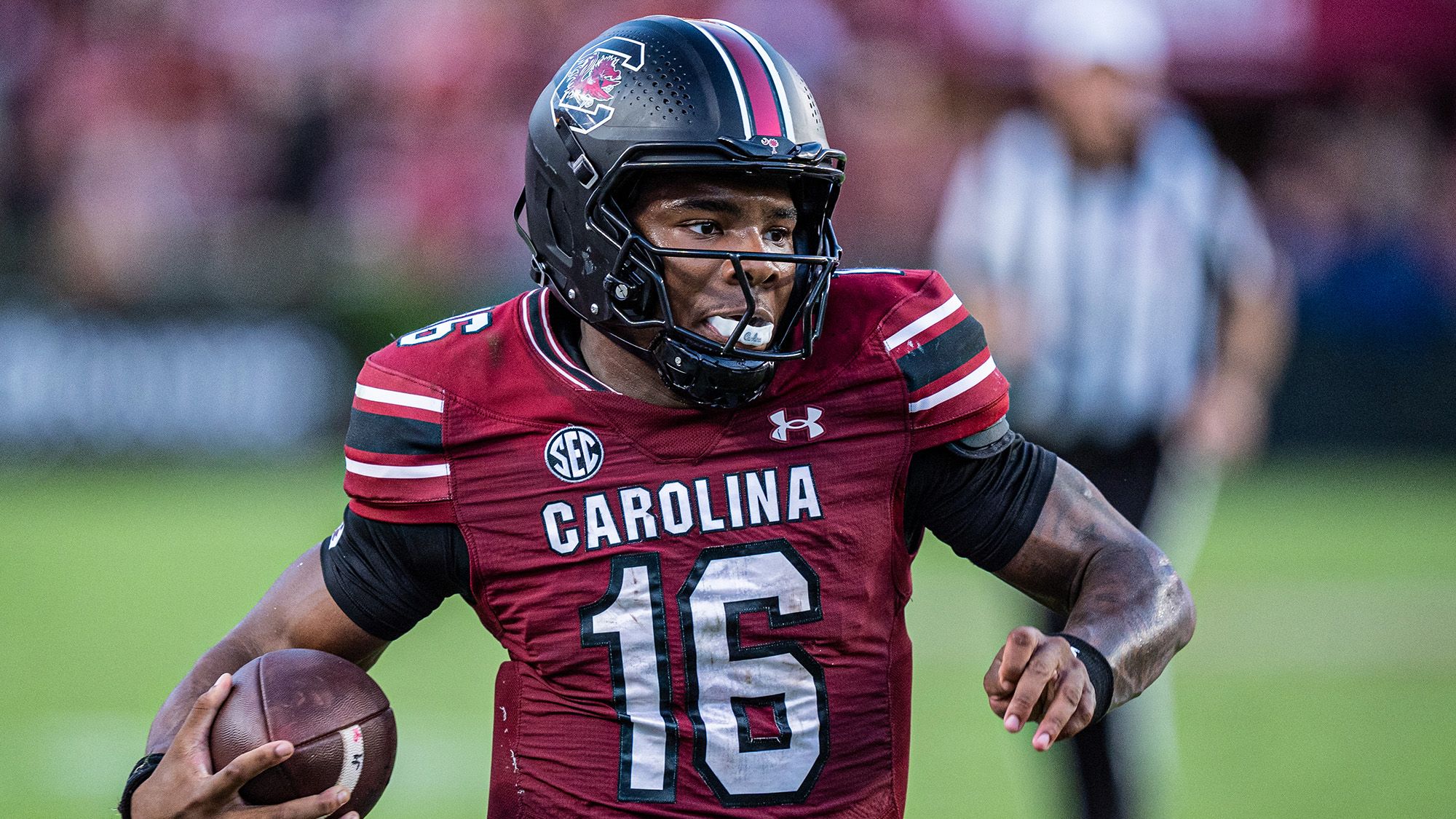
Who should that prospect be? Perhaps it’s South Carolina’s LaNorris Sellers, or someone who has yet to fly up (or down) the board. I couldn’t tell you at the moment; there are still a few months for the draft process to play itself out. Just know that whatever draft board you’re looking at, it isn’t predictive of how these prospects will perform in the NFL, and therefore, it shouldn’t dictate the Jets’ decisions, either.
This beaten and battered organization needs two things: to find a franchise quarterback, and to maximize the plethora of assets it possesses. For that reason, staying put at their first-round draft slot and selecting a quarterback may end up being their best course of action, even if the prospect they choose is unpopular.
