
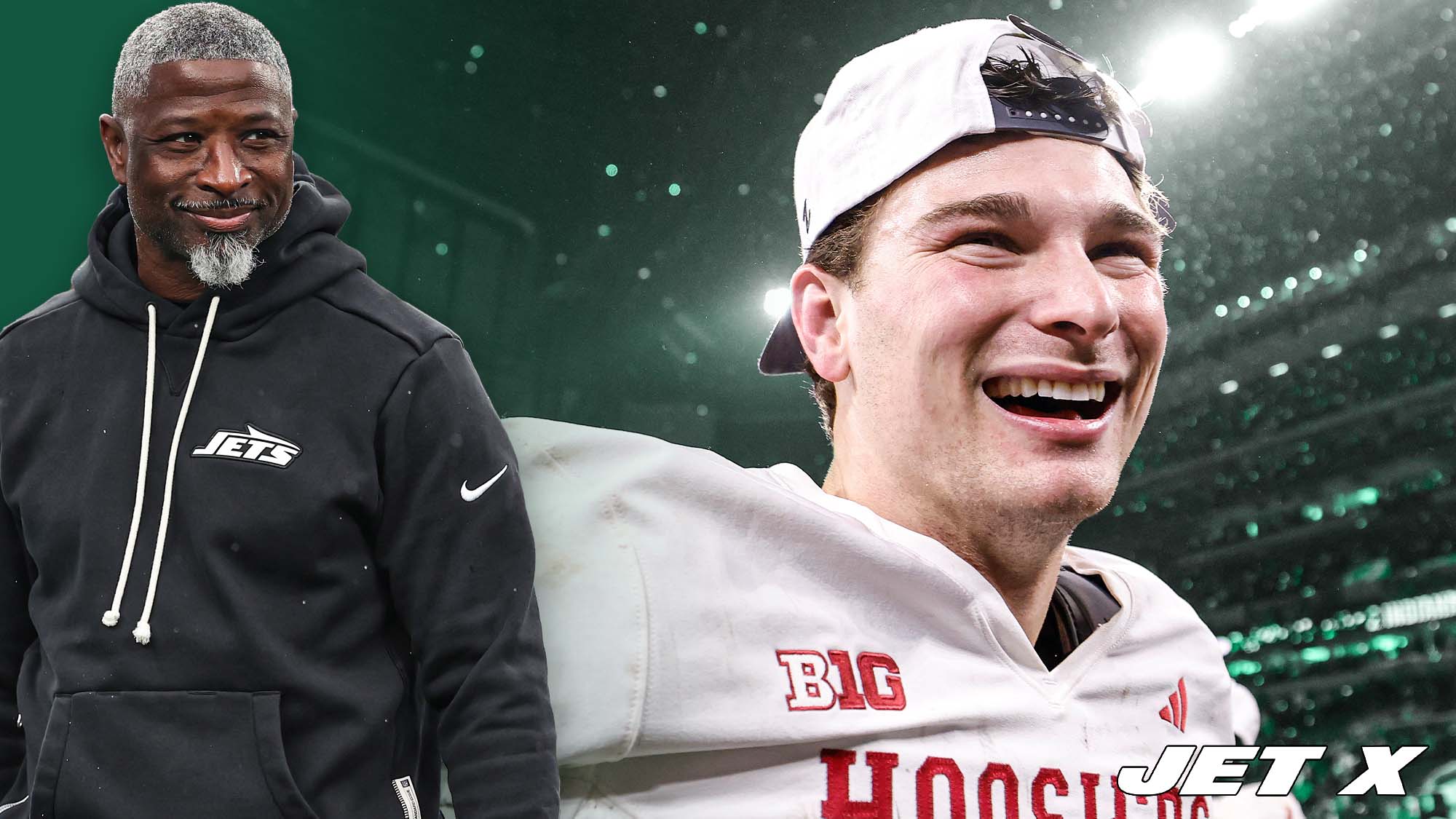
Indiana quarterback Fernando Mendoza is a polarizing prospect in NFL draft circles. While his production and leadership for the Hoosiers are undeniable, many question his ceiling at the NFL level, citing his merely adequate arm strength and athleticism.
Here’s why quarterback-needy teams like the New York Jets shouldn’t be overly concerned about those criticisms when projecting Mendoza’s ceiling.
Understanding where the NFL is headed
Every fan and analyst wants the next Cam Newton or Josh Allen in their highly drafted quarterback prospect. If a guy isn’t 6-foot-5 with a blazing forty time and a howitzer for an arm, he gets slapped with the “limited ceiling” label.
While it’s still awesome if a team can get its hands on an explosive athlete at the quarterback position, many people fail to realize that the NFL’s zeitgeist has undergone significant changes since these popular draft narratives were established.
Quietly, the league is trending away from requiring alien specimens at quarterback to score points at a high level.
When analyzing the NFL’s league averages over the past few years, three glaring trends stand out:
- Rising completion percentages
- Declining yards-per-completion
- Declining interception rates (INTs per attempt)

In today’s analytics-driven league, offenses are chasing efficiency. Big plays are no longer the priority. Instead, teams are delivering higher-percentage passes for fewer yards per pass.
Why? It’s simple: This approach increases the likelihood of generating consistent positive gains to keep the drive moving, and it reduces the likelihood of a killer turnover.
We’re seeing an increase in completions for under 10 yards, in exchange for a decrease in incomplete bombs. This trade-off minimizes the predictable second/third-and-long situations that put the defense at an advantage, leading to sacks and turnovers. It also allows offenses to produce a greater frequency of manageable fourth-down attempts, which have become commonplace after being taboo not long ago.
Overall, the league is becoming less explosive and more methodical. This is reflected in the per-drive stats of NFL teams.
In 2025, NFL teams are averaging 2.12 points per drive, an all-time record (if you exclude the 2020 Covid season that featured inflated offensive stats due to no crowds and depleted lineups). It is on pace to break the record of 2.07 points per drive set in 2024, which broke the record of 2.05 from 2021.
Offenses are more efficient than ever. However, you wouldn’t notice it by looking at final scores. The league-average of 23.2 points per game in 2025 is actually less than the 23.4 points per game we saw in 2013.
This is because teams are using more plays to generate their points. Drives have become more efficient in terms of yielding positive outcomes, but since teams are taking longer to score, we see fewer drives throughout a game, and thus, the final scoreboard doesn’t look much different.
NFL teams are averaging 6.01 plays per drive in 2025, the third-highest average all-time. Each of the top six marks occurred in the 2020s.
More plays per drive equals fewer drives per game. The 2025 season has seen an all-time low of 10.5 drives per game for each team, on pace to beat last year’s record of 10.7. It was only 12 years ago when the 2013 season saw NFL teams average 12 possessions per game.
This means that possessions in the NFL are more precious than ever before. Barely over a decade ago, teams essentially had two extra shots to score points. That’s two mistakes their quarterback could get away with that they couldn’t today.
In a league where possessions are growing increasingly scarce, efficiency is rapidly becoming every team’s bread and butter, and explosiveness is declining into nothing more than a luxury… a quarterback like Fernando Mendoza is precisely who modern NFL teams should covet if their goal is to raise the ceiling.
Fernando Mendoza is the modern high-ceiling QB
No, Mendoza is not going to wow you with his deep ball. In fact, he barely even attempts them in Indiana’s offense. Through his first 13 games of the 2025 season, Mendoza is 67th among FBS quarterbacks with 43 deep pass attempts (20+ air yards). That’s only 3.3 deep attempts per game.
So what?
Mendoza excels at things that fit into the modern NFL trends we just discussed, and that’s what matters most.
Short ball > Deep ball
The deep ball is no longer necessary for NFL stardom. Look no further than Josh Allen, who had one of the most revered arms of any quarterback prospect in league history. Allen has achieved his sustained NFL stardom by decreasing his reliance on the deep ball.
In 2025, Allen has thrown deep on just 11.8% of his pass attempts, ranking 21st out of 35 qualified quarterbacks. Compare that to his 2018 rookie year, when he led the NFL in that category with a whopping 19.7% rate. Essentially, he has gone from throwing deep on one out of every five passes to one out of every eight or nine.
Allen was the definitive high-ceiling first-round quarterback prospect. Yet, his lasting success in the league isn’t due to the traits that made him so exciting when he was coming out. Rather, it’s because of his incredible development in the areas that match the league-wide trends we discussed.
After coming into the league as a reckless gunslinger who looked to maximize the flashy traits that made people love him, Allen has learned to shred defenses with efficiency and consistency. His smarts and accuracy have improved leaps and bounds, and that’s why he’s so good. It’s cool that he can chuck the ball 70 yards, but so can Anthony Richardson; it’s not what has made Allen so hard to stop from drive to drive on a weekly basis for more than half a decade.
Going back to Mendoza, he already has the fundamental traits that Allen and other flashy quarterback prospects like him (such as Lamar Jackson) needed to develop before they became truly elite.
Mendoza is a surgeon on short passes (0-9 air yards). In 2025, he has completed 119 of 136 short passes for 1,145 yards, 11 touchdowns, and one interception with zero turnover-worthy throws. His 87.5% completion rate ranks second in the FBS behind Ohio State’s Julian Sayin, while the 11 touchdown passes lead the nation. His 136 attempts without a turnover-worthy throw are the second-most.
The last FBS quarterback to complete over 85% of their short passes for more than 10 touchdowns and less than two interceptions? Joe Burrow in 2019.
Fans are much less likely to get ecstatic about a quarterback prospect’s short accuracy than his deep prowess. But in today’s NFL, short accuracy is the meat and potatoes of the quarterback position. This is where the league is going. Offensive coordinators want point guards who can execute the scheme with consistent accuracy. Being able to chuck the occasional bomb is a bonus.
If you can’t hit the short pass like it’s a free throw, you aren’t going to last in today’s league. You could’ve made up for it with arm strength in previous eras, but not today. If you could, Anthony Richardson would’ve beaten out Daniel Jones in Indianapolis this past summer. Colts fans threw a collective fit when Indy announced that Jones had won the job, only for Shane Steichen to prove that he understands what works in today’s league by choosing the more reliable pocket passer.
While no NFL social media manager is going to chop up a highlight reel of Mendoza completing passes for under 10 air yards, his precision on those passes is as special a trait as any other you will see from a quarterback prospect. Think about it: he’s on the money seven times out of eight, and he hasn’t risked a turnover a single time across 136 passes.
That is the exact type of efficient, methodical football that the NFL prioritizes today.
And based on the trends we broke down at the top of this article, those traits are likely to only continue growing more prominent. If league-wide trends continue down the same path, we aren’t far off from a time where the league-average completion percentage flirts with 70, and a quarterback will be considered reckless for throwing 10 picks in a season.
It’s precisely why Mendoza-types are the NFL stars of today and tomorrow, no matter how un-sexy they may be compared to their more physically impressive peers.
The QB runner is headed to the wayside
Look at the best quarterbacks in the NFL this year. The most effective signal-callers of 2025 include players such as Matthew Stafford, Drake Maye, Dak Prescott, Jared Goff, Sam Darnold, and Daniel Jones, who have primarily done their damage through high-percentage, efficient throws within the structure of their offenses.
According to PFF, those six quarterbacks each rank top-10 in passing yards on short passes. Plus, according to FTN Fantasy, they each rank top-10 in total EPA (expected points added) on pass attempts from within the pocket.
After years and years of the NFL leaning into quarterbacks who could move the ball with their legs, following the wave that began with Josh Allen and Lamar Jackson, the pendulum is swinging back in the opposite direction. It’s the reason why Stafford is likely about to claim his first MVP award at age 37; if the mobile quarterback wave were really still pushing forward, Stafford would be out of the league, not playing the best ball of his career.
In 2025, NFL defenses have begun to figure out the running quarterback, as Jets X-Factor’s Robby Sabo recently broke down. As of Week 15, NFL quarterbacks were on pace to finish the season with a combined 9,804 rushing yards, which would be the fewest since 2021 and a massive decline from the record 11,035 yards they ran for in 2024.
Injuries to a few star runners are a part of that dip, but far from the only reason. Take a guy who has been healthy: Jalen Hurts. The reigning Super Bowl MVP has seen his rushing production dip wildly (down more than 15 rush YPG compared to last year and 25 YPG from his 2021 career-high), and the Eagles’ overall offensive production has fallen so far that some Philly fans are calling for him to sit on the bench.
Mendoza is not going to scare anybody on read-option plays in the NFL. He has respectable rushing numbers this season, racking up 60 carries for 278 yards and six touchdowns (with sack yardage removed), so he’s no statue, but nobody who watches Mendoza dreams of him in the Baltimore Ravens’ offense.
Yet again, it doesn’t really matter—not when projecting the ceiling of an NFL quarterback in the Big 2025.
Efficiency and ball security are king
In the spirit of valuing efficiency over explosiveness, NFL teams are becoming more interested in quarterbacks who can minimize negative plays than in quarterbacks who can produce highlight plays. As exciting as running quarterbacks can be when things are clicking, they tend to generate a plethora of negative plays as a consequence of pursuing highlight plays.
The Jets just witnessed the poster child of this phenomenon, Justin Fields. Few quarterbacks have a flashier highlight reel, but the price is that Fields produces an onslaught of sacks and turnovers due to his penchant for extending plays instead of just getting the ball out quickly and taking a small positive gain.
Most run-first quarterbacks struggle with sacks and turnovers, even if not to the same degree as Fields. Only the select few who manage to strike a healthy balance between playmaking and efficiency, like Allen and Jackson, have achieved true, consistent stardom in today’s league.
But as shown by the QB rushing decline in 2025, teams are moving away from coveting playmaking at the position. The reward is no longer worth the risk.
With possessions becoming increasingly rare and offenses under more pressure than ever to score points on each possession, the main priority is making every possession count. That means ball security has never been more important. Wasting possessions is more harmful than ever before, and teams don’t want to risk that happening just for some extra rushing yards.
Thus, once again, Mendoza fits into the mold teams covet.
In 13 games, Mendoza has taken 18 sacks (4.97% of dropbacks), thrown nine turnover-worthy throws (2.8% of passes), and fumbled twice. That’s an average of just 2.2 times per game in which Mendoza gets sacked or risks a turnover. In three games against top-10-ranked opponents, his average is almost identical (2.3).
For a quarterback who has been so dynamic at making plays, Mendoza’s ability to minimize mistakes is rare. He has generated a combined total of 181 first downs and touchdowns (between passing and rushing), compared to his 29 sacks, turnover-worthy throws, and fumbles. His 6.24-to-1 ratio between those two categories ranks 14th-best out of 131 qualified FBS quarterbacks (90th percentile).
It also surpasses his peers at the top of the 2026 quarterback class.
Ratio of First Downs/Touchdowns to Sacks/TWT/Fumbles, 2025 college football season (among consensus top-5 QBs at NFL Mock Draft Database), as of Dec. 18:
- QB1/No. 1 overall, Fernando Mendoza: 6.24 (14th) — 181 to 29
- QB2/No. 3 overall, Dante Moore, Oregon: 5.50 (24th) — 143 to 26
- QB3/No. 9 overall, Ty Simpson, Alabama: 4.15 (47th) — 195 to 47
- QB4/No. 37 overall, Garrett Nussmeier, LSU: 4.00 (52nd) — 104 to 26
- QB5/No. 74 overall, Cade Klubnik, Clemson: 5.96 (21st) — 149 to 25
Mendoza’s ratio is better than the majority of first-round quarterbacks drafted in the 2020s:
- Bo Nix, Oregon, 2023: 18.00
- Mac Jones, 2020: 9.63
- Zach Wilson, BYU, 2020: 9.29
- Michael Penix, Washington, 2023: 8.81
- Jayden Daniels, LSU, 2023: 7.77
- Tua Tagovailoa, Alabama, 2019: 7.06
- (Fernando Mendoza, 2025: 6.24)
- Bryce Young, Alabama, 2022: 6.00
- Joe Burrow, LSU, 2019: 5.98
- Anthony Richardson, Florida, 2022: 5.52
- J.J. McCarthy, Michigan, 2023: 5.48
- Drake Maye, UNC, 2023: 5.34
- Cam Ward, Miami, 2024: 5.33
- Jaxson Dart, Ole Miss, 2024: 5.12
- Trevor Lawrence, Clemson, 2020: 4.82
- Justin Fields, Ohio State, 2020: 4.55
- Kenny Pickett, Pittsburgh, 2021: 4.50
- Justin Herbert, Oregon, 2019: 4.48
- Caleb Williams, USC, 2023: 2.84
- Jordan Love, Utah, 2019: 2.79
While there is no direct correlation between this metric and future success in the NFL, it demonstrates that Mendoza’s efficiency at the quarterback position is what modern coaches look for in top-tier quarterback prospects. Among first-rounders since 2020, Mendoza’s 6.24 ratio is closest to Bryce Young (6.00) and Joe Burrow (5.98), two first-overall picks.
Don’t confuse a lack of physical traits for a lack of upside
Josh Allen, Lamar Jackson, and Patrick Mahomes have ruined the way that NFL fans evaluate quarterback prospects. Because of these megastars, people are prioritizing the wrong traits.
Allen, Jackson, and Mahomes are each unprecedented quarterbacks in their own special ways. Whether it’s Allen’s remarkable strength through contact, Jackson’s class-of-its-own elusiveness, or Mahomes’ uncanny knack for making plays off-schedule, these gifts have helped make each quarterback the MVP we know them as today.
But while these gifts are the most visible aspects of each quarterback’s game, they are not the primary reasons for their success.
Without the accuracy and football IQ they have developed over the years, none of those three players would be the quarterbacks they are today. When each of them was coming out of college, the entire football world already knew about Allen’s physical prowess, Jackson’s quickness, and Mahomes’ unorthodox arm angles. Yet, none of them were drafted in the top five.
That’s because scouts didn’t know yet whether they could develop the intangible traits that are integral to future success in the league.
All three players ultimately possessed those intangibles, enabling them to maximize their tangible traits. However, NFL fans and scouts took the wrong message from the success of Allen, Jackson, and Mahomes. Instead of learning the value of the between-the-ears traits that allowed them to hit their ceilings, the league came away believing that the correct approach was to prioritize the most visually appealing quarterbacks and trust that the intangible weaknesses would sort themselves out.
Thus, we have guys like Anthony Richardson and Zach Wilson getting picked in the first round.
After years of these types of quarterbacks faltering, the pendulum has swung back in the opposite direction. Efficiency is king at the quarterback position in today’s league, not athleticism. Matthew Stafford’s MVP-caliber ascension represents the fact that today’s young quarterbacks aren’t equipped for the revamped offensive play style that has taken over in recent years.
But as the league catches on, the next generation of young quarterbacks will be molded to fit this modern offensive vision—with Mendoza leading the charge.
And the Jets should be eager to lead the wave.
This franchise is perpetually behind the times. They don’t catch on to what works until it stops working. Justin Fields was the latest example.
It’s the Jets’ turn to break a new mold that everyone else tries to copy. Building around a franchise signal-caller known for his accuracy, consistency, efficiency, intelligence, and leadership will be the next trend in the NFL. Fernando Mendoza gives New York an opportunity to get out in front of what’s to come.
No matter how they get it done, whether it’s losing their way into a high enough slot to get him without trading up, or making a blockbuster move, the Jets should be eager to add Mendoza to their team as a top-five draft pick. Narratives about Mendoza’s lowly ceiling are outdated and ignore recent NFL trends. In today’s league, he is built to be a star.
If the Jets listen to fans and punt their quarterback pursuit to 2027 because Mendoza “doesn’t have a high enough ceiling,” they could live to regret it when they end up with the “higher-ceiling” prospect who sells more jerseys but is multiple years behind the NFL curve.
Mendoza, like every quarterback prospect, is not guaranteed to succeed. However, suggesting that he doesn’t have the ceiling of a star quarterback in the modern NFL is to show a lack of awareness of where the league is headed.
