
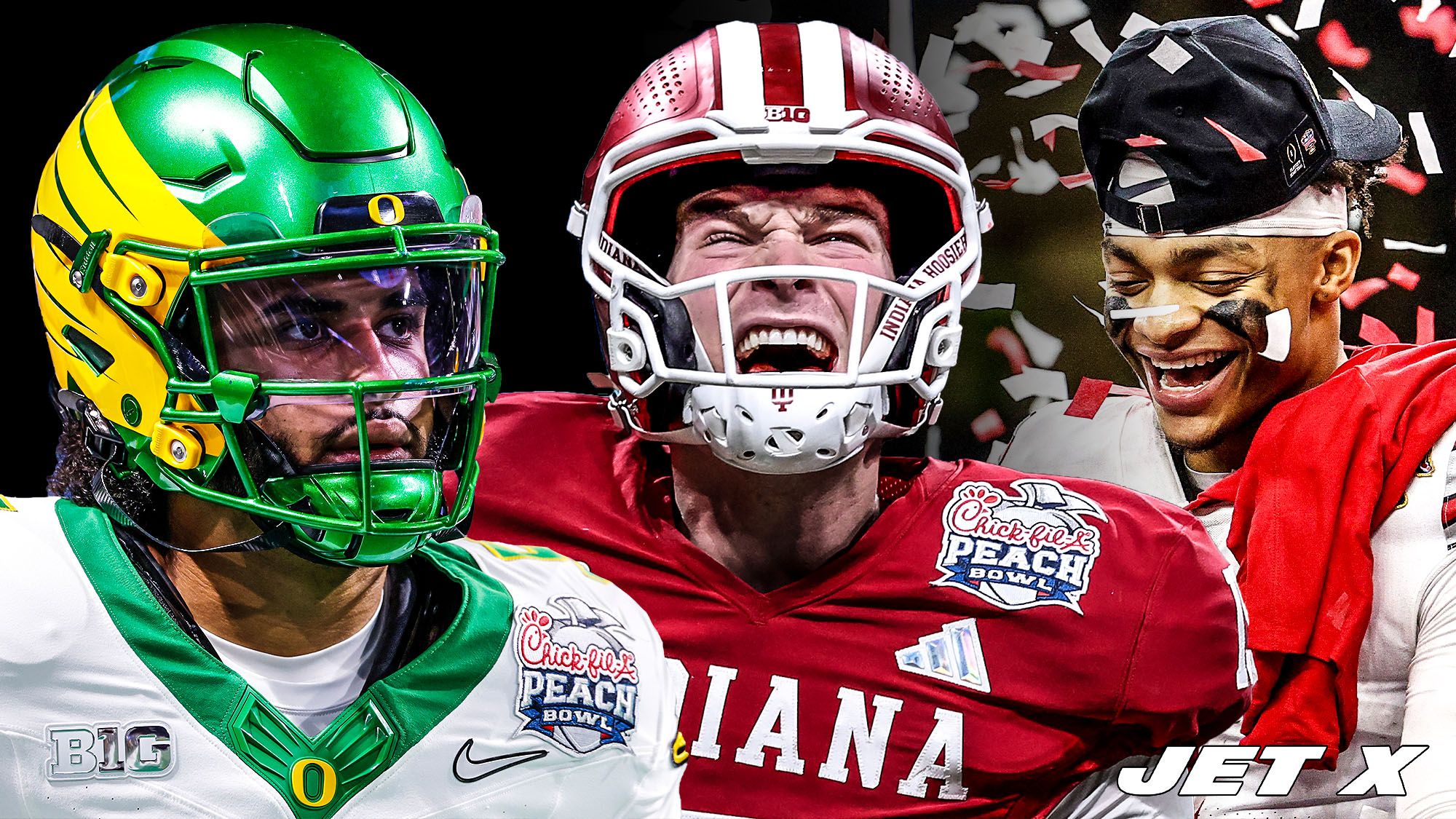
Ladies and gentlemen of the jury, along with the boys and girls at the pint-sized dinner table, let us harken back in time, just four short years ago.
On Jan. 1, 2021, then-Ohio State quarterback Justin Fields put on a college football performance for the ages. Fields finished with a combined 427 scrimmage yards and threw 6 touchdowns while leading his Garrett Wilson-involved Buckeyes to a convincing 49-28 victory over the Clemson Tigers in the College Football Playoff semifinals.
Quite literally overnight, New York Jets fans were enthralled. They were giddy. They were ecstatic and ready to run through a wall.
Not a soul was brave enough to utter a word to the contrary.
Buckeye Fields ‘saved’ the Jets
While simultaneously knowing that rookie head coach Robert Saleh was coming back for his sophomore season, Fields’s performance was more than a revelation; in the eyes of a significant percentage of the Jets fan base, it saved the franchise.
Remember, at that time, Frank Gore was the most delivish curse word in Jets land, and Adam Gase was eagerly thrown through the door more violently than DJ Jazzy Jeff.
The Jets were slated to pick second.
Yet, only one quarterback could legitimately be labeled as the “big prize.” Clemson’s Trevor Lawrence was that guy. He was considered “generational,” yet he had just inexplicably lost to the fresh face of the moment.
Fields’s stunning night made it a two-quarterback race in the eyes of the 2022 NFL draft.
At least that’s what the moment led everybody to believe. That’s what the hysteria of the time had everybody feeling.
Four years later, the very same man who tore up those semifinals is now a failed Jets starter. Fields, who head coach Aaron Glenn pointed to as the leader to replace the outgoing Aaron Rodgers, knows little about what his NFL future holds.
Did the January 2021 hype live up to the end result? Did the overreaction back then—in a positive direction for Jets fans—ultimately lead to a fruitful future?
We all know what transpired…
While seeking a QB2, one man showed face on the college football field. Thereafter, the actual QB2 of the draft climbed the ranks, thanks to what Jets legend Wayne Chrebet so aptly calls the “Underwear Olympics.”
Joe Douglas selected Zach Wilson, to the dismay of the Fields supporters. Wilson failed as the Jets’ franchise face.
Yet, Fields wound up in Florham Park, N.J., nonetheless. The Jets fans who had been screaming for their team to draft their guy back in 2022—with “told you so” vitriol—once again ramped up the noise.
Fields failed.
Round and round we go.
While it’s human to overreact to Friday night’s Peach Bowl, the truth of the matter is much simpler, even if it’s much tougher to identify: A young quarterback’s situation is what matters most in today’s NFL. It’s with that particular gusto where genuine overreaction should reign supreme in Jets land.
Peach Bowl madness
Nonetheless, Indiana’s 56-22 romp over Oregon certainly improved Fernando Mendoza’s stock.
The Heisman Trophy winner collected 177 yards and 5 touchdowns on an absurdly efficient 17 of 20 passing. Time and again, Mendoza cut through the Ducks’ defense in the three-step, on-schedule game. His pinpoint precision and mind-boggling timing are impossible to refute.
The old-fashioned whipping simultaneously injured Dante Moore’s NFL draft stock. Shoot, the day after, questions about his status are suddenly led the way—prompting many to believe he’s intent on returning to Eugene, Oregon.
Despite throwing for 285 yards and 2 touchdowns on 24 of 39 passing—while not having the benefit of a rushing attack for most of the game—it was his two costly turnovers that put the game quickly out of reach in the first half.
The questions about Moore’s inexperience only injured his stock, whereas Mendoza’s momentum moved from obvious to wildly out of control.
Yet, it’s tough not to feel a hint of deja vu. Why does the living, breathing football world overreact so irresponsibly to college football’s on-field results?
Granted, it matters. Joe Burrow’s senior year is a thing of mythology at this point. What he did at LSU will forever live in football lore.
What mattered most to pro evaluators, however, was matching Burrow’s tape to the on-field experience. Once that match was confirmed, Burrow, as the undisputed QB1 in the NFL draft, was a no-doubt-about-it situation.
That’s not what we’re experiencing today. As great as Fernando Mendoza played Friday night, as great as he’s expected to play in the National Championship—against the Miami Hurricanes—there are several high-level concerns.
Working from within a heavy RPO scheme, everything Mendoza does in the 3-step game is near-flawless on the collegiate gridiron. The kid’s pre-snap reads, and post-snap timeliness and placement are other-worldly.
Why is this the case, though? How much of it is due to him, which can naturally translate to the NFL, and how much of it comes from genius coaching?
Curt Cignetti might be the best football coach on planet Earth. How his Indiana Hoosiers play the “tendency” game on both sides of the ball, and how they execute in real time, is nothing short of mind-boggling.
Plus, my goodness, gracious, Suzyn, notwithstanding the excellence of the throws, how many jaw-dropping catches were made by his receivers Friday night? While that thought may be meaningless for Cignetti’s squad en route to a hopeful title, it’s a tangible element that must be factored into the equation for personnel folks in the NFL.
Like it or not, Mendoza enjoys the obscene advantage of a dominant rushing attack that rarely forces him in third-and-long situations (which is most definitely by design). The fact that this offense ran the ball over 55% of the time, in a season where a quarterback won the Heisman, is an insane rarity.
By no means does the power of his team automatically dock him a few evaluation points. Instead, it’s just one of the many factors that must be taken into account en route to achieving an objective grade.
The real rub
Despite the deserving nature of Mendoza’s upward-trending stock, concerns about his overall pocket feel and poise, particularly in imperfect pocket situations, will reign supreme this offseason for every NFL organization. Make no mistake about that certainty—despite the varying grades.
Couple that with Moore’s big-game struggles, and, of course, New York Jets fans, who root for the team with the No. 2 overall pick in the 2026 NFL draft, are dangling on the ledge.
Please, don’t jump.
Those who jump won’t experience how Fernando Mendoza’s pro football career unfolds. Those who jumped in 2021 never learned just how ridiculous the Justin Fields hysteria was when he knocked down the “generational” Trevor Lawrence a few pegs.
Those who overreact should be gobsmacked about how much of a struggle it’s been for Bryce Young, who cut through the rest of college football with his Alabama Crimson Tide in 2022—until meeting Auburn on the grandest stage. They’d also have a hard time understanding how Lawrence’s career has fluctuated so strangely thus far.
What in the world? He was “generational.” Right?
Pay no mind to the fact that he played in a heavy-RPO/three-step system that relied on chain management and timeliness—which is extremely similar to Mendoza’s situation in Indiana. The football world told us he was generational, so he must be … generational. Right?
For everybody, jumpers or not, while the overall talent level of the quarterback surely matters, this new brand of ball has placed a critical importance on coaching, specifically offensive architecture and play-calling. Just ask the current Heisman Trophy winner—who struggled so mightily at Cal—how the 2025 season would have gone had he not bumped into Curt Cignetti.
Perhaps nobody can sum it up better than New York Jets legend Joe Namath, whose succinct message following Super Bowl 3 rings so true today…
“No … no, we’re king of the hill; we got the team, brother,” said a victorious Namath in the Orange Bowl locker room.
When you have the team, you have the team. This is just one of the many ideas that allow the best talent evaluators to even begin considering the correct variables leading up to the NFL draft.
Perhaps this level of hysteria is deserving, just not as it relates to which quarterback is available to draft at No. 2. The outrage and dismay should be targeted at something else New York Jets-related altogether—something that is much more influential in today’s game.
Something that’s more responsible for the creation of the idea of a “franchise quarterback” these days.
In other words, prime Bill Walsh (as offensive coordinator) and Joe Montana wouldn’t fix the New York Jets as currently constituted—not in this league, and certainly not with the team philosophy we witnessed this past season.
That’s precisely the point.
Besides, much like the universe, we know nothing yet. To pretend otherwise—so concretely—only hikes the price of therapists everywhere, particularly in New Jersey (taxes and all).
Who knows? Maybe it’s Ty Simpson who winds up as the quarterback gem of the 2026 NFL draft class.
Call me crazy now … choose to forget about recent history later.
